This summer has been so hot I haven't been able to use the Formic Acid I wanted to use when I first saw mites on my girls.
I got a whole new colony this spring because the one from last year froze during a really brutally cold winter; and this one is far more gentle. Not quite as productive, but really friendly to work with, and they calm down very quickly.
But I saw mites in July, and I started dusting them all with powdered sugar every time I went in, and I even went into the hive a couple of extra times just to dust them and make sure they got a good coating with the stuff, and my mite counts have actually gone down. Right when they were rocketing up on the colony that died of them.
So I'm convinced it's an effective treatment, never mind the study and the hundreds of hives they did in the study that said the same thing... *laughs* I'm actually seeing it work with my own two eyes and it's amazing to not find deformed young bees in the deeps, to not see any mites on the field workers throughout the supers, and to find the mite drops on my sticky board at the bottom of the hive go *down* significantly over the summer.
So simple and so harmless. Not that easy to do, as it requires going in a lot more often, and that's actually been good for my beekeeping skills, just doing it more makes it easier to do.
I also pulled two medium supers of capped frames today. All full up and ready to go for when my brother-in-law and his wife get here to help with spinning the honey.
Showing posts with label summer. Show all posts
Showing posts with label summer. Show all posts
Wednesday, August 29, 2018

Friday, September 8, 2017
Expectations
I'll admit that I'm as guilty as the next person with respect to building up a model of the world and having a hard time changing it when I find out that things are different than I believed. I really, truly believed that my bees couldn't make enough honey for another harvest, and that during the early September examination, that they'd only have partially filled the emptied super I'd put on and would need some help filling their brood box for the winter. Having lost my last colony to a bad mite infestation and very slow shipping on mite control substances, I was also convinced that I'd have to treat for mites.
I was entirely wrong on all points, and had to take half a day to process what I really found when I went into the hive.
I also kind of resisted going in, as I'd really wanted the bees to just keep all their honey for the winter and not have to deal with them again until they'd started to pack up for the cold; but it all kept nagging at me, as they'd been so quick to fill the supers the first time around. So to be responsible to them, I had to go in.
So I did.
 On Monday, the 4th, I went in to see what there was to see. Despite all the smoke from the local forest fires, I decided to use smoke to calm the bees 'cause it's more effective than the sugar syrup spray; and by late summer, they're having to defend their hive from other bees and wasps constantly. So they get really defensive and feisty when I go in, so it's better all around that I just use smoke and get them to go feed while I get things opened up to where I want to get.
I like applying the smoke and then letting them feed for a while before I go in and start opening things up. It gives me a chance to get everything ready and it gives them a chance to have some honey and fill their bellies so that they don't sting me. John and I actually sat and talked for a good hour over exactly what it was I was going to do, what it was that I needed to figure out, and what the further actions would be given what data I got.
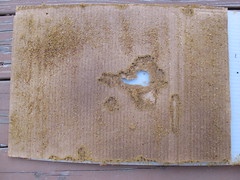
 And the first thing I find is that they've build honeycomb all the way onto the lid. It's a good way of keeping down drafts and robbers through the main body of the hive, keeping all incoming to the outside frames; however, when they stick the whole thing to the top, it's kind of a pain to get the lid off.
Sure enough, the girls had filled all the frames completely full, which was why they'd built above it all as well. All the way to the edge frames, too, which they normally leave only half filled, but with the spacing and everything, they'd filled all of them completely with capped honeycomb, which meant that the honey was completely finished and dried enough to store for nearly ever.
I moved both supers so that I could take a look into the brood chamber, too, as I needed to assess if they had varroa mites, which has been one of the leading causes of colony deaths. And the local Beekeepers' Association had a full out educational thing going on about how everyone could test for the mites by rolling the bees in powdered sugar. The powdered sugar dislodges the mites from the bees, and it has very little impact on the bees themselves, and with in 24 hours, the mites drop off and can be pulled out of the hive with a removable bottom board, which I have.
But that only happens when the bees have mites, and the idea is to put a cup of bees into a glass quart jar, pour powdered sugar on them, and then roll them in it. Then shake all the sugar out with the mites and then release the bees, ghost white from sugar but still entirely alive and unharmed. The mites fall off quickly, so you can get a count of them; and I could test how many were in there.

When I got down into the brood boxes and the frames down there, I found that the frames were completely filled with honey and pollen. They had huge stores in there, and they were all full, too. So that answered the question of if they'd already put away good stores for the winter...
And when I pulled the brood frame out, I shook bees into a glass jar and tested them for mites. There wasn't a single dead mite. And on the bottom board, I had only seen one mite all summer. The usual level where you want to control the mites is if there's more than 2 mites per hundred bees. To have absolutely none of them in the hive at all meant that the girls were doing great at avoiding infestation.
It was an unexpectedly good result to the test. I was really expecting there to be some, and there just weren't any. And the chemical treatments that are commonly used are detrimental to the hive, if you think about it, it makes sense, as you're basically trying to kill a smaller bug riding on a bigger bug without harming the bigger bug too much, and it's a tricky thing to kill one without killing the other.
 However... since the powdered sugar serves to a) loosen mites if there are any, b) have the girls clean the mites off each other if there are any with the powdered sugar coating, c) powdered sugar is something they can just eat and has no adverse affects on the bees themselves, and d) it's cheap and easy to apply: I decided to just go ahead an apply the stuff.
Then I put the supers back on, closed it all up and went and sat in the kitchen trying to figure out what to do next. Most beekeepers at this time of year just have three responsibilities, get the supers off the hive and collect the honey, treat for mites if that's necessary, and make sure that the bees will have enough stores for the winter.
I had been assuming that I'd just leave all the honey for the girls for the winter, and that they'd need that. But they obviously didn't. They'd filled everything to the brim already, and if anything, they had nothing to really do for the remaining month and a half before the first frost and the flowers went away. There were still plenty of flowers around, and these are domesticated bees, bred and made to create honey and wax that needs to be taken away for them to fulfill their commercial duties.
I also narrowed the front entrance so that the robber bees and wasps would have a harder time making it in, and I removed the shims from the top of the hive, so that there wouldn't be as easy an access to the insides. It was a good thing, too, as the temps fell into the 40's that night, and closing it up made it easier for them to keep things warm inside.
So... it took me a few days, but on Thursday, we pulled the entire top super and two of the frames in the lower super, and we extracted all of them, and I put the two empty frames back into the lower super so that the girls would have something to do. The whole lower super was completely full of honey, too, so I was leaving them six full frames there along with the completely full deep.

We got a lot of honey. We extracted everything and then put the empty super back onto the hive to let the girls clean up all the drips and the last bits in the emptied comb. I'll probably collect the emptied super on Saturday so that they have a day to clean it out.
So we had 2 1/2 gallons in the first harvest and probably another 3.25 gallons in the second. And there's likely 3 left in the remaining super and another five to seven in the two deep brood boxes from the heft of those things. So the bees will have plenty for the winter, and they have time, still, to refill the remaining two super frames in the super that I left them. I'm definitely going to leave them that for the winter and only collect that honey in the spring if it's still there.
That should allow me to not feed them over the winter and early spring; and should let them have plenty of the good enzymes and stuff in their honey that they can get. And, worst case, I can probably just pour a quart or two of their honey into a feeder for them if they do need it by then.
One of the girls managed to get into the pants of my beekeeper suit when I was putting the super back onto the hive, and she stung me solidly. It hurt, but it didn't swell at all, so I have to say that the bee venom therapy I had through my allergy clinic worked really well.
But all in all, it was kind of weird to realize that these domesticated bugs really were created to make honey that needed to be taken from them for them to function correctly. That I had to go in and get all that and it was how they're made. In order for me to shorten their hive enough so that they can keep it good and warm, I have to take at least one of the supers off before winter; but it felt weird when I really had initially decided that I was just going to leave them the honey they'd worked so hard to get.
Still, now, if I sell a lot of this, I will make up all the extra money I had to pay for the colony during the bee shortage; and with the extra money, I should be able to buy another super and frames for them and maybe also make sure I have solid mite treatments for next year. They've mostly already paid for the extractor and their own costs. That's been pretty amazing.
I was entirely wrong on all points, and had to take half a day to process what I really found when I went into the hive.
I also kind of resisted going in, as I'd really wanted the bees to just keep all their honey for the winter and not have to deal with them again until they'd started to pack up for the cold; but it all kept nagging at me, as they'd been so quick to fill the supers the first time around. So to be responsible to them, I had to go in.
So I did.
 On Monday, the 4th, I went in to see what there was to see. Despite all the smoke from the local forest fires, I decided to use smoke to calm the bees 'cause it's more effective than the sugar syrup spray; and by late summer, they're having to defend their hive from other bees and wasps constantly. So they get really defensive and feisty when I go in, so it's better all around that I just use smoke and get them to go feed while I get things opened up to where I want to get.
I like applying the smoke and then letting them feed for a while before I go in and start opening things up. It gives me a chance to get everything ready and it gives them a chance to have some honey and fill their bellies so that they don't sting me. John and I actually sat and talked for a good hour over exactly what it was I was going to do, what it was that I needed to figure out, and what the further actions would be given what data I got.
 And the first thing I find is that they've build honeycomb all the way onto the lid. It's a good way of keeping down drafts and robbers through the main body of the hive, keeping all incoming to the outside frames; however, when they stick the whole thing to the top, it's kind of a pain to get the lid off.
Sure enough, the girls had filled all the frames completely full, which was why they'd built above it all as well. All the way to the edge frames, too, which they normally leave only half filled, but with the spacing and everything, they'd filled all of them completely with capped honeycomb, which meant that the honey was completely finished and dried enough to store for nearly ever.
I moved both supers so that I could take a look into the brood chamber, too, as I needed to assess if they had varroa mites, which has been one of the leading causes of colony deaths. And the local Beekeepers' Association had a full out educational thing going on about how everyone could test for the mites by rolling the bees in powdered sugar. The powdered sugar dislodges the mites from the bees, and it has very little impact on the bees themselves, and with in 24 hours, the mites drop off and can be pulled out of the hive with a removable bottom board, which I have.
But that only happens when the bees have mites, and the idea is to put a cup of bees into a glass quart jar, pour powdered sugar on them, and then roll them in it. Then shake all the sugar out with the mites and then release the bees, ghost white from sugar but still entirely alive and unharmed. The mites fall off quickly, so you can get a count of them; and I could test how many were in there.

When I got down into the brood boxes and the frames down there, I found that the frames were completely filled with honey and pollen. They had huge stores in there, and they were all full, too. So that answered the question of if they'd already put away good stores for the winter...
And when I pulled the brood frame out, I shook bees into a glass jar and tested them for mites. There wasn't a single dead mite. And on the bottom board, I had only seen one mite all summer. The usual level where you want to control the mites is if there's more than 2 mites per hundred bees. To have absolutely none of them in the hive at all meant that the girls were doing great at avoiding infestation.
It was an unexpectedly good result to the test. I was really expecting there to be some, and there just weren't any. And the chemical treatments that are commonly used are detrimental to the hive, if you think about it, it makes sense, as you're basically trying to kill a smaller bug riding on a bigger bug without harming the bigger bug too much, and it's a tricky thing to kill one without killing the other.
 However... since the powdered sugar serves to a) loosen mites if there are any, b) have the girls clean the mites off each other if there are any with the powdered sugar coating, c) powdered sugar is something they can just eat and has no adverse affects on the bees themselves, and d) it's cheap and easy to apply: I decided to just go ahead an apply the stuff.
Then I put the supers back on, closed it all up and went and sat in the kitchen trying to figure out what to do next. Most beekeepers at this time of year just have three responsibilities, get the supers off the hive and collect the honey, treat for mites if that's necessary, and make sure that the bees will have enough stores for the winter.
I had been assuming that I'd just leave all the honey for the girls for the winter, and that they'd need that. But they obviously didn't. They'd filled everything to the brim already, and if anything, they had nothing to really do for the remaining month and a half before the first frost and the flowers went away. There were still plenty of flowers around, and these are domesticated bees, bred and made to create honey and wax that needs to be taken away for them to fulfill their commercial duties.
I also narrowed the front entrance so that the robber bees and wasps would have a harder time making it in, and I removed the shims from the top of the hive, so that there wouldn't be as easy an access to the insides. It was a good thing, too, as the temps fell into the 40's that night, and closing it up made it easier for them to keep things warm inside.
So... it took me a few days, but on Thursday, we pulled the entire top super and two of the frames in the lower super, and we extracted all of them, and I put the two empty frames back into the lower super so that the girls would have something to do. The whole lower super was completely full of honey, too, so I was leaving them six full frames there along with the completely full deep.

We got a lot of honey. We extracted everything and then put the empty super back onto the hive to let the girls clean up all the drips and the last bits in the emptied comb. I'll probably collect the emptied super on Saturday so that they have a day to clean it out.
So we had 2 1/2 gallons in the first harvest and probably another 3.25 gallons in the second. And there's likely 3 left in the remaining super and another five to seven in the two deep brood boxes from the heft of those things. So the bees will have plenty for the winter, and they have time, still, to refill the remaining two super frames in the super that I left them. I'm definitely going to leave them that for the winter and only collect that honey in the spring if it's still there.
That should allow me to not feed them over the winter and early spring; and should let them have plenty of the good enzymes and stuff in their honey that they can get. And, worst case, I can probably just pour a quart or two of their honey into a feeder for them if they do need it by then.
One of the girls managed to get into the pants of my beekeeper suit when I was putting the super back onto the hive, and she stung me solidly. It hurt, but it didn't swell at all, so I have to say that the bee venom therapy I had through my allergy clinic worked really well.
But all in all, it was kind of weird to realize that these domesticated bugs really were created to make honey that needed to be taken from them for them to function correctly. That I had to go in and get all that and it was how they're made. In order for me to shorten their hive enough so that they can keep it good and warm, I have to take at least one of the supers off before winter; but it felt weird when I really had initially decided that I was just going to leave them the honey they'd worked so hard to get.
Still, now, if I sell a lot of this, I will make up all the extra money I had to pay for the colony during the bee shortage; and with the extra money, I should be able to buy another super and frames for them and maybe also make sure I have solid mite treatments for next year. They've mostly already paid for the extractor and their own costs. That's been pretty amazing.
Thursday, August 10, 2017
Making Room
The previous Wednesday I went to a little spin-in with four ladies and we dyed wool from the setup that the lady there had. But one of the other ladies was thinking about keeping bees as she’d inherited a top bar hive from a family that had simply neglected it, thinking that it was kinder to not bother the bees.
The bees had filled the hive, getting past a stopper that was supposed to keep them from the rest of the hive, and building on all the bars past that. And when they’d run out of space, they’d left. So I really wanted to make sure that my colony had plenty of space to build and store honey.
The bees had filled the hive, getting past a stopper that was supposed to keep them from the rest of the hive, and building on all the bars past that. And when they’d run out of space, they’d left. So I really wanted to make sure that my colony had plenty of space to build and store honey.
Monday, July 10, 2017
Opening Up for Summer
The weather has been finally getting really hot, in the mid to high 90's for a few days, and I knew that I had to get better ventilation into the hive for those weeks when it would be close to 100. The hard part of it all is that I have to replace the bottom board to do so.
There might have been other ways? But I've did this both years when I had my last hive, and I liked having the bottom board be sealed when the colony was small and needed fewer entrances to defend. It was obvious, from watching the bees coming in and out each day, that they had good numbers to defend themselves, now. Plus, the girls might need more room, so I prepared a super with another eight frames for them to build on and fill that would fit above the deeps that I was leaving for them to keep full of honey, pollen, and brood.
There might have been other ways? But I've did this both years when I had my last hive, and I liked having the bottom board be sealed when the colony was small and needed fewer entrances to defend. It was obvious, from watching the bees coming in and out each day, that they had good numbers to defend themselves, now. Plus, the girls might need more room, so I prepared a super with another eight frames for them to build on and fill that would fit above the deeps that I was leaving for them to keep full of honey, pollen, and brood.
Friday, August 15, 2014
Another Two Gallons
The girls have been very productive, indeed... and I've been kind of remiss about actually recording everything.
In July, on the 25th, I actually pulled four frames, or one and a quarter gallons of honey, from the bottom of the two supers I had on the hive, and I swapped the positions of the supers, so that they'd work on the "lower" and half-full super before they worked on the upper one. John and I scraped clean the four frames, and the next morning I put them all back in to let the bees clean them off.
 Then, this month, on August 12th, I pulled the other four frames from the upper super, and found out that they'd half built and filled one of the empties I'd put in in July. The super that was now on the bottom was about three-quarters full. So I pulled three full frames out of that, and left the five half-filled ones, putting the half-built frame from the upper into the lower, and added the two frames that were still empty from the upper super.
Then I took the upper super completely off the hive, to help the colony compact a little before fall. I'm going to have to have all the supers off before winter and before I do my mite treatment, so it's better to get them used to a little smaller space. But I also wanted to shuffle through the frames as we emptied them to allow the bees to clean all the honey off of them.
It took us two days to get the first three frames cleaned off, and by then, the girls had actually built comb up on one of the 'empty' frames. They'd also completely filled the top super with bees, who were busily building and filling! Agh. I pulled that frame out, put it by the entrance to let the bees empty it of the uncapped honey, and I managed to shuffle in the three empty frames, and then after taking a night off to Estes Park, we came back and I shuffled in two more of the empty frames. Tonight we're finally emptying the last two, and I hope to get those in tomorrow, along with the wax built one, hopefully for the other one that was in there from yesterday, but it's been a little crazy going in every day. They don't seem to mind that much so long as I don't leave the hive open too long.
And it looks like two more gallons of honey.
 I also saw some hornets and wasps stealing honey and trying to rob the hive, but the girls were having none of that. I've left a lot of things open for ventilation for the summer, but with the nights getting longer and cooler, I'm probably going to remove the summer shims from the inner cover and put in my usual winter popsicle sticks that just allow ventilation and no actual insects through. The girls have taken to lining the inside of the outer cover and completely covering the bottom of the inside cover with bees just to defend those slots. So I'm going to close those up tomorrow. I think that, also, the two brood boxes aren't quite meeting, but I also have a single knothole in the back of the hive that the girls have been using as a second entrance for the last two years.
I had a lot of fun just squashing wasps and hornets when they touched down on the honey in my empties tray and as soon as I could ID 'em, I'd squash 'em.
Anyway... that's more than four gallons of honey this year, or something like 50 pounds already. That's a LOT of honey. I got 40 all together last year. So the "common knowledge" that a colony usually does better its second year is already true for this one.
In July, on the 25th, I actually pulled four frames, or one and a quarter gallons of honey, from the bottom of the two supers I had on the hive, and I swapped the positions of the supers, so that they'd work on the "lower" and half-full super before they worked on the upper one. John and I scraped clean the four frames, and the next morning I put them all back in to let the bees clean them off.
Then I took the upper super completely off the hive, to help the colony compact a little before fall. I'm going to have to have all the supers off before winter and before I do my mite treatment, so it's better to get them used to a little smaller space. But I also wanted to shuffle through the frames as we emptied them to allow the bees to clean all the honey off of them.
It took us two days to get the first three frames cleaned off, and by then, the girls had actually built comb up on one of the 'empty' frames. They'd also completely filled the top super with bees, who were busily building and filling! Agh. I pulled that frame out, put it by the entrance to let the bees empty it of the uncapped honey, and I managed to shuffle in the three empty frames, and then after taking a night off to Estes Park, we came back and I shuffled in two more of the empty frames. Tonight we're finally emptying the last two, and I hope to get those in tomorrow, along with the wax built one, hopefully for the other one that was in there from yesterday, but it's been a little crazy going in every day. They don't seem to mind that much so long as I don't leave the hive open too long.
And it looks like two more gallons of honey.
I also saw some hornets and wasps stealing honey and trying to rob the hive, but the girls were having none of that. I've left a lot of things open for ventilation for the summer, but with the nights getting longer and cooler, I'm probably going to remove the summer shims from the inner cover and put in my usual winter popsicle sticks that just allow ventilation and no actual insects through. The girls have taken to lining the inside of the outer cover and completely covering the bottom of the inside cover with bees just to defend those slots. So I'm going to close those up tomorrow. I think that, also, the two brood boxes aren't quite meeting, but I also have a single knothole in the back of the hive that the girls have been using as a second entrance for the last two years.I had a lot of fun just squashing wasps and hornets when they touched down on the honey in my empties tray and as soon as I could ID 'em, I'd squash 'em.
Anyway... that's more than four gallons of honey this year, or something like 50 pounds already. That's a LOT of honey. I got 40 all together last year. So the "common knowledge" that a colony usually does better its second year is already true for this one.
Wednesday, June 18, 2014
A Surprise Harvest
Still, the girls were going strong, and I wanted to see where they were. Also, the top of my two deep brood boxes was filled with old frames that had wood that was starting to come apart. So I wanted to swap out some of the old frames for new ones and move the frames with brood still in them more to the edge so that I could, eventually, take them out, too. A long, slow process, but I figured I'd start by pulling one of the honey-filled frames in that box and substitute in a new frame.
I also wanted to see how they were doing with the new super, how far they'd gotten. The last time I'd looked, they'd only started building comb in the box. I had had a queen excluder between the brood box and the supers, but I pulled it out in impatience during the last inspection, as last year the queen hadn't left the established brood chamber at all, so I hoped that she wouldn't this year either.
I was well rewarded with my hope.
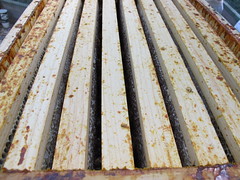
I was pretty amazed. Last year, when the bees first came and were establishing themselves, they had managed to fill three-quarters of one brood box by this time, and there wasn't even the thought of supers or honey that I could harvest at the this point, but it was pretty clear that they were doing really well right now. One of the keepers on the local email lists had said that the local yellow clover was going crazy with the unusually damp spring, so that we should all expect a lot of nectar flow. I still hadn't quite expected *this*.
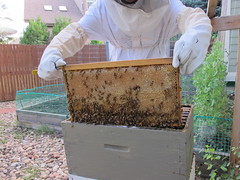
I'll probably do the shift the next time I go into the brood box, but it's good to just get the frame in. A local keeper had just done a study where he found that the keepers that just left all the old brood comb and frames in the box were less likely to have a die off than those that regularly circulated out old frames. It was a correlation, not causation, so he doesn't know why the die offs were less with old comb. Just that those with those tendencies had those results. So I'm unlikely to switch out a lot. And thinking it through some more I probably should have just worked to swap out the broken frame. Next time...
Still... this time I stole a bit more honey, and hopefully made a bit more room for the bees to fill in the brood box. They don't seem in any more of a situation where they will swarm, so this should just help that.
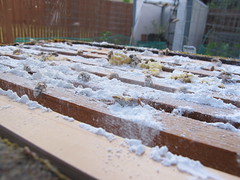
It's also kind of fun to see all the powdered "ghost" bees zooming around, though it does kind of perturb the poor girls. I do see a much higher mite count on the bottom board when I do this than when I don't, which probably just means that they're pulling more mites off each other and themselves when I do this. I'm supposed to do it on a weekly basis to really do a good job of it, but I just don't manage to get into the hive that often. Things are so busy during the summer. But I am happy that I remembered to do it while I did have the brood box open. There have been times when I've had the sugar all ready for it and I just totally forget in the midst of the adrenaline rush of having the hive open.
I will admit that with practice the adrenaline rush is getting easier to handle. I'm now able to observe while I have the hive open, when at the beginning, it was just so overwhelming. Now I know better what to do, what to expect, how to do it, and how to keep the girls from getting crushed or not worrying too much when two or three of them do get damaged. So I'm not quite as exhausted by the time I'm done doing the work that I outlined for myself. I'm still impressed by the super experienced keeps who can go through eight hives at a shot when they're in a beeyard. Practice really does make perfect.
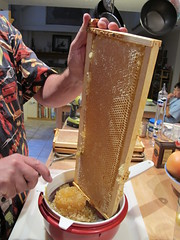
When he was done scraping the two frames, I put my equipment on and popped the two frames, still coated in honey, back into the top super. It should make it more attractive to the bees, and they may get going on building those up quickly with the incentive. The old empty frame I put next to the hive, and that night some creature dragged it away from the hive to try and eat it. But the plastic foundation foiled it and I let the girls clean it off the next day. Also the next day John put the pan of mashed wax out by the hive, so that the bees could eat some of the honey, but it was so hot out there that the whole pan just melted. One bee got caught, but that was it, and it cooled with the evening, so when I found it, the wax had solidified into a cake on top of a pool of pure honey. We poured that honey into another jar, and it's great. There are two jars from John's mashing that are pretty cloudy and I'm afraid he got more wax into them than I usually like having. We'll see how it settles, as the wax should come to the top. Eventually. *laughs*
For a beginning of the summer harvest, we got three quarts and another two-thirds of a pint, so about ten pounds of honey. Given than I'd gotten 40 pounds from this colony last year, I wouldn't be surprised if I got a lot more honey this year than last. But they also started a lot faster and were at great numbers even in March, so I'm just watching them very closely to make sure they have no reason to swarm.
Subscribe to:
Posts (Atom)