Showing posts with label inspections. Show all posts

Friday, September 8, 2017

Expectations

I'll admit that I'm as guilty as the next person with respect to building up a model of the world and having a hard time changing it when I find out that things are different than I believed. I really, truly believed that my bees couldn't make enough honey for another harvest, and that during the early September examination, that they'd only have partially filled the emptied super I'd put on and would need some help filling their brood box for the winter. Having lost my last colony to a bad mite infestation and very slow shipping on mite control substances, I was also convinced that I'd have to treat for mites.

I was entirely wrong on all points, and had to take half a day to process what I really found when I went into the hive.

I also kind of resisted going in, as I'd really wanted the bees to just keep all their honey for the winter and not have to deal with them again until they'd started to pack up for the cold; but it all kept nagging at me, as they'd been so quick to fill the supers the first time around. So to be responsible to them, I had to go in.

So I did.

On Monday, the 4th, I went in to see what there was to see. Despite all the smoke from the local forest fires, I decided to use smoke to calm the bees 'cause it's more effective than the sugar syrup spray; and by late summer, they're having to defend their hive from other bees and wasps constantly.  So they get really defensive and feisty when I go in, so it's better all around that I just use smoke and get them to go feed while I get things opened up to where I want to get.

I like applying the smoke and then letting them feed for a while before I go in and start opening things up. It gives me a chance to get everything ready and it gives them a chance to have some honey and fill their bellies so that they don't sting me. John and I actually sat and talked for a good hour over exactly what it was I was going to do, what it was that I needed to figure out, and what the further actions would be given what data I got.

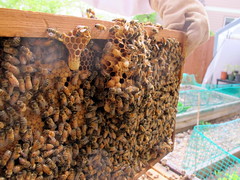
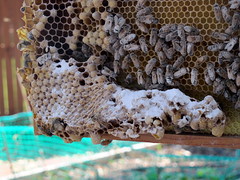
And the first thing I find is that they've build honeycomb all the way onto the lid. It's a good way of keeping down drafts and robbers through the main body of the hive, keeping all incoming to the outside frames; however, when they stick the whole thing to the top, it's kind of a pain to get the lid off.

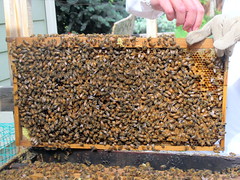
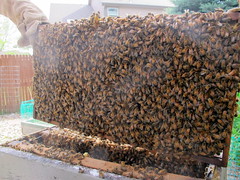
Sure enough, the girls had filled all the frames completely full, which was why they'd built above it all as well. All the way to the edge frames, too, which they normally leave only half filled, but with the spacing and everything, they'd filled all of them completely with capped honeycomb, which meant that the honey was completely finished and dried enough to store for nearly ever.

I moved both supers so that I could take a look into the brood chamber, too, as I needed to assess if they had varroa mites, which has been one of the leading causes of colony deaths. And the local Beekeepers' Association had a full out educational thing going on about how everyone could test for the mites by rolling the bees in powdered sugar. The powdered sugar dislodges the mites from the bees, and it has very little impact on the bees themselves, and with in 24 hours, the mites drop off and can be pulled out of the hive with a removable bottom board, which I have.

But that only happens when the bees have mites, and the idea is to put a cup of bees into a glass quart jar, pour powdered sugar on them, and then roll them in it.  Then shake all the sugar out with the mites and then release the bees, ghost white from sugar but still entirely alive and unharmed.  The mites fall off quickly, so you can get a count of them; and I could test how many were in there.


When I got down into the brood boxes and the frames down there, I found that the frames were completely filled with honey and pollen.  They had huge stores in there, and they were all full, too.  So that answered the question of if they'd already put away good stores for the winter...

And when I pulled the brood frame out, I shook bees into a glass jar and tested them for mites.  There wasn't a single dead mite.  And on the bottom board, I had only seen one mite all summer.  The usual level where you want to control the mites is if there's more than 2 mites per hundred bees.  To have absolutely none of them in the hive at all meant that the girls were doing great at avoiding infestation.

It was an unexpectedly good result to the test.  I was really expecting there to be some, and there just weren't any. And the chemical treatments that are commonly used are detrimental to the hive, if you think about it, it makes sense, as you're basically trying to kill a smaller bug riding on a bigger bug without harming the bigger bug too much, and it's a tricky thing to kill one without killing the other.

However... since the powdered sugar serves to a) loosen mites if there are any, b) have the girls clean the mites off each other if there are any with the powdered sugar coating, c) powdered sugar is something they can just eat and has no adverse affects on the bees themselves, and d) it's cheap and easy to apply: I decided to just go ahead an apply the stuff.

Then I put the supers back on, closed it all up and went and sat in the kitchen trying to figure out what to do next.  Most beekeepers at this time of year just have three responsibilities, get the supers off the hive and collect the honey, treat for mites if that's necessary, and make sure that the bees will have enough stores for the winter.

I had been assuming that I'd just leave all the honey for the girls for the winter, and that they'd need that.  But they obviously didn't. They'd filled everything to the brim already, and if anything, they had nothing to really do for the remaining month and a half before the first frost and the flowers went away. There were still plenty of flowers around, and these are domesticated bees, bred and made to create honey and wax that needs to be taken away for them to fulfill their commercial duties.

I also narrowed the front entrance so that the robber bees and wasps would have a harder time making it in, and I removed the shims from the top of the hive, so that there wouldn't be as easy an access to the insides.  It was a good thing, too, as the temps fell into the 40's that night, and closing it up made it easier for them to keep things warm inside.

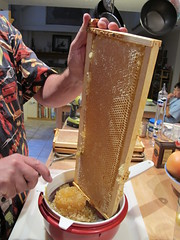
So... it took me a few days, but on Thursday, we pulled the entire top super and two of the frames in the lower super, and we extracted all of them, and I put the two empty frames back into the lower super so that the girls would have something to do. The whole lower super was completely full of honey, too, so I was leaving them six full frames there along with the completely full deep.


We got a lot of honey.  We extracted everything and then put the empty super back onto the hive to let the girls clean up all the drips and the last bits in the emptied comb. I'll probably collect the emptied super on Saturday so that they have a day to clean it out.

So we had 2 1/2 gallons in the first harvest and probably another 3.25 gallons in the second.  And there's likely 3 left in the remaining super and another five to seven in the two deep brood boxes from the heft of those things.  So the bees will have plenty for the winter, and they have time, still, to refill the remaining two super frames in the super that I left them. I'm definitely going to leave them that for the winter and only collect that honey in the spring if it's still there.

That should allow me to not feed them over the winter and early spring; and should let them have plenty of the good enzymes and stuff in their honey that they can get.  And, worst case, I can probably just pour a quart or two of their honey into a feeder for them if they do need it by then.

One of the girls managed to get into the pants of my beekeeper suit when I was putting the super back onto the hive, and she stung me solidly. It hurt, but it didn't swell at all, so I have to say that the bee venom therapy I had through my allergy clinic worked really well.

But all in all, it was kind of weird to realize that these domesticated bugs really were created to make honey that needed to be taken from them for them to function correctly. That I had to go in and get all that and it was how they're made.  In order for me to shorten their hive enough so that they can keep it good and warm, I have to take at least one of the supers off before winter; but it felt weird when I really had initially decided that I was just going to leave them the honey they'd worked so hard to get.

Still, now, if I sell a lot of this, I will make up all the extra money I had to pay for the colony during the bee shortage; and with the extra money, I should be able to buy another super and frames for them and maybe also make sure I have solid mite treatments for next year. They've mostly already paid for the extractor and their own costs. That's been pretty amazing.

Thursday, August 10, 2017

Making Room

The previous Wednesday I went to a little spin-in with four ladies and we dyed wool from the setup that the lady there had. But one of the other ladies was thinking about keeping bees as she’d inherited a top bar hive from a family that had simply neglected it, thinking that it was kinder to not bother the bees.

The bees had filled the hive, getting past a stopper that was supposed to keep them from the rest of the hive, and building on all the bars past that. And when they’d run out of space, they’d left. So I really wanted to make sure that my colony had plenty of space to build and store honey.

Monday, July 10, 2017

Opening Up for Summer

The weather has been finally getting really hot, in the mid to high 90's for a few days, and I knew that I had to get better ventilation into the hive for those weeks when it would be close to 100.  The hard part of it all is that I have to replace the bottom board to do so.

There might have been other ways? But I've did this both years when I had my last hive, and I liked having the bottom board be sealed when the colony was small and needed fewer entrances to defend.  It was obvious, from watching the bees coming in and out each day, that they had good numbers to defend themselves, now.  Plus, the girls might need more room, so I prepared a super with another eight frames for them to build on and fill that would fit above the deeps that I was leaving for them to keep full of honey, pollen, and brood.

Sunday, May 28, 2017

First Inspection

We're leaving tomorrow for vacation, and for the last week, it's been on and off again rain.

I don't really like to go into the hive when it's raining, since the bees get grumpy about getting exposed to bad weather.  So I just held off for four days. I'd been hoping to do the inspection on Wednesday, but it wasn't good and sunny until Sunday morning.

So I skipped church, and went into the hive in mid-morning, when the sun was full on, and a lot of the field workers were out. I prepped with a sugar water spray bottle, my suit, and head gear, and just went right in.

They were all over the bottom box. Building all the way out into the outer frames. It was good to see.  I carefully lifted a center frame, and there wasn't that much weight to it. Not a lot of honey, but when I got it out and looked, more than half of both sides of it were capped brood. So the queen was busy and the workers were all over it, feeding the young. I could see larvae in the backs of the dark cells, pretty easily, and they looked like they were doing fine. The queen wasn't on that frame, so I put it in a box in the shade, and then started going through the other frames.

There was a ton of brood, not a lot of honey, but then they were probably using it quickly to get the newly hatched to grow and develop.  The pollen patties I had put into the box were getting used really quickly. That is all to the good, as the sooner there are more workers getting born, the sooner they will be able to get more nectar and get the hive to grow.

The interesting thing for me was that they'd built all the way to the outside frames already... and she was laying eggs all the way out to the outside frames. The workers were storing nectar and pollen throughout, and getting all the way to the outside frames.  So it was time to put on a second deep, already.  It makes sure that they feel like they have plenty of room, and the weather lately has been wet enough that the local flowers and grasses are going crazy.

So I put the box back together, went with John into the garage and the two of us put together another eight frames with foundation and put them into one of the boxes.  Then I opened things back up, rescued a worker that had gotten squished into the pollen patties, and she was fine. That was good.  I then put the second deep box on top of the first, and then added top back on and the telescoping lid.  The weather for the next ten days is going to be a mix of rain and sun. Not too hot and not too cold, so I left the medium opening in, and didn't worry too much about venting the top, yet. Time enough for that then the temps get up into the 90's.

One of the really encouraging things was finding that in the bottom box that the bees hadn't built any crazy wax structures.  I'd actually spaced the frames well enough that they hadn't found it necessary to bridge any gaps.  So after I placed the top box on the bottom one, I took my gloves off in order to re-gap them so that they were as even as I really wanted them.

I can only hope that they keep that up.

After they fill the second deep, I'll be able to add a queen excluder and the supers; but I'll give them the time and the space to do all the building that they want. It's been nearly four weeks since I put them in, and six weeks is when the first wave of the new bees should be coming out of the box. That will be soon after we're back from our trip, and I'm half hoping that I can move them away from the part of the yard with the play structure.

John had originally figured that we'd put the hive here because our roof had to get redone, and the solar panels that were living just above the old location for my hive.  So to keep the bees out of the workers' way, we'd put it where it is.  Moving them is going to be interesting as there's a saying that you can move a hive two feet or ten miles, because the bees orient around the location of their hive, and if it's moved just two feet, they can easily find it again, but if it's more than that, these tiny creature of utmost habit seem to have a really hard time.  They just go out and try to come back to where the hive used to be.

There are tricks to it.  So we'll be trying them when we get back and it's warm enough for the workers to survive even if they don't find the hive immediately.  I am going to have to get them to reorient when they go out of the hive, and do a little management of the ones that go back to the old site anyway for a day or two, I think.

In the meantime, though, they'll get to just stay in peace while we go off on our trip.

Friday, May 5, 2017

Queen Release

It paid off.

Putting the mini-marshmallow in instead of having to dig the cork out later. I did like I did last time, and waited three days to make sure they'd all settled in before I went into the hive in order to figure out if the Queen had made it out and if there were things I had to do in order to get the missing frame back in.

There were things I had to do, the girls were really busy.


Wednesday, June 18, 2014

A Surprise Harvest

"sticky" board
I pulled my sticky board from the screened bottom board and found that there were a pretty good number of mites stuck to it, so I knew I wanted to treat the girls with more of the powdered sugar. (You can see them in the close up of the corners, they're pretty thick). I'll probably stick to that for most of the summer, and after all the honey supers come off, I'll probably treat with a miticide in the late fall.

Still, the girls were going strong, and I wanted to see where they were. Also, the top of my two deep brood boxes was filled with old frames that had wood that was starting to come apart. So I wanted to swap out some of the old frames for new ones and move the frames with brood still in them more to the edge so that I could, eventually, take them out, too. A long, slow process, but I figured I'd start by pulling one of the honey-filled frames in that box and substitute in a new frame.

I also wanted to see how they were doing with the new super, how far they'd gotten. The last time I'd looked, they'd only started building comb in the box. I had had a queen excluder between the brood box and the supers, but I pulled it out in impatience during the last inspection, as last year the queen hadn't left the established brood chamber at all, so I hoped that she wouldn't this year either.

I was well rewarded with my hope.

Honey!
This is the top of the super, right as I went in. If you look closely, you can see that the tops of five of the eight central frames are *capped* honeycomb, i.e. the bees had filled them, dried them enough so that they can't spoil, and then capped them. Capped honey is always dense enough to last on its own. The surprising thing, for me, was that this whole box was empty at the end of May, so in just a little over three weeks, they've more than half filled this box!!

I was pretty amazed. Last year, when the bees first came and were establishing themselves, they had managed to fill three-quarters of one brood box by this time, and there wasn't even the thought of supers or honey that I could harvest at the this point, but it was pretty clear that they were doing really well right now. One of the keepers on the local email lists had said that the local yellow clover was going crazy with the unusually damp spring, so that we should all expect a lot of nectar flow. I still hadn't quite expected *this*.

Pulling a deep frame
I still took off the top box, and found that even a medium, eight-frame super is pretty heavy when it's nearly full. The deep box, when full, was impossible for me to move, but I found that this was actually quite doable! I was happy with my choice to go to medium supers instead of using the old deeps. I then went into the brood box to take one of the old frames out, so that I could replace it with a new one. I should probably have moved the damaged one to the edge. Usually the queen doesn't lay in the edge frames, but the baby bees would have the time and support needed to hatch out. Then I could have removed *that* one.

I'll probably do the shift the next time I go into the brood box, but it's good to just get the frame in. A local keeper had just done a study where he found that the keepers that just left all the old brood comb and frames in the box were less likely to have a die off than those that regularly circulated out old frames. It was a correlation, not causation, so he doesn't know why the die offs were less with old comb. Just that those with those tendencies had those results. So I'm unlikely to switch out a lot. And thinking it through some more I probably should have just worked to swap out the broken frame. Next time...

Still... this time I stole a bit more honey, and hopefully made a bit more room for the bees to fill in the brood box. They don't seem in any more of a situation where they will swarm, so this should just help that.

Ghost Bees!
Next, to treat for the mites, I sprinkled sifted powdered sugar on top of the brood box's top bars. I aimed for between the bars, but of course missed some. There was a pretty good study that when the brood box bees are sprinkled with powdered sugar that they'll clean each other off. And when they clean each other off, they'll pick the mites off each other, and the fall of mites through a screened bottom board onto a sticky board is much much higher than when the hive isn't powdered.

It's also kind of fun to see all the powdered "ghost" bees zooming around, though it does kind of perturb the poor girls. I do see a much higher mite count on the bottom board when I do this than when I don't, which probably just means that they're pulling more mites off each other and themselves when I do this. I'm supposed to do it on a weekly basis to really do a good job of it, but I just don't manage to get into the hive that often. Things are so busy during the summer. But I am happy that I remembered to do it while I did have the brood box open. There have been times when I've had the sugar all ready for it and I just totally forget in the midst of the adrenaline rush of having the hive open.

I will admit that with practice the adrenaline rush is getting easier to handle. I'm now able to observe while I have the hive open, when at the beginning, it was just so overwhelming. Now I know better what to do, what to expect, how to do it, and how to keep the girls from getting crushed or not worrying too much when two or three of them do get damaged. So I'm not quite as exhausted by the time I'm done doing the work that I outlined for myself. I'm still impressed by the super experienced keeps who can go through eight hives at a shot when they're in a beeyard. Practice really does make perfect.

Collecting Honey
I did take two of the full frames from the super. I put two empty frames in from my second super, and left a gap in the brand new box. I did put the second super on top of the first, to give them even more room, and I left a gap of the two frames because, as John said, we were going to harvest them anyway and it would be relatively easy to pop them back in. John was great and took the lead in actually getting the honey out of the wax. We just do the scrape, smash, and filter process, and he did the work of it. We have a relatively wide mesh metal screen basket that works well enough to keep most of the wax out and he just mashed and mashed until there wasn't much left in the wax.

When he was done scraping the two frames, I put my equipment on and popped the two frames, still coated in honey, back into the top super. It should make it more attractive to the bees, and they may get going on building those up quickly with the incentive. The old empty frame I put next to the hive, and that night some creature dragged it away from the hive to try and eat it. But the plastic foundation foiled it and I let the girls clean it off the next day. Also the next day John put the pan of mashed wax out by the hive, so that the bees could eat some of the honey, but it was so hot out there that the whole pan just melted. One bee got caught, but that was it, and it cooled with the evening, so when I found it, the wax had solidified into a cake on top of a pool of pure honey. We poured that honey into another jar, and it's great. There are two jars from John's mashing that are pretty cloudy and I'm afraid he got more wax into them than I usually like having. We'll see how it settles, as the wax should come to the top. Eventually. *laughs*

For a beginning of the summer harvest, we got three quarts and another two-thirds of a pint, so about ten pounds of honey. Given than I'd gotten 40 pounds from this colony last year, I wouldn't be surprised if I got a lot more honey this year than last. But they also started a lot faster and were at great numbers even in March, so I'm just watching them very closely to make sure they have no reason to swarm.

Tuesday, May 27, 2014

Inspecting for a Queen

During the inspection I'd done on the 19th, I had half a dozen BIG larvae out of their comb in the middle of the area between the two deep brood boxes. I was worried that I'd just killed a bunch of queen larvae, but they were all together. It turns out that if the hive is making queens, they usually spread them around the box, half a dozen of them. And the only way I could tell if they were really doing that was by doing in and looking through the whole top box, which is where most of the new eggs and larvae now are.

I had one objective on the 19th, which was to get the screened bottom board in and give the hive the ventilation it needed. On the 20th, I wanted to do a complete inspection of the top box, and get some powdered sugar into the hive for the mites. Plus, on the 19th, one of the frames in the top box had the bottom bar break free of the frame, so I needed to wire it together so that it wouldn't fall apart.

May 20 Inspection
When I finally got around to getting the frame out, balance on the edge of the box, and a wire around it, I found that I couldn't manipulate the wire except by taking a glove off. It was just too thin a wire, and there were too many manipulations I had to do very carefully for me to be able to do it any way but barehanded.

I was shaking pretty badly with that, but none of the girls bothered my hand at all. There were four of them bumping constantly at my veil and buzzing me continuously, but none of them bothered my hand at all. I was pretty impressed. I did get the wire around the frame and twisted together to hold. I was amazed at how hard that actually turned out to be, but I think it'll be all right. The bees can't get rid of the wire the way they can bite and chew and remove rubber bands (it still amazes me how quick they are to do that).

But the old deep frame are definitely coming apart.

May 20 Inspection
The entire hive was just dripping with bees. So many bees that I couldn't even see everything that the comb was holding, but this particular blanket of bees was pretty smooth. Queen cells are bumps that are on the edges, usually, and by themselves, whereas the regular worker brood is more like this, just covered with nurse bees and the foragers who are bringing in pollen and nectar to feed all the babies.

I was amazed. The upper box had been much lighter than the lower box, but then again the lower box was more full of honey. If the upper was nearly entirely full of brood, it would be lighter than the liquid content of the honey boxes and frames.

May 20 Inspection
There were some lumps and bumps, and sections that the girls had built when and where the neighboring frame was bare.

It allowed them to build the drone comb, where the cells are MUCH bigger than the worker comb, and they fill them with the male drones. The drones are very large, and they grow in packs like the big lump there in the middle. One of the strange things was realizing that there were no queen cells but a whole lot of drone clumps in all the edges and nooks and crannies that I hadn't really been able to see that much of. One of the really big chunks was right where those other poor larvae had fallen out when I'd pulled apart the boxes.

So there were drones, but all good, healthy hives are going to throw off a lot of drones this time of year. It's a way of sharing the hive's genetics, and it's a natural part of the bounty of the nectar flow. The good news was that I didn't see any queen cells at all. And I was able to drop a lot more powdered sugar on everyone. *laughs*

May 20 Inspection
One of the strangest "growths" was this one, which was at the bottom corner of one of the frames. The facing frame was completely bare. This was made even more strange with the powdered sugar which I put on before I took the picture, by accident. But the fall of sugar makes it even odder yet.

Still, it really look like drone comb to me, just big cells all together instead of single Queen cells. So it looks like the hive isn't going to be swarming soon, and I'm trying to stay ahead of it by adding supers and making the hive bigger all the time.

Monday, May 19, 2014

Just a bit of summer ventilation

I went in today to add the screened bottom board with sticky paper to see what the mite count is like. I wanted to get some powdered sugar in there as I could see that the girls were cleaning themselves off on the entrance board, and I also wanted to see how they were doing with the super. AND I didn't have my husband's usual help as he was busy all day.

So I got everything ready, suited up, got my weather cover off by hand, lit the smoker, and went in. It was relatively simple to just get the boxes off, moved onto surfaces that could catch a queen if she happened to drop, and I found drones everywhere. Tis the seasons for the boys to get out, I suppose, but they were so big and I haven't been good at spotting the queen and I was just wondering if any of them were her, especially once I got down to the bottom board, had all the workers who were trying to come in backed up and buzzing me, and one of the drones took off from the bottom board and dropped into one of my basement window wells. Agh.

Anyway... I also had problems remembering how everything went with the bottom board and the screened board. One of those utterly newbie mistakes where I just forgot how the damned thing went together, and spent five minutes trying to keep bees off all the pieces and puzzle-solve it while all the bees were gathering in a bigger and bigger cloud.

Of course I also found three huge larva, naked, between the bottom brood box and the top brood box. At first, I panicked, thinking that they were exposed queen larvae... and that the hive is thinking about swarming! Eeek... but they were all in a bunch and there wasn't protective walls around them. I suspect that they were actually just more drones.

They were also going through the queen excluder to the supers and building comb in the super I'd placed a month ago. The top brood chamber isn't completely full, either, and I started to do a frame by frame inspection of the top box, but one of the old frames fell apart on me, the bottom bar just pulled free, with the nail right through it. I'm probably going to have to wire that one back together again eventually.

I think I was a little unnerved by just how MANY bees there are this spring compared even to last summer. There are just so many more of them!

I finally just decided to put everything back together, with the extra ventilation shims at the top of the hive, and the extra height bars for the front entrance, so that they have a bigger landing pad. It's hard to balance those things with gloved hands, but it was pretty clear that they were trying pretty hard to sting me when I found one of the girls hanging by her stinger in my deerskin glove. She didn't get through, though, so I'm going to have to go get my bee venom shot in a week or two. *laughs*

My goals were to just give the whole hive more ventilation and put the screened board in, and do a powdered sugar sprinkle. I got the powdered sugar into the brood boxes and we'll see how that goes in a few days. They clean the sugar off themselves and in the process clean off the Varroa mites. I haven't seen evidence of any other problems, yet, and I'm hoping that that'll be enough for this summer at least.

I did what I intended, but the possibility of the colony actually swarming really threw me. I wasn't expecting that, and I know that a second year queen is always stronger than the first year she starts to lay. I had added the super to make sure they had room, and they haven't actually filled all of the top brood box yet, either, so... there may actually be plenty of space. It's all such a puzzle, and I need to keep ahead of them to accommodate their needs. I'd rather not split them unless I have to... which probably means I need to really go in and do another frame-by-frame check to see if there are queen cells anywhere.

Probably in the next day or two. Sadly, since John wasn't here, I wasn't able to get any pictures of anything, and it would have been really useful to have pictures of the broken open larvae for ID purposes from experienced keepers.

Sunday, April 20, 2014

First Full Inspection of the Spring

Had a really truly full day today, and I absolutely decided that I had to fit an inspection in today.

It started with breakfast with my son, then grocery shopping for an Easter party tomorrow that will have about six families who all decided to accept the invitation today. Then I had to get a bee block for a research project for individual wasps and bees by the University of Colorado, luckily the professor lives here in Longmont, so I didn't have to go into Boulder to get it. Then my husband, son, and I helped move furniture for the owner of one of the flooded houses. The house is mostly together, and a neighbor had been storing her furniture and needed to get rid of it. So we were there to put it all into place. Luckily, one other member of the church came to help us as there was some significantly heavy lifting.  Then I had an hour and a half saber lesson with the Denver Fencing Club, and my son and I both go to that, and I was exhausted by the end of it.

So, knowing I was tired, I sat down with my bee journal and a pen and wrote down exactly what it was I wanted to do with the inspection and what my decision points were. I needed to do the following:

  1. Figure out if there were queen cells and/or drone cells to see if my very busy hive was preparing to swarm.
  2. See what the honey situation in the hive was to figure out if I needed to supplement with sugar syrup.
  3. To see what the population in the hive really was after wintering-over. And see if it was big enough to warrant a super already.
  4. To remove the entrance restriction. Our neighborhood's fruit trees are blossoming now, all the dandelions are out, and so our flow is On and there was going to rain tonight and tomorrow. Plus, there was going to be a week of 60+ degree day weather and no freezes at night. So it seemed time to at least do that. But I know that here we can still have a snow or two before Mother's Day, so I didn't want to put the screened bottom board in, yet.
  5. To remove a few frames of really badly formed comb so that I could do inspections without rolling so many bees. I knew, from last summer that two frames on the bottom box were badly deformed, and I'd deliberately moved that box to the bottom so that they'd eat it out first.
  6. To see how the brood was doing and what the queen's laying pattern looked like just to assess how she was doing this spring. There have been at least half a dozen orienting flights since early March that I've seen, so I knew she was laying pretty well, but I still wanted to see how it was going.
I don't do a lot of inspections. I do them only when I have a reason to, unlike some beeks who say that they go in every week, no matter what, just to keep the bees used to them. But I also don't let them just do their own thing, I'm their beekeeper, and they do rely on me to manage things, especially things like space, mite control, and the size of their entrance. And I really, truly needed to know if they were going to need to be split. I wasn't prepared to do the split today, but I needed to know if I had to prepare for it.

And knowing I was tired meant that I had to plan all my moves and contingencies. Especially since I was kind of nervous about it as I haven't done a frame-by-frame inspection of the brood box since last fall. And if I had most of my decisions points plotted out beforehand, I could just do things and follow the decision points.

First good surprise was finding that the lower box was nearly completely full of bees. Last spring, I installed the package, and they mostly stayed in a tight ball in the center of the box together, and built out from there. Most of the wax, of course, is still from last year, but I hadn't expected nearly all of it to be full of either brood or honey!

I did the usual thing, for me at least, of taking the top box and putting it on the lid and then going into all of the bottom box, as that was the one that I was most concerned about with regards to the misshapen comb and the amount of honey that was left.

It was really full, though, so I had to be really careful about making sure that I could get one frame out and then start sliding the other frames over so that I could remove them without crushing anyone. Luckily, nearly every frame in this particular box was new, factory assembled, and solid enough that even when they were full of honey, they lifted out quite easily and the top staple held just fine.


You can see the sheer density of bees. They were up and down most of the frames. I was using smoke so I tried to keep them away from the edges so that I could get good hand holds on the frames and not drop them.

I was surprised to see not quite as many bridging comb as I thought there was going to be. I remembered the last time I went into this box that they had comb going from frame to frame in all kinds of crazy places. I think it was one way to get drone comb in when I hadn't put any drone foundation into it. But the three pieces of bridging comb I did see was all honey comb!!

I took a few of those pieces by smoking the bees off the protrusions, and then scraping them off with my hive tool. I learned from last year, when I scraped a piece off with the bees still on it. All the bees that were on it drowned in the honey. So I decided not to do that ever again.

Another cool surprise was seeing the sheer amount of brood comb now in this box. The last time I'd done a complete inspection of this particular box, the center frames had been half filled with brood and half filled with honey. They hadn't built all the way to the top.

As you can see in this picture, the brood is pretty solid where the bees haven't hatched out, yet, and when I looked into the cells with larva in them, they were all tightly packed together. So the queen is still doing her thing and doing it really well. There were at least two solid frames of brood already, and I was pretty amazed.

The top box had the last, dried remains of the bee patties. I cleaned them all off and tossed them into our compost. The bees were pretty solid through this box as well, though it was a much lighter box than the bottom one. I think they'd eaten out all the honey and brood's pretty light.

Still, there were a lot of girls up here, too, and the brood pattern was now just the lower half of the frames up here, but they were filling the rest with honey and bee bread. I was pretty impressed by all of that, and it seems that the girls feel like they have plenty of room, as I didn't see any queen cells.

That was one of my prime worries. I didn't want to lose a very strong colony to swarming when I'd done so much work to help them make it through an extremely cold winter.

One lady who sells honey at the Longmont Farmer's Market said that they lost 70% of their hives. So it's been a pretty rough year for the commercial keepers. She said that I was good and lucky to have been able to keep my hive alive. So I'll take that as having done something right with the way I do things.

Given the sheer numbers, I thought I'd put a medium super on with a queen excluder between the brood boxes and the super. It wouldn't hurt to give them more space to grow into, and just discourage the idea of swarming all the more.

I got tired of the gloves, too, as the ladies were very gentle with me, and so when I had to respace the top bars of the super to make sure they were set at the right space, I just took my gloves off and went at it.

It's interesting that in the spring, the girls seem to be more gentle, when I know that last fall, when I was taking honey, they were really upset with me and were actively attacking me and following me around the yard after I'd stolen so much. But today, even when I was scraping off the misshapen bits, they didn't seem to care at all. They were just too busy getting things going again to bother with me.

So it was a nice, successful inspection. I didn't see any signs of diseases. The brood looked all healthy, solid, and in good shape. There were a LOT of bees, and there seemed to be plenty of honey in the hive for them to eat, since they seemed to be able to make even more as there was new, uncapped honey in a good bit of the comb.

I am very grateful that they wintered well, and that they're doing so well.

Friday, January 17, 2014

A Warm Break

It was warm today, nearly 60, and the side yard was sunny and bright. When I went out at 2pm I heard the hum that Jet calls 'the vacuum sound'. It's the usual sound of new bees orienting themselves!

After the other article about the fact that the bees are still rearing young in the winter, it wasn't as unexpected as it would have been before. But I was still pleasantly surprised to see the cloud of bees hovering in front of the hive. It made me put on my suit and veil and have John light up my smoker, because I was going to approach a living, active hive instead of the one that was very quiet and didn't have that many bees in December.

The Bee Patties
This is the box of patties that I was mailed. It's probably more than a single hive can use in a winter, given how slowly they're actually eating it. It's about 10 pounds of pollen substitute, sugar, and corn syrup cooked into slabs that can fit under the lid of the hive. The mix of proteins smells like brewer's yeast when I open up the bag, and it's supposed to be refrigerated, so I keep it in our 30 degree garage on the most part. When the weather warms and I start putting supers onto the boxes I can't have this stuff on the bars because the bees will try to pack some of it away.

So it'll probably go into the freezer at that point, and there's plenty for at least another year, even if I split the hive into two hives and have two in the spring. We'll see how it works out.

It's interesting thinking about what a bee probiotic really is, *laughs* I do love the advertising, though.

They're eating them!!
Here's what we saw when I pulled the top off the boxes. There's a lot more bees than there were in December. I was pretty impressed at how many were on the patties themselves and getting chunks off of it to feed on. There's a huge chunk out of the front patty and they're both pretty nibbled.

So I figured that they were definitely using the things. The only problem was that I couldn't move the original remains, as they were too soft from the warmth of the day! So I had to cut a new patty into strips to try and fit it into the spaces between.

I am glad that they're using them, so it means that they really needed the extras. The bees do keep a little pollen in what they call beebread, and they stuff some cells with the stuff, but here there's no flowers through the winter, so pollen's hard to come by. Therefore, these patties are supplementing the food needed to raise larvae.

Plenty of Bees
When I raised the lid in December none of the bees were on the lid, and nearly none of them were in the upper chamber of the two boxes. So seeing this many bees on the lid was very cool. They were active, buzzing, and two or three were coming at me to defend the hive. The rest were just busy going about their business in the box and on the lid.

There were just a few bees using the front entrance at this point. The others had already oriented, and were gone back inside. The sun had gone to the west enough to leave the hive in shadow, so it was getting gradually chillier.

I had some problems putting the new patty on until I realized that the inner lid actually had a lip of about an inch and a half, not just the width of the rim of the boxes. I had to pull the new stuff back far enough so that the lid could go back on. It was pretty clear, though, that the bees were doing well, and that their numbers have already increased.

There were about a dozen bodies out the front entrance, and one lady was dead on the front edge of the landing board. That was interesting to see, she looked as if she were about to take off, but was so utterly still.

Carved Away
Here's a clearer look of the two eaten away patties. There's holes in the one to the left and the one on the right is carved away quite neatly. There's poke marks everywhere, so they're definitely taking away from them both. The new patty that I put half of on here was all shiny and smooth.

The girls were all pretty active, so I have good hopes for the coming year. It's definitely not looking like they're going to die out this winter, even if it gets cold again. After they survived two cold spells, they're now increasing their numbers, so it's looking good. The more of them there are, the more area they'll be able to incubate, and the more they'll increase. I just hope that I manage to figure out if I should split the hive in March before they decide to swarm.

Wednesday, August 14, 2013

Moving House and Ghost Bees

On August 4th, I actually did a full inspection of the hive, because it had been a while, and I wanted to just see what was going on. I'd been on vacation to Seattle, so hadn't really had a chance until then to get at the girls. I also waited for the boards from Corky so that I could build the supers I needed.

Babies
I found a very happy, full, busy hive, with lots of larvae in the bottom two brood boxes, three or four full frames of honey down there, too, and nearly half the deep super already filled wtih new white comb and honey.

I put another super on, then, just in case the girls wanted to be ambitious, and I left the hive bodies staggered, because the weather had been wicked hot for the the last several weeks. They'd been bearding on every available surface, so I thought I'd let them do that as much as they could from every front and back of the boxes.

But in the last week, it's gotten both wet and colder, especially at night. It's been in the 50's at night, though still in the high 70's and low 80's during the day. There's still lots of flowers out all around the neighborhood, and in the wild field just across the street. So it's not like it's totally fall, yet, but it's certainly not the dog days of August I'm used to having.

Mosh Pit
For that inspection, though, the hive was full of bees, they'd probably doubled their numbers again, since I'd last seen them, and the sheer number of bees amazed me. I even saw a bunch of them doing an orienting flight, just as I was approaching the boxes to open them all up. The girls had also created huge amounts of propolis, glueing the front board to the entrance and cementing all the boxes together. That amazed me.

When we'd come home from Seattle, one of the boards blocking the skunks from entering our backyard was shifted, and there was a trench dug in front of the hive! They'd evidently come in and tried to dig their way under the hive to get at things. They hadn't gotten far in the hard-packed clay, so it wasn't really a viable plan. Still, it surprised me that they'd tried.

Anyway... I did take one chunk of honeycomb they'd probably built on one of the top bars, off the foundation. It had dropped in the 104 degree weather they'd had while we were away, and they'd glued it to the bottom of one of the foundations. It was so thick it was mashing bees when I tried to pull out that frame, so I shoo'ed all the girls off it, and then just used my hive tool to scrape it off the plastic foundation, onto a cookie sheet. I mashed it later, ran it through a steel mesh filter, and it's been really tasty in my tea.

But a few days later I noticed tiny, tiny black specks that were running around and jumping between the girls on the their front porch! The girls were scraping them off each other, but the tiny things were running around. One of the bee girls looked like she was chasing them around, shooing them off the porch. Not the red of Varroa or tracheal mites, but someone was still trying to hitch a ride and food from my girls.

Between that and the weather, I decided to get a screened bottom board with a drawer for sticky board, and then straighten up the boxes but still leave ventilation from the top super. So, today, I wanted to get all that in. Of course, it clouded up and started raining. John was amazing, and because I was going to have to take off all the boxes in order to get to the bottom board, he volunteered to build a new stand for it all so that I could move the whole thing two yards forward, off the basement window well, and make it a lot easier for me to lift and carry the full deeps.

The Old Setup
Here you can see the old setup, and it's getting tall enough and heavy enough that I couldn't lift much while standing on the edge of the cover for the well. It's actually held up by two 2x4's stretched across the very strong metal well walls, so there was no danger of it falling it. The only danger was for me to fall in if I got close enough to spare my back.

John's back had been acting up, lately, too, so I did all the lifting this time, and basically put all the boxes on the lid a little ways out of the way. It got a little crazy, this time, since I was taking away the entire hive, and the girls got pretty agitated while I moved and stacked boxes, trying not to crush anyone. And then, of course, it started to rain, and all the field workers started to come back to the hive. Poor girls, they were hovering like crazy in exactly the same spot they used to hover in, in order to make a landing at the hive, but there was no where to land!

I had to clear out the old equipment and clean off the old bottom board. An enormous spider had taken up residence under the bottom board, and had a huge accumulation of wings, all stuck together, down there. The spider had run away onto one of the supporting 2x4's, and I figure she was probably who had eaten all the dead bees that the girls had thrown out of the hive, because I never found bodies in front of the hive or under it in the window well. Given how thoroughly she was cleaning up, I didn't really mind her there.

I had to put the new stand in place. John suggested testing it, so I did, and jumped up and down in a cloud of bees to make sure it was set solidly. Then I put the cleaned bottom board on it, and on top of that, the screened bottom board with a drawer in the back for sticky board. The sticky board we had was just covered in Vaseline, but it's sticky enough that if the mites fall on it, they aren't going to be able to get out or jump back on the bees.

The New Setup
And then I was finally able to put the bottom brood box back into place.

Whew.

In this picture, you can even see where I'd stacked all the boxes in reverse order, on the lid.

With the entrance board out front, but two inches down, all the incoming workers landed on the board, but then had a two-inch climb that confused the heck out of them. John went off to get an extra piece of 2x4, while I made sure that the box was in place, and the workers smoked down so that I could place the next box, which was another heavy one. But it made all the difference in the world that I could keep the box next to my body while I carried it. I had to work quickly to get the front board back into place, too, as every girl in the air kept trying to land on it, as it was familiar, so I kept one hand waving in front, while I got the board in. I've never been so glad of my protective gear.

I was swearing at the girls when they boiled up over the top bars, and it was only after I got both brood boxes and the nearly full deep when I remembered that I was going to treat them with powdered sugar. When you dump powdered sugar on bees, they start to clean each other off, and they do such a thorough job of it that they often clean the mites off each other, too. It's a great way to get mites to drop off, and onto the sticky board. It doesn't really harm them, it basically feeds them, and it's cheap and can be very easy to do. They recommend treating once a week, but just the brood boxes. *laughs*

I don't think that the powdered sugar affects the honey, but really the brood workers are the ones most at risk of the mites, which I think is why you just do the brood boxes. Half a cup of sifted powdered sugar went between the frames.

Ghost Bee
And ghost bees came zooming out. Poor girls. They were completely covered with the stuff. I saw one girl practically blinded by the stuff, trying to throw herself out of a small area between two frames. I gently helped her out of that into the body of the hive itself.

This one flew out, climbed onto Jet, and then tried to go into his pants. John got her out of there, but she left a trail of powdered sugar all over Jet. *laughs*

But all the girls that came out were frantically being cleaned by all the other bees. It was fun to see how cooperative they were about doing that for each other, and I'll see, tomorrow, how many mites were caught by the sticky board. Or if the sugar even made it to the bottom. The drawer means that I can look and check without bothering the girls.

Whew
It all went together beautifully. The top super had a lot of bees in it, but no comb, yet, or honey. It seem to just be living space for them, and there were a lot of them up there when I first opened things up.

Stacking everything up felt good, and I got most of the bees out of the way with practice. I just need to do this more often to be more comfortable with the doing. Still, not bad for having a whole cloud of bees flying all around me while I got the stand and the bottom back into place, just two feet in front of where it used to be. The girls were doing orienting flights, afterward, circling around as if they were figuring out where everything was again. It still amazes me that moving them such a short distance still confuses them so much. Nearly none of the field workers, coming back, seemed even able to see the boxes that were piled on the lid just a right-corner away. But once the box was back in the orientation it used to have, in nearly the same place, they homed in and landed as if nothing were wrong.

Now they'll have fewer entrances to guard, and I'll get a better handle on the mites, I think, and help them manage what they're already doing. If they clean the mites off each other in the hive, the mites can drop through the mesh, and can't get back out, unlike when they were cleaning each other on the front porch, and the mites were just jumping right back onto them.

I'll have to put it back on the solid bottom board again before winter, but now I'll have a portal into how they're actually doing.

Friday, June 28, 2013

Bottom to Top Inspection on June 25th

The fires have been fierce, and we were seeing the smoke from the two fires that were right after we got back. The weather has gotten even hotter and dryer, and on the 22nd of June I saw a bunch of the girls hanging out on the front entrance board instead of inside the hive.

I hadn't seen that behavior before, and I kind of panicked as there was something about the bees hanging out like that because they were thinking of swarming, but usually it's a huge beard of bees, not just a few wandering aimlessly outside...


So that night, I just went and put another box on top, just in case. I knew that I was going to have to do an inspection soon, but I wanted to wait until it was mid-day and I had enough time and patience to do it right. So I planned to go in on Tuesday, when I would have John at home and I knew the weather would be clear.

I also went to the Internets, and they said no worries, if the ladies are hanging when it's hot, it's likely just a way to cool off and to help keep the hive from overheating. That I should look to give them better ventilation and or more cooling options. I also read up on more ways to do a bottom-up inspection when I had multiple boxes stacked on.

Bottom Box
The top box that I'd put on was completely empty of anything but a few curious bees. It was easy to lift, and I just stacked it on an upside down doormat I'd put out of the flight path. The top brood box was a lot harder to lift. *laughs* I've been doing dead lifts with the weightlifting system that got me started on, and I was soooo glad of having done a lot of those with up to seventy pounds of weight on the bar.

The real problem was that John had built a little platform for the hive over the window well of our basement. The well has a mesh over it that was solid enough for careless two, three, or even five-year-olds, but it can't hold the weight of an adult human being, not to mention such a human being with another thirty pounds of beehive. I had to stand on the rim of the well, reach, and lift the hive body and carefully bring it to me so that I didn't shake any of the girls out of the completely open bottom.

As you can see from this picture, the girls started to build linking comb from the bottom box to the top one, so it was kind of important that I take all that apart.

The bottom of both boxes has to be open to allow passage between the two levels and to let air circulation happen. The bees are very good at clinging to their frames, but... it was still kind of hairy doing it. Both my boys watched very carefully to see that nothing but a bit of honey dropped from the top box before I had it on top of the topmost level that was resting on the mat.

Just comb?
Very busy girls. There was one entire frame that was utterly empty, one that they'd started one, but then the next six were chock-a-block with bees, brood and honey. This was one of the brood frames, and they'd just kept building. This is just comb on the bottom, but I needed John to take a picture so that I could be sure that it wasn't a queen cell.

Yes, that's Jet in the background. He'd donned my extra veil and hat and was watching me do all this from very very close up. He wasn't bothered by any of the girls at all, and was fascinated with the whole procedure! I loved his interest and it was really nice to have him there as yet another pair of hands while John was handling the camera, the smoker, and other things.

All Brood All The Time
This made me very happy, as it's a frame that's almost completely covered, edge to edge, with capped brood. The eggs develop into larve, which then get fed until they're fat enough to be covered. They spin their coccon after that, and under go metamorphsis over the last two weeks of development. So all of these were laid within a week of each other, for nearly all of them to still be under caps. So the Queen's been very very busy, and doing a very good solid job of laying in nearly every cell.

It was interesting to me, though, to see the wax over the top bar, and that they just kept going with the cells.

Honey?
This was beautiful and brand new to me. This is a frame with nothing but honey. There was one of these on each level, where it was nothing but honey. Both boxes also had one frame where the outside of them was all honey and the brood side of them had about half a side of brood and all the outside was honey. Those were pretty heavy as well.

I was astonished at just how heavy these were!! But front and back, this frame was nothing but honey. This side was all capped, as it had dehydrated enough to be thick enough for them. The other side, though, was open and still drying out. That might have been another reason for the bees that were outside the hive during the night. The extra humidity in the hive was only added to with more bees in the hive, so in order to allow the drying action to happen, they stayed outside.

Once this is capped, there might be less humidity in the hive. I'm kind of hoping.

A Mistake
Then I ran into an interesting problem.

I had had one frame in the bottom box that the girls had doubled the comb up on me on the frame. They'd hung another sheet of comb from the top bar, simply because there was too much space in that box. I am trying to fix it by spacing the frames in there closer together and leaving that extra space on the sides, but... at the beginning I didn't know there was even a problem, until they'd already built the comb.

This time, when I went in, I found that second sheet already fallen from the bar, and lying in the bottom of the box. It had been supported by the frame it had been hanging with, but had clearly broken free a while ago and was just slumped. Luckily, it had probably fallen a while ago, so the Queen hadn't laid anything more in it. Unluckily, there were still a few bees just barely fully developed still in the cells, struggling to get out. I ended up rubberbanding what was left of this into an empty frame, and inserting it into upper box, replacing one of the completely empty frames, and moving all the full frames over one slot to cover the empty areas.

I know, it was a lot of manipulation, but I really wanted to get an empty foundation and frame where they were doing the most honey making, and I wanted this slab of a mistake out of there. In the picture there's actually a dozen bees trying to help the baby bees out and feeding them.

Hello?
John, in the meantime, got some amazing shots from the boxes I wasn't paying attention to. *laughs* I didn't have any problems with any other hives trying to rob this one, so I just left all the boxes open while I worked.

The top box was 3/4 full, too, and, as I said, I moved all the full ones over to give room for another empty frame. Then two days later, on Thursday, I suited up and went back in to pull out the 'empty' frame and found it covered with bees trying to fill it with honey!

I smoked most of them off, and just tapped the rest of them off back into the hive, after making sure the queen wasn't with them. Most of the bees that were in cells on that piece had already been born. I freed one more, right there, and put her back into the hive so she'd have a chance, and then we threw the piece of comb away, and tucked a clean, new frame in there with just fresh foundation for them to draw out and fill.

They'd already drawn out one new leaf of comb, but it was small, and I didn't feel badly about taking it. The interesting thing is that the comb cells were much, much bigger than the ones that the workers built in traveling box! I wasn't sure why that was so.

IMG_9773
They've been pretty enthusiastic builders. I cleaned off all this protruding comb. But both top and bottom boxes have empty frames, still, and there's nothing like a queen cell anywhere. So no real threat of swarming. I added a spacer between the lid and the boxes so that there could be more air flow. I'm not sure it's enough. I might want to remove the inner lid and just have the telescoping lid on top of the spacers, but it's not as easy to clean as the inner lid.

So the usual schedule of adding a super in July is about right for these girls, and I'll be doing that sometime next week. I don't want to be bugging them so much.

The good news is that night, when it was pretty cool, all the girls were in the hive. There's plenty of room for them, I think, still, and so long as it's cool enough, they're happy to stay within where it's safe.

The other interesting thing was that when I tasted the honey I'd gotten from scraping off the cross-frame comb, it was sweet and floral and smoky. I wonder if some of that forest fire smoke got into their honey?

Monday, June 10, 2013

Inspection After a Month...

... since I did the last inspection, and I figured it was time. So a total of 42 days since installment.

This time I practiced with the smoker beforehand, I went over a game plan with John before I even opened it up, and then we went strictly by the guidelines and boundaries I set down for the whole thing, and it was really good.

I'm realizing, the more I do this, the better it is to have an end in mind before I go in. There's no point in disturbing the girls unless I have a decision point to make, and I need to figure out what it is I'm going to do. There are some books that say that in order to manage a hive properly, you need to go in every week. On the other side, there's several that say that every time you go in, you set them back by a week, and others that say that during good nectar flow in the summer you should never go in or you'll interrupt them badly.

I don't think I did much interrupting today, and it was good to see how far the ladies have gotten in just the month I was away.

Top Box
Before we left for China, I'd put a second deep box on top of the first, because the bees had already filled five of the eight frames, and I wanted to give them plenty of room while we were away. Unfortunately, I also knew that they have a tendency to want to go straight up from where they've already established brood or comb, so I needed to know if they'd spread out a little or had simply gone up.

I think another reason I needed the very clear plan before I went in was because I'm still jet-lagged and kind of woozy during the day. Mental processes haven't been as clear or as clean since the trip, between the cold and the drastic time shift. I keep wanting to sleep during the day and waking up at night, even more so than usual, so I've been fighting all that, too.

One of the things was just to get rid of the feeder, because while the sugar water was really good for getting the colony to build up its numbers, the bees were likely to take and store the sugar syrup instead of honey, and it just doesn't hold as well as actual nectar from flowers of all kinds. So I just took the whole top off, put the feeder out on the grass, and trusted that the two workers that were left in it would find their way home.

Building Up
It's kind of fun to see the brand-new clean top edges of the new frames that I'd bought from the bee equipment place. Already loaded with foundation, I didn't have to worry about the evenness of how the foundations were built or set.

The first three frames were empty of everything but bees exploring their surfaces. The fourth was partially built on the right side, and the left was facing this particular frame, which is almost entirely built out! I was very happy to see this nearly filled with bees drawing out the wax. It's a clean side, with the wax nearly the same color as the foundation, and you can see through it, so no buildups from brood or anything, yet.

It was interesting to see this frame in contrast to the center one and the ones on either side of that, which were filled with nearly complete brood. Since it's been about a month since I put this box on, if the Queen had gone directly for the first frame when I put it on, there was time enough for a whole round of baby bees to grow up (takes them 21 days to hatch, develop, morph, and break free to fly.

Looking Down a Level
It was also fun to look down between the slats when I had the empty ones out to see how they were doing on the first box. They'd built out a little more, with two empty frames to the same side as on the top, so they were starting to fill it all up as well as they could, too. I love this picture as it's like a whole carpet of bees...

They seem to be doing quite well, as there are so many of them, but one thing I really did notice was that they were becoming more and more the same. That the all-yellow or all-black workers that I'd started with just weren't there anymore. All the ladies are looking more like sisters, now, with the same pattern of stripes and the same brown fuzzy thoraxes.

The dying workers are being tossed out the front door, too, and I'm seeing more and more of them piled up just off the edge of the entrance. They dry out into these abstract shapes of just the carapace and look almost like dried flower buds.

IMG_9718
The next frame was solid brood. Capped and ready to fly in a week or two. On both sides. There were just a few holes, and I wasn't exactly sure if these were cells that the Queen had missed or if she'd laid in them and these were the first bees to fly. Either way, they were pretty scattered and few, which meant that the mass of the cells had eggs laid in them.

It was pretty intense to see a whole frame that was nothing but brood when it had felt so haphazard the last time I went in for an inspection, but the girls are doing their best to multiply and do it as quickly as their nectar flow and pollen finds allow. They're carrying in legloads of pollen all the time, and it's amazing seeing how much pollen they're finding and using to rear their young.

Lots of Baby Bees
On the left, here, is one of the corners of the really crowded frames. It definitely reassured me that she was laying in nearly every cell she could reach, and just missed a few by mistake. It's just chock-full of pupae, who are about ready to be capped and let go to cocoon themselves and grow wings. So many of the workers were head-first into the cells they looked black. I had to study them pretty closely to see that they weren't a problem at all, and had a very good sense of what needed maintaining.

I really loved seeing the open cells again, and being able to distinguish, so easily, which cells were honey and which were brood. I was impressed to see how little they're storing, yet, and how much they're just pumping up the numbers within the colony. It fits the cycle, I think.... where they just up their numbers for a while and then try to store honey away so that they can survive the winter. Luckily, there's a number of fields of weeds nearby that are completely chock-a-block with dandelions. I saw them ALL blooming just a week ago, and the girls have plenty to eat.

The interesting thing was seeing that these frames were duller, more solid than the open, airy, uncapped frame where the light could just shine through. These were solid with developing bees.

I think I found her! I think I found her!!
Then I saw this frame. Both sides were like this, where the center was empty, dark, and being cleaned out by the workers. The cell darkens after having held a pupae through larval stage and into adult. I hadn't seen any of this during the first inspection, of course, as they hadn't had the time to get that far.

It was really cool to see it up close, and then I realized that the queen is on this side of this frame! She's surrounded by attendants, and she's laying and she has a black thorax instead of the fuzzy brown one that the workers have. She's the only bee that isn't head-first into a cell... and if you click on the picture, it'll take you to flickr, where I've got her marked. *laughs*

The amazing thing was knowing now that she's re-laying the frames, and putting eggs into used, cleaned cells the way she's supposed to, and that it's going quite well. None of the bees seemed particular disturbed by my moving things around, and no one was attacking me and none of them were particularly agitated by my observations. I hadn't crushed anyone, for all that there were a lot more bees in there. Counting the full frames, the estimates are about half a pound of workers per completely covered frame, so I have approximately six pounds of bees now, about doubling what I started with, even with the loss of all the old workers.

Fanning
As a parting shot... *laughs* This bee was fanning furiously, as it was a pretty hot day, and they simply can stand at the top of a frame to fan out the heat. There's a few ventilation holes in the boxes, now, and I'm offsetting them a little to improve air flow. There's also a steady supply of water outside and the top box has a few holes drilled into it.

Given that the workers were starting to explore the frames to the side, and that they'd only really half-filled the boxes I'd given to them, I decided not to add a new super, yet, and let them just do what they were doing.

Over the weekend, one of our neighbors was having a garage sale, and her flowering tree in the front yard was just covered with bees. She's near enough that she was happily saying that she was feeding my girls... *laughs* I loved that. They weren't bothering her or anyone that was going to the sale, staying strictly on the blossoms. And I actually found a flowering cherry tree nearby that was also covered with the girls, so they're doing quite well in our neighborhood. Next up will be the Russian sage, the butterfly bushes, and plenty of summer roses. It's funny how aware I now am of the local flora...

Friday, May 10, 2013

The 12-Day Inspection

In which I learned a great deal about the fact that planning really does help the inspection of a hive, and I actually FIND evidence that the queen is amazing and doing really really well. My husband was wonderful and helped keep me on track and focused for the whole thing, and did an amazing job as cameraman. 

I really love that you can see John's shadow in this picture, too.

But one of the main things I started with was deciding to use smoke for the first time. I had only used sugar water to spray the girls so that they would clean each other off before this. The feeding mechanism makes them full and the belly distension seems to make it impossible for them to sting.

The same mechanism is why smoke works, or so they say. *laughs* There is more lore about bees than I even really want to think about; but smoke makes the girls gorge on honey in case they have to fly away, and when they're full they can't sting. Usually the last thing bees have to worry about when the forest is on fire is a bear intent on eating them.

When I bought my bee suit, I got the smoker, too, and while the discussions on the Boulder beekeeper's list indicated that I might not have to use it, that sugar syrup was better, I decided to do it anyway. During the windy, cold day I was scared that I was going to draw too much heat out of the girls by spraying them with liquid, this way I didn't have to worry about them being wet. The nights are still going down into the 40's, so I thought I'd play it safe.

The smoke worked like a charm, too. When I got the feeder and empty box off the top, they were all well within the slats of the frames, and hovering over their stores. Also, since this time I did it in the middle of the day, on a sunny, calm day, a lot of the workers were out, and the hive itself wasn't quite so full. Still, as you'll see, there were plenty of the girls inside, still, to make it very interesting. You can also see here that the frames were pretty close together, and that there's a much bigger cap between the third and fourth frame from the left. Yes, that's where the doubled comb ended up.

The difference seems minuscule to my eye, too...
Two of the frames on the right were completely empty, and this time I took them out and just stood them upright to the side. That gave me enough room to move the other frames around before taking them out so that I could move slowly and get all the way into the box.

This is the next frame over, and you can see that they're building already. A small network of bees drawing comb, and they were drawing equal comb on the matching side of the frame next to it. So they were getting good and busy and building out a pretty good deal. It was interesting that it looked like they'd begun to build where the queen was first caged, and then started spreading from there, eventhough it was off of center by a frame. I guess she really is irresistible to them.

This is pretty typical, with the honey on the outside cells, and capped cells more to the middle with the brood and pollen and the like. You can see that they're all over the faces of this, and each tending to their own thing all at the same time.

It was surprising and really cool to hold these frames up and look at them in sunlight and not really bother the bees at all! I was surprised at how easy it was and how little notice they took when all I was doing was looking at them. They just kept working at all the things they were doing. Another cool thing was seeing how they all varied so much. Some were really dark and others really bright yellow, and I loved seeing the contrast across them all. It made it much harder to actually spot the queen, though! And I found out from Ken that when the Northern Colorado Beekeepers did their buy, they decided to not ask the breeders to mark the queens. It's something that stresses them, so I'm okay with having to be a better beekeeper to find her! *laughs*

I really loved being able to study each and every frame and with John's urgings actually take my time doing it. There were so many bees, and they were festooning all over the frames, building comb as fast as they could.

It turns out that they need a lot of sugar to be able to build wax, and these girls seemed really well supplied as they were building like mad. There were three completely full frames, and three partial ones like the first one that I looked more closely at. And the bees stuck to them all like they were glued in place. Nearly none of the girls took off or fell off, which was a relief for me as I always hated the idea of the queen just falling and getting crushed or something.

I added more smoke in the middle of the inspection because John said that the note of the hive was going up a little, but also because the next frame was the Big One that I'd felt like I'd failed at really looking at the time before. 

So I added some more smoke, let the girls settle, and then got my courage together. I moved the frame over a few centimeters, grabbed both sides and removed it from the box, slowly and gently and didn't shake anyone off. One of two of the girls just took of into the air, now and again, but none of them were really bumping into me, or buzzing at that hum that really alerted ALL the "get ready to dodge or duck" instincts. They were pretty content, and doing all right. I also wasn't breaking any comb the way I had last time...

This is the infamous doubled up comb. It is pretty organic, and the weight of it is actually stretching the wax at the top of the comb, which was intriguing to me.

The bright orange cells are filled with pollen! Which is what they need to feed brood, which meant that they were raising brood, so that was my Really Good Sign.

I still couldn't see under the wax to see if the queen was there or laying, and I was mildly frustrated by that, until I got to take a very close look at the lower corner of the other side of this frame...

If you go to this picture and look into the uncapped cells around and under the bees, you'll see little white rings of larvae!!!

I was so happy to see them. I was just so relieved to actually see them, big, fat, glossy and happy. And the texture of the caps next to them meant that there were probably hundreds, if not thousands, of workers all laid, growing, and sealed off to cocoon and develop into bees! But it was amazing to see that the laying pattern was such that the queen was probably hitting every single cell, and putting eggs into all of them. The swarms of workers here were feeding, capping, cleaning, and otherwise caring for the babies.  I also love that you can see one of the nearly transparent all-yellow workers in this shot too, a little above the center.
Putting the frame back in was a lot easier with the extra space.

No pushed around bees. No angry bee, nothing that seemed to make any of them any unhappier than they were.

I was even able to give the broken off piece of comb to a kid that was fascinated by them, and he loved seeing how it fit together and how it broke. *grins*

The amazing thing to me was seeing it all go back together without any problems at all. And it gave me the courage to just go through the rest of the box!

So this is the last of the built frames, and it's about two-thirds full, which I was really happy to see. The workers on this one are "festooning"... where they're all kind of linked together, and connected up in order to build comb in a synchronized fashion. For some reason it seems to make it easier for them to build the stuff when they're all doing it at once.

And, of course, they were completely ignoring me and John, who had the camera and no protective clothing but a veil. We got the veils from a couple of friends of ours who had bought them for a Halloween costume party. They had no use for them, so when they heard that I was going to actually keep bees, they sent me the veils!

Buttoning up was pretty easy, though I was kind of squimish about closing the gap between the Fat Frame and the others, but the bees are really used to very very tight quarters. The bee space is practically exactly the amount of space a bee needs to get through, so they just build to the point where they have to just squeeze through. It makes for good insulation.

But I basically scootched (that's a technical term!) the frames over until they were as close as they could get with the workers still between them, and finally fit all the frames into the box.  Since they'd built out six of the eight frames to some extent, I decided to add another box of frames on top. It would just give them more room. I also set up more sugar syrup and a watering station for them, with a tray filled with sand and rocks that could get water from our automated drip irrigation! So they'll have water and everything else, too!

So this second inspection was much, much, much more successful than the first, and I was so relieved about being able to see real evidence of the queen being just fine that I just collapsed for a while. Adrenalin and relief are a potent dose. *laughs* It's been twelve days since the queen was released, so I guess this is as good a time as any to see that she's been doing well.