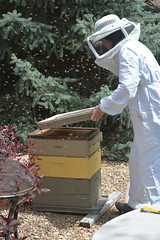
The weather has been finally getting really hot, in the mid to high 90's for a few days, and I knew that I had to get better ventilation into the hive for those weeks when it would be close to 100. The hard part of it all is that I have to replace the bottom board to do so.
There might have been other ways? But I've did this both years when I had my last hive, and I liked having the bottom board be sealed when the colony was small and needed fewer entrances to defend. It was obvious, from watching the bees coming in and out each day, that they had good numbers to defend themselves, now. Plus, the girls might need more room, so I prepared a super with another eight frames for them to build on and fill that would fit above the deeps that I was leaving for them to keep full of honey, pollen, and brood.
Showing posts with label queen bee. Show all posts
Showing posts with label queen bee. Show all posts
Monday, July 10, 2017

Friday, May 5, 2017
Queen Release
It paid off.
Putting the mini-marshmallow in instead of having to dig the cork out later. I did like I did last time, and waited three days to make sure they'd all settled in before I went into the hive in order to figure out if the Queen had made it out and if there were things I had to do in order to get the missing frame back in.
There were things I had to do, the girls were really busy.
Putting the mini-marshmallow in instead of having to dig the cork out later. I did like I did last time, and waited three days to make sure they'd all settled in before I went into the hive in order to figure out if the Queen had made it out and if there were things I had to do in order to get the missing frame back in.
There were things I had to do, the girls were really busy.
Monday, May 1, 2017
The Girls are Back in Town
Murdoch's called last week to say that the bees would be in town on May 1st, and that I'd have 24 hours to pick them up. Then yesterday, Sunday, they called to say that people could pick them up Sunday afternoon/evening as well as Monday; but since I wasn't actually expecting them, I didn't get the message until today. And they said that we could pick them up until 5pm today.
So we went there a little before 2pm, as I had 911 all morning. It was kind of a rough set of incidents, including one with a suicidal father whom the dispatchers called directly to get him out of the house without weapons... that worked out; but it was odd to listen through.
But it was good to be with John and getting the girls.
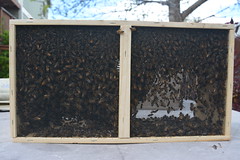 They came in the standard wire box. When we went into the store to pick them up, the customer care guy told us that we had to go around back, as they didn't want people bringing their bees through the store itself. I kind of blinked at that, and I guess I understood, but at a gut level I was just laughing. Homeless bees are harmless, but people react badly to stinging insects, I guess.
So we went round back, and they had a few dozen of the wired cages in the back, with the lovely buzzing of warm bees. The weather had been freezing over the weekend, with snow and ice and all that, so yesterday they'd been a lot more quiescent, and the lady back there was saying that they were a lot more active with the warm weather. I got to pick my box, and I tried for the one where they were clumped up most closely to the queen. They'd definitely accepted her and were hanging near her to keep her warm, and there were fewer dead bodies at the bottom.
So I picked them up, took them to the back of our car, and we put them in a crate that would hold any droppings that happened, and we went and got Jet from school. *laughs*
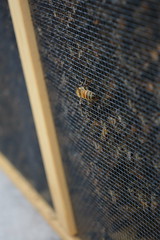 As always, there were always a few bees hanging out on the outside of the cage, but they stayed there while we were in transet, as they had the last time I'd gotten them, so there was no worry about that. Jet got in at school and was cheerful enough about sitting in the back seat. They were back in the hatchback of the car, and there were no worries. He asked if he could help, but there really wasn't much for him to do.
John mostly kept me focussed on the checklist, what it was I had to do, and I knew the steps were pretty straightforward, i.e. take out the can, get the queen out, put a marshmallow in for the plug, and then get her into the hive. Pour all the workers on top, and then try and get a feeder onto it so that they would have something to eat. I also put the can into the hive, so that they would have that as a source of food as well. The hive was full of old comb, so I figured they'd have plenty to walk around on, there would be ready-made insulation, and old comb is attractive to bees.
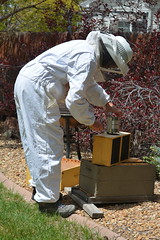 It was easier the second time. A lot easier. I knew what to expect, and knew how docile the girls really would be. So when the can came out and they zoomed out of the box, it was easy for me to ignore the sounds and the little insect brushing and bouncing against my hands and all my gear. The can came out easily with the hive tool, and only a few of them clung to it, and they moved readily when I set the can down on the tops of the frames in the box.
I think they could smell the comb, so they dropped down into the rows quickly.
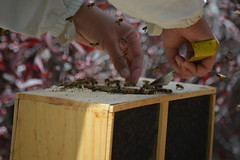 For some reason, the whole things was a lot more tightly secured than it had been the previous box I'd had. And the band holding the queen's cage into the box was more deeply inset into the wood. I had to really pry to get the tab to come up, but it was double folded and I had no problems holding onto it in order to work it free from the slot it had been put into. Having all the bees crawling all over my hands was really kind of cool. *laughs*
I know most people wouldn't say that, but I really loved it; and loved knowing that I wasn't going to react badly to it. I was very carefully suppressing any urge to swat or wave at the girls; and it was kind of fun knowing that I didn't have to in a way. I trusted them, and they rewarded the trust by not ever stinging me or making the move that was a prelude to a sting.
The tab was actually of such sharp metal that it cut into the wood, so I had to work it free at different angles.
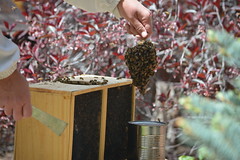 When she came out, she came out with a lot of attendants. So many that I had to give the whole cluster a little shake to get them to drop into the hive. I always worry about damaging the queen when I do that, so I was really careful about it. And when I could finally get a good grasp on the cage and turn it around to actually look at her, she looked just fine.
She's really active, and it looked like she was really doing well in there.
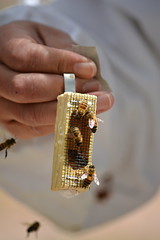 Last time I'd just hung her in the hive and decided to worry about removing the plug later, and it had been kind of a pain to get it out the second time when the bees had already decided it was their home. So this time, instead, I dug the cork out to begin with, and I stuffed a mini marshmallow into the hole, like the instructions said to do. It kind of peels off the outsides and squishes into the hole really well and really stickly. *laughs*
The idea is to just keep the queen in the hive until everyone had decided that this is going to be their home. She usually sticks with the workers once they've established the hive, and they stick with her while she's stuck in the cage. And the idea is that she and her workers will eat at the candy plug until they can free her and clean her off. This way they release her eventually.
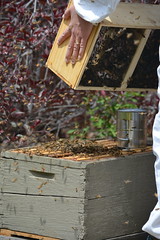 The other thing I did differently than last time was that this time I actually shook all the girls out onto thier home, rather than waiting patiently for them to figure it out by just sticking the wire box into the hive top. I thought about it, but decided not to, but I also did the second deep so that they could still keep the can of sugar syrup from the traveling case in the hive with them for the first couple of nights.
I may well remove that and the second deep if it gets too cold at night. They also have a feeder on top, with about a quart of simple syrup up there. I'll have to check it soon and probably refill it as soon as they're done with it. Though the spring here has been wet recently, so there should be plenty of bloom for them to forage off of. Still, it was snow, which can freeze off a lot of bloom. Still, the dandelions are popping everywhere, and there should be more stuff sooner rather than later.
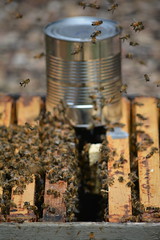 They were everywhere, and there were one or two actually chasing me already. I'm not sure what that bodes? But they had the angry sound, which I was more used to in the deeper end of summer.
We actually have the box in a different part of the yard than where they'll end up staying; but we have people coming on Monday to put the solar panels back up on the roof. So we had to put the hive in a place that would be out of the way and keep the workers out of the flight path.
I loved being able to just stand in the cloud of bees, though, and they were doing fine with where they'd ended up. I made sure that the queen cage was facing out the right way, and the spacing looked right for what they had in there. They also all seemed to find good footing, and were happy to get into and onto all the comb that they could find and clean it all out. There had been some wax month damage on the waxed frames I'd kept from the end of the hive three years ago. There can't be mites and I'd frozen them, but then put them back out into the garage, and the wax months had found them again.
 I put the feeder on top, then the top board, and finally the telescoping tin lid to keep everything else off. *laughs*
This time I had the snow brush to brush all the girls into the box before I placed anything anywhere. That was really good to have this time. *laughs* The things I learned from the mistakes of the previous time. I often think that if one is just lucky the first time, you don't get to learn what you actually did *right* the same way you get to learn what you did wrong from the mistakes of the previous time.
That seems to always be true, no matter the endeavour.
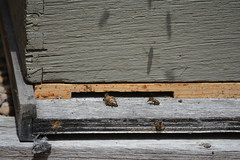 By the time I was done, they were already doing orienting flights from the front entrance. I have the restrictor on, at mid length, as the temps at night are still in the high 30's. Not super warm, but also not terribly cold. They should be able to defend this size entrance.
It was amazing how satisfying it was to just see happy, healthy bees orienting on the hive entrance.
I went and adjusted a few things, putting a deep box on the top instead of the medium one, and having to leave a crack between it and the feeder to begin with because so many of the girls were using the crack as an entrance at the start. I also put the shipping cage into the shade behind the hive.
When the sun started to go down behind some clouds, all the bees who were in the cage got into the hive, and fewer and fewer were wandering outside, and I finally just went over and closed the gap, with bare hands and no protective gear. With the gap closed, too, they were keeping more heat in the hive, which is important these first few nights.
I'm really grateful that ours didn't come two weeks ago, the way the Boulder Beekeepers' bees came. With the snow and temperatures in the 20's, I would have had a hard time worrying about them. As it is, now, while it's near freezing at night, I know they should be all right.
So we went there a little before 2pm, as I had 911 all morning. It was kind of a rough set of incidents, including one with a suicidal father whom the dispatchers called directly to get him out of the house without weapons... that worked out; but it was odd to listen through.
But it was good to be with John and getting the girls.
So we went round back, and they had a few dozen of the wired cages in the back, with the lovely buzzing of warm bees. The weather had been freezing over the weekend, with snow and ice and all that, so yesterday they'd been a lot more quiescent, and the lady back there was saying that they were a lot more active with the warm weather. I got to pick my box, and I tried for the one where they were clumped up most closely to the queen. They'd definitely accepted her and were hanging near her to keep her warm, and there were fewer dead bodies at the bottom.
So I picked them up, took them to the back of our car, and we put them in a crate that would hold any droppings that happened, and we went and got Jet from school. *laughs*
John mostly kept me focussed on the checklist, what it was I had to do, and I knew the steps were pretty straightforward, i.e. take out the can, get the queen out, put a marshmallow in for the plug, and then get her into the hive. Pour all the workers on top, and then try and get a feeder onto it so that they would have something to eat. I also put the can into the hive, so that they would have that as a source of food as well. The hive was full of old comb, so I figured they'd have plenty to walk around on, there would be ready-made insulation, and old comb is attractive to bees.
I think they could smell the comb, so they dropped down into the rows quickly.
I know most people wouldn't say that, but I really loved it; and loved knowing that I wasn't going to react badly to it. I was very carefully suppressing any urge to swat or wave at the girls; and it was kind of fun knowing that I didn't have to in a way. I trusted them, and they rewarded the trust by not ever stinging me or making the move that was a prelude to a sting.
The tab was actually of such sharp metal that it cut into the wood, so I had to work it free at different angles.
She's really active, and it looked like she was really doing well in there.
The idea is to just keep the queen in the hive until everyone had decided that this is going to be their home. She usually sticks with the workers once they've established the hive, and they stick with her while she's stuck in the cage. And the idea is that she and her workers will eat at the candy plug until they can free her and clean her off. This way they release her eventually.
I may well remove that and the second deep if it gets too cold at night. They also have a feeder on top, with about a quart of simple syrup up there. I'll have to check it soon and probably refill it as soon as they're done with it. Though the spring here has been wet recently, so there should be plenty of bloom for them to forage off of. Still, it was snow, which can freeze off a lot of bloom. Still, the dandelions are popping everywhere, and there should be more stuff sooner rather than later.
We actually have the box in a different part of the yard than where they'll end up staying; but we have people coming on Monday to put the solar panels back up on the roof. So we had to put the hive in a place that would be out of the way and keep the workers out of the flight path.
I loved being able to just stand in the cloud of bees, though, and they were doing fine with where they'd ended up. I made sure that the queen cage was facing out the right way, and the spacing looked right for what they had in there. They also all seemed to find good footing, and were happy to get into and onto all the comb that they could find and clean it all out. There had been some wax month damage on the waxed frames I'd kept from the end of the hive three years ago. There can't be mites and I'd frozen them, but then put them back out into the garage, and the wax months had found them again.
This time I had the snow brush to brush all the girls into the box before I placed anything anywhere. That was really good to have this time. *laughs* The things I learned from the mistakes of the previous time. I often think that if one is just lucky the first time, you don't get to learn what you actually did *right* the same way you get to learn what you did wrong from the mistakes of the previous time.
That seems to always be true, no matter the endeavour.
It was amazing how satisfying it was to just see happy, healthy bees orienting on the hive entrance.
I went and adjusted a few things, putting a deep box on the top instead of the medium one, and having to leave a crack between it and the feeder to begin with because so many of the girls were using the crack as an entrance at the start. I also put the shipping cage into the shade behind the hive.
When the sun started to go down behind some clouds, all the bees who were in the cage got into the hive, and fewer and fewer were wandering outside, and I finally just went over and closed the gap, with bare hands and no protective gear. With the gap closed, too, they were keeping more heat in the hive, which is important these first few nights.
I'm really grateful that ours didn't come two weeks ago, the way the Boulder Beekeepers' bees came. With the snow and temperatures in the 20's, I would have had a hard time worrying about them. As it is, now, while it's near freezing at night, I know they should be all right.
Monday, June 10, 2013
Inspection After a Month...
... since I did the last inspection, and I figured it was time. So a total of 42 days since installment.
This time I practiced with the smoker beforehand, I went over a game plan with John before I even opened it up, and then we went strictly by the guidelines and boundaries I set down for the whole thing, and it was really good.
I'm realizing, the more I do this, the better it is to have an end in mind before I go in. There's no point in disturbing the girls unless I have a decision point to make, and I need to figure out what it is I'm going to do. There are some books that say that in order to manage a hive properly, you need to go in every week. On the other side, there's several that say that every time you go in, you set them back by a week, and others that say that during good nectar flow in the summer you should never go in or you'll interrupt them badly.
I don't think I did much interrupting today, and it was good to see how far the ladies have gotten in just the month I was away.
 Before we left for China, I'd put a second deep box on top of the first, because the bees had already filled five of the eight frames, and I wanted to give them plenty of room while we were away. Unfortunately, I also knew that they have a tendency to want to go straight up from where they've already established brood or comb, so I needed to know if they'd spread out a little or had simply gone up.
I think another reason I needed the very clear plan before I went in was because I'm still jet-lagged and kind of woozy during the day. Mental processes haven't been as clear or as clean since the trip, between the cold and the drastic time shift. I keep wanting to sleep during the day and waking up at night, even more so than usual, so I've been fighting all that, too.
One of the things was just to get rid of the feeder, because while the sugar water was really good for getting the colony to build up its numbers, the bees were likely to take and store the sugar syrup instead of honey, and it just doesn't hold as well as actual nectar from flowers of all kinds. So I just took the whole top off, put the feeder out on the grass, and trusted that the two workers that were left in it would find their way home.
 It's kind of fun to see the brand-new clean top edges of the new frames that I'd bought from the bee equipment place. Already loaded with foundation, I didn't have to worry about the evenness of how the foundations were built or set.
The first three frames were empty of everything but bees exploring their surfaces. The fourth was partially built on the right side, and the left was facing this particular frame, which is almost entirely built out! I was very happy to see this nearly filled with bees drawing out the wax. It's a clean side, with the wax nearly the same color as the foundation, and you can see through it, so no buildups from brood or anything, yet.
It was interesting to see this frame in contrast to the center one and the ones on either side of that, which were filled with nearly complete brood. Since it's been about a month since I put this box on, if the Queen had gone directly for the first frame when I put it on, there was time enough for a whole round of baby bees to grow up (takes them 21 days to hatch, develop, morph, and break free to fly.
 It was also fun to look down between the slats when I had the empty ones out to see how they were doing on the first box. They'd built out a little more, with two empty frames to the same side as on the top, so they were starting to fill it all up as well as they could, too. I love this picture as it's like a whole carpet of bees...
They seem to be doing quite well, as there are so many of them, but one thing I really did notice was that they were becoming more and more the same. That the all-yellow or all-black workers that I'd started with just weren't there anymore. All the ladies are looking more like sisters, now, with the same pattern of stripes and the same brown fuzzy thoraxes.
The dying workers are being tossed out the front door, too, and I'm seeing more and more of them piled up just off the edge of the entrance. They dry out into these abstract shapes of just the carapace and look almost like dried flower buds.
 The next frame was solid brood. Capped and ready to fly in a week or two. On both sides. There were just a few holes, and I wasn't exactly sure if these were cells that the Queen had missed or if she'd laid in them and these were the first bees to fly. Either way, they were pretty scattered and few, which meant that the mass of the cells had eggs laid in them.
It was pretty intense to see a whole frame that was nothing but brood when it had felt so haphazard the last time I went in for an inspection, but the girls are doing their best to multiply and do it as quickly as their nectar flow and pollen finds allow. They're carrying in legloads of pollen all the time, and it's amazing seeing how much pollen they're finding and using to rear their young.
 On the left, here, is one of the corners of the really crowded frames. It definitely reassured me that she was laying in nearly every cell she could reach, and just missed a few by mistake. It's just chock-full of pupae, who are about ready to be capped and let go to cocoon themselves and grow wings. So many of the workers were head-first into the cells they looked black. I had to study them pretty closely to see that they weren't a problem at all, and had a very good sense of what needed maintaining.
I really loved seeing the open cells again, and being able to distinguish, so easily, which cells were honey and which were brood. I was impressed to see how little they're storing, yet, and how much they're just pumping up the numbers within the colony. It fits the cycle, I think.... where they just up their numbers for a while and then try to store honey away so that they can survive the winter. Luckily, there's a number of fields of weeds nearby that are completely chock-a-block with dandelions. I saw them ALL blooming just a week ago, and the girls have plenty to eat.
The interesting thing was seeing that these frames were duller, more solid than the open, airy, uncapped frame where the light could just shine through. These were solid with developing bees.
 Then I saw this frame. Both sides were like this, where the center was empty, dark, and being cleaned out by the workers. The cell darkens after having held a pupae through larval stage and into adult. I hadn't seen any of this during the first inspection, of course, as they hadn't had the time to get that far.
It was really cool to see it up close, and then I realized that the queen is on this side of this frame! She's surrounded by attendants, and she's laying and she has a black thorax instead of the fuzzy brown one that the workers have. She's the only bee that isn't head-first into a cell... and if you click on the picture, it'll take you to flickr, where I've got her marked. *laughs*
The amazing thing was knowing now that she's re-laying the frames, and putting eggs into used, cleaned cells the way she's supposed to, and that it's going quite well. None of the bees seemed particular disturbed by my moving things around, and no one was attacking me and none of them were particularly agitated by my observations. I hadn't crushed anyone, for all that there were a lot more bees in there. Counting the full frames, the estimates are about half a pound of workers per completely covered frame, so I have approximately six pounds of bees now, about doubling what I started with, even with the loss of all the old workers.
 As a parting shot... *laughs* This bee was fanning furiously, as it was a pretty hot day, and they simply can stand at the top of a frame to fan out the heat. There's a few ventilation holes in the boxes, now, and I'm offsetting them a little to improve air flow. There's also a steady supply of water outside and the top box has a few holes drilled into it.
Given that the workers were starting to explore the frames to the side, and that they'd only really half-filled the boxes I'd given to them, I decided not to add a new super, yet, and let them just do what they were doing.
Over the weekend, one of our neighbors was having a garage sale, and her flowering tree in the front yard was just covered with bees. She's near enough that she was happily saying that she was feeding my girls... *laughs* I loved that. They weren't bothering her or anyone that was going to the sale, staying strictly on the blossoms. And I actually found a flowering cherry tree nearby that was also covered with the girls, so they're doing quite well in our neighborhood. Next up will be the Russian sage, the butterfly bushes, and plenty of summer roses. It's funny how aware I now am of the local flora...
This time I practiced with the smoker beforehand, I went over a game plan with John before I even opened it up, and then we went strictly by the guidelines and boundaries I set down for the whole thing, and it was really good.
I'm realizing, the more I do this, the better it is to have an end in mind before I go in. There's no point in disturbing the girls unless I have a decision point to make, and I need to figure out what it is I'm going to do. There are some books that say that in order to manage a hive properly, you need to go in every week. On the other side, there's several that say that every time you go in, you set them back by a week, and others that say that during good nectar flow in the summer you should never go in or you'll interrupt them badly.
I don't think I did much interrupting today, and it was good to see how far the ladies have gotten in just the month I was away.
I think another reason I needed the very clear plan before I went in was because I'm still jet-lagged and kind of woozy during the day. Mental processes haven't been as clear or as clean since the trip, between the cold and the drastic time shift. I keep wanting to sleep during the day and waking up at night, even more so than usual, so I've been fighting all that, too.
One of the things was just to get rid of the feeder, because while the sugar water was really good for getting the colony to build up its numbers, the bees were likely to take and store the sugar syrup instead of honey, and it just doesn't hold as well as actual nectar from flowers of all kinds. So I just took the whole top off, put the feeder out on the grass, and trusted that the two workers that were left in it would find their way home.
The first three frames were empty of everything but bees exploring their surfaces. The fourth was partially built on the right side, and the left was facing this particular frame, which is almost entirely built out! I was very happy to see this nearly filled with bees drawing out the wax. It's a clean side, with the wax nearly the same color as the foundation, and you can see through it, so no buildups from brood or anything, yet.
It was interesting to see this frame in contrast to the center one and the ones on either side of that, which were filled with nearly complete brood. Since it's been about a month since I put this box on, if the Queen had gone directly for the first frame when I put it on, there was time enough for a whole round of baby bees to grow up (takes them 21 days to hatch, develop, morph, and break free to fly.
They seem to be doing quite well, as there are so many of them, but one thing I really did notice was that they were becoming more and more the same. That the all-yellow or all-black workers that I'd started with just weren't there anymore. All the ladies are looking more like sisters, now, with the same pattern of stripes and the same brown fuzzy thoraxes.
The dying workers are being tossed out the front door, too, and I'm seeing more and more of them piled up just off the edge of the entrance. They dry out into these abstract shapes of just the carapace and look almost like dried flower buds.
It was pretty intense to see a whole frame that was nothing but brood when it had felt so haphazard the last time I went in for an inspection, but the girls are doing their best to multiply and do it as quickly as their nectar flow and pollen finds allow. They're carrying in legloads of pollen all the time, and it's amazing seeing how much pollen they're finding and using to rear their young.
I really loved seeing the open cells again, and being able to distinguish, so easily, which cells were honey and which were brood. I was impressed to see how little they're storing, yet, and how much they're just pumping up the numbers within the colony. It fits the cycle, I think.... where they just up their numbers for a while and then try to store honey away so that they can survive the winter. Luckily, there's a number of fields of weeds nearby that are completely chock-a-block with dandelions. I saw them ALL blooming just a week ago, and the girls have plenty to eat.
The interesting thing was seeing that these frames were duller, more solid than the open, airy, uncapped frame where the light could just shine through. These were solid with developing bees.
It was really cool to see it up close, and then I realized that the queen is on this side of this frame! She's surrounded by attendants, and she's laying and she has a black thorax instead of the fuzzy brown one that the workers have. She's the only bee that isn't head-first into a cell... and if you click on the picture, it'll take you to flickr, where I've got her marked. *laughs*
The amazing thing was knowing now that she's re-laying the frames, and putting eggs into used, cleaned cells the way she's supposed to, and that it's going quite well. None of the bees seemed particular disturbed by my moving things around, and no one was attacking me and none of them were particularly agitated by my observations. I hadn't crushed anyone, for all that there were a lot more bees in there. Counting the full frames, the estimates are about half a pound of workers per completely covered frame, so I have approximately six pounds of bees now, about doubling what I started with, even with the loss of all the old workers.
Given that the workers were starting to explore the frames to the side, and that they'd only really half-filled the boxes I'd given to them, I decided not to add a new super, yet, and let them just do what they were doing.
Over the weekend, one of our neighbors was having a garage sale, and her flowering tree in the front yard was just covered with bees. She's near enough that she was happily saying that she was feeding my girls... *laughs* I loved that. They weren't bothering her or anyone that was going to the sale, staying strictly on the blossoms. And I actually found a flowering cherry tree nearby that was also covered with the girls, so they're doing quite well in our neighborhood. Next up will be the Russian sage, the butterfly bushes, and plenty of summer roses. It's funny how aware I now am of the local flora...
Friday, May 10, 2013
The 12-Day Inspection
In which I learned a great deal about the fact that planning really does help the inspection of a hive, and I actually FIND evidence that the queen is amazing and doing really really well. My husband was wonderful and helped keep me on track and focused for the whole thing, and did an amazing job as cameraman.

But one of the main things I started with was deciding to use smoke for the first time. I had only used sugar water to spray the girls so that they would clean each other off before this. The feeding mechanism makes them full and the belly distension seems to make it impossible for them to sting.
The same mechanism is why smoke works, or so they say. *laughs* There is more lore about bees than I even really want to think about; but smoke makes the girls gorge on honey in case they have to fly away, and when they're full they can't sting. Usually the last thing bees have to worry about when the forest is on fire is a bear intent on eating them.
When I bought my bee suit, I got the smoker, too, and while the discussions on the Boulder beekeeper's list indicated that I might not have to use it, that sugar syrup was better, I decided to do it anyway. During the windy, cold day I was scared that I was going to draw too much heat out of the girls by spraying them with liquid, this way I didn't have to worry about them being wet. The nights are still going down into the 40's, so I thought I'd play it safe.

The smoke worked like a charm, too. When I got the feeder and empty box off the top, they were all well within the slats of the frames, and hovering over their stores. Also, since this time I did it in the middle of the day, on a sunny, calm day, a lot of the workers were out, and the hive itself wasn't quite so full. Still, as you'll see, there were plenty of the girls inside, still, to make it very interesting. You can also see here that the frames were pretty close together, and that there's a much bigger cap between the third and fourth frame from the left. Yes, that's where the doubled comb ended up.
The difference seems minuscule to my eye, too...

This is the next frame over, and you can see that they're building already. A small network of bees drawing comb, and they were drawing equal comb on the matching side of the frame next to it. So they were getting good and busy and building out a pretty good deal. It was interesting that it looked like they'd begun to build where the queen was first caged, and then started spreading from there, eventhough it was off of center by a frame. I guess she really is irresistible to them.

This is pretty typical, with the honey on the outside cells, and capped cells more to the middle with the brood and pollen and the like. You can see that they're all over the faces of this, and each tending to their own thing all at the same time.
It was surprising and really cool to hold these frames up and look at them in sunlight and not really bother the bees at all! I was surprised at how easy it was and how little notice they took when all I was doing was looking at them. They just kept working at all the things they were doing. Another cool thing was seeing how they all varied so much. Some were really dark and others really bright yellow, and I loved seeing the contrast across them all. It made it much harder to actually spot the queen, though! And I found out from Ken that when the Northern Colorado Beekeepers did their buy, they decided to not ask the breeders to mark the queens. It's something that stresses them, so I'm okay with having to be a better beekeeper to find her! *laughs*

I really loved being able to study each and every frame and with John's urgings actually take my time doing it. There were so many bees, and they were festooning all over the frames, building comb as fast as they could.
It turns out that they need a lot of sugar to be able to build wax, and these girls seemed really well supplied as they were building like mad. There were three completely full frames, and three partial ones like the first one that I looked more closely at. And the bees stuck to them all like they were glued in place. Nearly none of the girls took off or fell off, which was a relief for me as I always hated the idea of the queen just falling and getting crushed or something.

I added more smoke in the middle of the inspection because John said that the note of the hive was going up a little, but also because the next frame was the Big One that I'd felt like I'd failed at really looking at the time before.
So I added some more smoke, let the girls settle, and then got my courage together. I moved the frame over a few centimeters, grabbed both sides and removed it from the box, slowly and gently and didn't shake anyone off. One of two of the girls just took of into the air, now and again, but none of them were really bumping into me, or buzzing at that hum that really alerted ALL the "get ready to dodge or duck" instincts. They were pretty content, and doing all right. I also wasn't breaking any comb the way I had last time...

The bright orange cells are filled with pollen! Which is what they need to feed brood, which meant that they were raising brood, so that was my Really Good Sign.
I still couldn't see under the wax to see if the queen was there or laying, and I was mildly frustrated by that, until I got to take a very close look at the lower corner of the other side of this frame...

If you go to this picture and look into the uncapped cells around and under the bees, you'll see little white rings of larvae!!!
I was so happy to see them. I was just so relieved to actually see them, big, fat, glossy and happy. And the texture of the caps next to them meant that there were probably hundreds, if not thousands, of workers all laid, growing, and sealed off to cocoon and develop into bees! But it was amazing to see that the laying pattern was such that the queen was probably hitting every single cell, and putting eggs into all of them. The swarms of workers here were feeding, capping, cleaning, and otherwise caring for the babies. I also love that you can see one of the nearly transparent all-yellow workers in this shot too, a little above the center.

No pushed around bees. No angry bee, nothing that seemed to make any of them any unhappier than they were.
I was even able to give the broken off piece of comb to a kid that was fascinated by them, and he loved seeing how it fit together and how it broke. *grins*
The amazing thing to me was seeing it all go back together without any problems at all. And it gave me the courage to just go through the rest of the box!

So this is the last of the built frames, and it's about two-thirds full, which I was really happy to see. The workers on this one are "festooning"... where they're all kind of linked together, and connected up in order to build comb in a synchronized fashion. For some reason it seems to make it easier for them to build the stuff when they're all doing it at once.
And, of course, they were completely ignoring me and John, who had the camera and no protective clothing but a veil. We got the veils from a couple of friends of ours who had bought them for a Halloween costume party. They had no use for them, so when they heard that I was going to actually keep bees, they sent me the veils!

But I basically scootched (that's a technical term!) the frames over until they were as close as they could get with the workers still between them, and finally fit all the frames into the box. Since they'd built out six of the eight frames to some extent, I decided to add another box of frames on top. It would just give them more room. I also set up more sugar syrup and a watering station for them, with a tray filled with sand and rocks that could get water from our automated drip irrigation! So they'll have water and everything else, too!
So this second inspection was much, much, much more successful than the first, and I was so relieved about being able to see real evidence of the queen being just fine that I just collapsed for a while. Adrenalin and relief are a potent dose. *laughs* It's been twelve days since the queen was released, so I guess this is as good a time as any to see that she's been doing well.
Monday, May 6, 2013
Fail on Trying to Check on the Queen
I had a pretty thorough failure today, and with some thought and research, I am realizing why I failed to really find any evidence that the queen was in residence or laying, and there are multiple reasons.
Let's go through exactly what I did, first, and then what it was that really went wrong and where I lost heart and what I want to do about it the next time I go into the hive.
First off, I didn't get any pictures because I did it on my own while John was at some meeting that evening. So I didn't have my usual backup; however, I'd also gotten the mistaken impression that I should go in five days after the queen was released. I don't know where I got that number, and one Gabriel Petrut commented much later on one of my latter posts that one should wait until plenty of comb has been built, at least a week, if not more to give the queen time to go. I also read, later, that one shouldn't disturb the hive too much in the first ten days (after installation? After queen release? I'm not sure) or else the workers might ball the queen. Gah!
So I went in today. I put on all my equipment, went out to the box fairly late in the day, as my son was busy inside. The weather was windy, cloudy, and just a bit rainy, sprinkling even on an on again and off again basis. And the girls seemed crankier with the weather. I did use sugar syrup in a spray to calm them down now and again, but it was rougher going than the installation or the queen release.
I wasn't sure, at the time, if it was just because I was more nervous without my husband along, or if it was just me... and not the bees...
But I only had the one box. I had an empty box above, to keep a zip-loc bag of sugar syrup with holes in it. The feeder box had been leaking, so we'd taken it off, cleaned it out, dried it, and resealed it. but it was still drying, and I thought I needed to see what was going on.
I didn't really think things through, and just lifted one of the middle frames first. Something gave and then broke, and I was holding a frame with a lot of bees on it. I looked at both sides, and definitely saw honey and deep gold pockets all through the comb, a lot of the center was capped, but the edges were open, and when I looked closely, I couldn't see anything in the cups that I could recognize.
Then I was horrified to find that the next frame over was doubled up on comb! They'd actually attached a whole extra sheet of comb to one side of the frame, so I had absolutely no means of looking under it to see the bees that were hidden in the pocket between! I was so flummoxed by this that I had to stop and breathe for a bit. I broke off one of the pieces experimentally, and the bees got pretty angry with that, no duh, because I was breaking their home.
So I put it back, very slowly, as the bigger mass of comb meant that the frame was too big to fit into its usual slot, and a whole cascade of workers was pushed onto the top of the next frame! I was upset about that, too, and just decided to stop there and close things ups. I hadn't found specifics of her being there or not being there, and it really made me kind of obsessed for the next week, as I didn't want to bother them again. We did feed them, did fix the feeder and get plenty of straight syrup to them, but I didn't dare go in for another week plus...
Afterwards I did this research:
Let's go through exactly what I did, first, and then what it was that really went wrong and where I lost heart and what I want to do about it the next time I go into the hive.
First off, I didn't get any pictures because I did it on my own while John was at some meeting that evening. So I didn't have my usual backup; however, I'd also gotten the mistaken impression that I should go in five days after the queen was released. I don't know where I got that number, and one Gabriel Petrut commented much later on one of my latter posts that one should wait until plenty of comb has been built, at least a week, if not more to give the queen time to go. I also read, later, that one shouldn't disturb the hive too much in the first ten days (after installation? After queen release? I'm not sure) or else the workers might ball the queen. Gah!
So I went in today. I put on all my equipment, went out to the box fairly late in the day, as my son was busy inside. The weather was windy, cloudy, and just a bit rainy, sprinkling even on an on again and off again basis. And the girls seemed crankier with the weather. I did use sugar syrup in a spray to calm them down now and again, but it was rougher going than the installation or the queen release.
I wasn't sure, at the time, if it was just because I was more nervous without my husband along, or if it was just me... and not the bees...
But I only had the one box. I had an empty box above, to keep a zip-loc bag of sugar syrup with holes in it. The feeder box had been leaking, so we'd taken it off, cleaned it out, dried it, and resealed it. but it was still drying, and I thought I needed to see what was going on.
I didn't really think things through, and just lifted one of the middle frames first. Something gave and then broke, and I was holding a frame with a lot of bees on it. I looked at both sides, and definitely saw honey and deep gold pockets all through the comb, a lot of the center was capped, but the edges were open, and when I looked closely, I couldn't see anything in the cups that I could recognize.
Then I was horrified to find that the next frame over was doubled up on comb! They'd actually attached a whole extra sheet of comb to one side of the frame, so I had absolutely no means of looking under it to see the bees that were hidden in the pocket between! I was so flummoxed by this that I had to stop and breathe for a bit. I broke off one of the pieces experimentally, and the bees got pretty angry with that, no duh, because I was breaking their home.
So I put it back, very slowly, as the bigger mass of comb meant that the frame was too big to fit into its usual slot, and a whole cascade of workers was pushed onto the top of the next frame! I was upset about that, too, and just decided to stop there and close things ups. I hadn't found specifics of her being there or not being there, and it really made me kind of obsessed for the next week, as I didn't want to bother them again. We did feed them, did fix the feeder and get plenty of straight syrup to them, but I didn't dare go in for another week plus...
Afterwards I did this research:
- Studied a number of YouTube videos showing brood cells and their difference from honey cells.
- Realized that most inspections are done on sunny, calm days, in the middle of the day.
- Figured out that I should pull out one of the completely empty side frames, first.
- Realized that I really needed to try out the smoker instead of just the sugar syrup spray.
- Realized it would be easier with my husband as moral support, because emotional support really helped with the adrenaline rush and the tunnel vision effects while I'm still very new to this.
- Looked up the development stages of the larvae and realized that I REALLY had to give the queen more time before I looked for capped brood, as it would be at least eight days until they'd be developed enough to cap.
- Counted the days from the release to figure out what to look for when.
- Had another beginner beekeeper open a 'messed up hive' with comb being built so that it connected two frames! Eek. But learned from him that none of the experienced keeps had any specific advise to offer him, other than to make sure that the frames of any supers were spaced correctly, 3/8ths of an inch between frames.
- Sat back and realized that the doubled comb was not THAT big a deal. It was all right if I couldn't find the queen if I could find viable brood.
Friday, May 3, 2013
Release the Queen!
Three days after I installed the bees, I had to release the queen. She was still in her cage, being seen to by her attendents, and with her caught in the hive, the other bees wouldn't leave her and would do their best to stick with her. But after two or three days, she had to be let out so that she could lay eggs for new workers so that they could get on with the business of being a hive.
 I decided to do it in the evening, when it had started to cool on that side of the building, and there was a little wind so that the bees wouldn't be too active, and since I had to make sure that the queen stayed in her cage until I got her to the hive, I gloved up. Thin gloves, which might not have actually stopped a sting, but gloves nonetheless.
The feeder was also leaking, so we wanted to check it to see how much syrup was in it and time what we were going to do to it. It really had to come out sometime, be cleaned, dry out, and then be resealed and the sealing had to be allowed to set. So it was going to be a matter of a few days.
John did a little research and figured out that a simple Ziploc bag could be used to hold the syrup. Small slits would be cut into it and the bees could reach the syrup through the slits if they were at the top surface of the bag. There were dozens of bees in the feeder, and plenty of syrup still, so we decided to wait until night time to do that particular transfer since that Sunday night it wasn't supposed to get below the high 40's. It was in the high 70's during the day and felt wonderful. So the first hurdle was one we didn't have to take.
 I had set up all my tools, and everything I thought I'd need on a chair by the hive, including one of the windshield brushes that one uses to brush snow off a windshield. It was going to be my bee brush, after almost crushing a few girls last time I remembered I had a brush and could use it.
I removed an empty frame, moved it to the side, and then slid the other frames a little off kilter so that I could get to the queen cage, which was still rubber-banded to one of the central frames. I very carefully got the metal tab that was sticking out and picked up the cage, which was completely covered with attendant bees.
The brush was really great for getting those girls off the cage so that I could take a pair of needle nose pliers and take the cork out of the cage. It came out really easily, and I stuck my thumb over the hole, until I could bend over and put the cage, hole side down, into the hive.
In one of the YouTube videos, the queen just comes right out. When I had her up and could see her, she looked active, healthy, and ready to rumble. She was pacing back and forth inside the tiny area. But when I put the cage into the hive, worker bees crowded into her Majesty's chamber. They just charged right in and I couldn't figure out if she'd left or not! I stood there, just holding the cage in the milling crowd of bees as they got gradually louder and louder and...
 That's when I remembered that I had my sugar syrup spray bottle. I got it out and spritzed everyone a few times and all the ladies calmed right down. A little sweetness goes a long way with these girls.
So I just crouched there for a while longer, hoping that she had already come out. All the workers in the hive were really active, and I got a good look inside. There were already huge layers of beeswax built on the base in the frames. I was really amazed at seeing that, as they'd only had three days, and after seeing the leaf of comb that was in the shipping box, I'd expected them to have only been able to build that much. It seems that with the bases already there and only having to draw out comb, these girls could build a whole lot more quickly.
I knew that snow was coming Tuesday night and for all of Wednesday, so it was good that they were getting their insulation in. Plus, the Queen, when she decided to go, would now have cells to lay eggs into. Eventually, I just laid the queen cage on the top of a few of the frames, so that the entrance/exit was open and she could come out when she damned well pleased, if she hadn't already. Or the workers could get out as well. I just left it there, and started to put the hive back together again.
 Shuffling all the frames back into place was pretty easy. I just did it slowly and gradually, and all the bees got out of the way. The fuller ones amazed me with their weight and size and mass. And there were a few frames that were at the wrong distance, not quite the right bee distance apart, so I shifted them either closer or further depending on what they needed before I put the frame I'd taken out back into the box.
I was amazed at seeing the amount of activity that was going on, and it was just fun to work through things when I had all my protective gear on and I didn't have to worry about consequences. I buttoned things up after that, getting the feeder back on and with the brush it was easy to get the lid and telescoping lid back on, without crushing anyone.
 On Monday night, we went in, took the feeder, got the sugar syrup sack in and then closed it up again. They were just humming along quietly to themselves, and we did it all without any equipment at all. They weren't at all upset, and it was beautifully warm all day.
On Tuesday morning I finally got the queen cage out, as she'd left it and there were just four worker bees hanging out in it. I brushed them off and shook them out and finally got it out of there. I'd also seen some bees landing and trying to fight with my girls. I know there's another hive in the neighborhood, so expected a little robbing and exploration between the hives.
Also, since I knew that on Tuesday night and Wednesday morning, the weather was going to be in the low 20's and cold, that it would probably be a good idea to restrict the entrance a little, instead of leaving it wide open. The more open the bottom entrance is, the more air flow there is through the hive. It's a wonderful thing in the height of the summer, but bad for cold weather. Also a more restricted entrance gives the bees in the hive less space they have to defend in order to keep intruders out. The bottom board came with an entrance restriction bar, so I asked John to put it in that night, and he did. I late read, on the beekeepers' association mailing lists, that that is all you really do need to do for cold weather.
 And it was a good thing, too....
It snowed nearly a foot here in Longmont, and today it's been melting.
In the midst of all that one of my crowns came off of the stump of a tooth it was protecting while I was flossing at night. I freaked out a little, until John could get it back into my mouth in the right direction. And I had to fit the dentist's chair, to get it glued back in, amid two other appointments.
And it was a good thing, too....
It snowed nearly a foot here in Longmont, and today it's been melting.
In the midst of all that one of my crowns came off of the stump of a tooth it was protecting while I was flossing at night. I freaked out a little, until John could get it back into my mouth in the right direction. And I had to fit the dentist's chair, to get it glued back in, amid two other appointments.
Luckily the last of those was a massage with Bonnie, and that really helped even out a rough day. Then, this morning, I went in for training as a volunteer administrative assistant for the local 911 dispatchers. It was pretty overwhelming at first, trying to learn everything pertaining to my job at once, but I think I have a general handle on what's going on. What's best, though, is that my boss in the department was the same man who answered my question about how often to spray sugar syrup on my caged bees!! *laughs* He's a keeper! And has eight viable hives scattered around the city. Wow. It's like it was meant to bee. XD
The feeder was also leaking, so we wanted to check it to see how much syrup was in it and time what we were going to do to it. It really had to come out sometime, be cleaned, dry out, and then be resealed and the sealing had to be allowed to set. So it was going to be a matter of a few days.
John did a little research and figured out that a simple Ziploc bag could be used to hold the syrup. Small slits would be cut into it and the bees could reach the syrup through the slits if they were at the top surface of the bag. There were dozens of bees in the feeder, and plenty of syrup still, so we decided to wait until night time to do that particular transfer since that Sunday night it wasn't supposed to get below the high 40's. It was in the high 70's during the day and felt wonderful. So the first hurdle was one we didn't have to take.
I removed an empty frame, moved it to the side, and then slid the other frames a little off kilter so that I could get to the queen cage, which was still rubber-banded to one of the central frames. I very carefully got the metal tab that was sticking out and picked up the cage, which was completely covered with attendant bees.
The brush was really great for getting those girls off the cage so that I could take a pair of needle nose pliers and take the cork out of the cage. It came out really easily, and I stuck my thumb over the hole, until I could bend over and put the cage, hole side down, into the hive.
In one of the YouTube videos, the queen just comes right out. When I had her up and could see her, she looked active, healthy, and ready to rumble. She was pacing back and forth inside the tiny area. But when I put the cage into the hive, worker bees crowded into her Majesty's chamber. They just charged right in and I couldn't figure out if she'd left or not! I stood there, just holding the cage in the milling crowd of bees as they got gradually louder and louder and...
So I just crouched there for a while longer, hoping that she had already come out. All the workers in the hive were really active, and I got a good look inside. There were already huge layers of beeswax built on the base in the frames. I was really amazed at seeing that, as they'd only had three days, and after seeing the leaf of comb that was in the shipping box, I'd expected them to have only been able to build that much. It seems that with the bases already there and only having to draw out comb, these girls could build a whole lot more quickly.
I knew that snow was coming Tuesday night and for all of Wednesday, so it was good that they were getting their insulation in. Plus, the Queen, when she decided to go, would now have cells to lay eggs into. Eventually, I just laid the queen cage on the top of a few of the frames, so that the entrance/exit was open and she could come out when she damned well pleased, if she hadn't already. Or the workers could get out as well. I just left it there, and started to put the hive back together again.
I was amazed at seeing the amount of activity that was going on, and it was just fun to work through things when I had all my protective gear on and I didn't have to worry about consequences. I buttoned things up after that, getting the feeder back on and with the brush it was easy to get the lid and telescoping lid back on, without crushing anyone.
On Tuesday morning I finally got the queen cage out, as she'd left it and there were just four worker bees hanging out in it. I brushed them off and shook them out and finally got it out of there. I'd also seen some bees landing and trying to fight with my girls. I know there's another hive in the neighborhood, so expected a little robbing and exploration between the hives.
Also, since I knew that on Tuesday night and Wednesday morning, the weather was going to be in the low 20's and cold, that it would probably be a good idea to restrict the entrance a little, instead of leaving it wide open. The more open the bottom entrance is, the more air flow there is through the hive. It's a wonderful thing in the height of the summer, but bad for cold weather. Also a more restricted entrance gives the bees in the hive less space they have to defend in order to keep intruders out. The bottom board came with an entrance restriction bar, so I asked John to put it in that night, and he did. I late read, on the beekeepers' association mailing lists, that that is all you really do need to do for cold weather.
Luckily the last of those was a massage with Bonnie, and that really helped even out a rough day. Then, this morning, I went in for training as a volunteer administrative assistant for the local 911 dispatchers. It was pretty overwhelming at first, trying to learn everything pertaining to my job at once, but I think I have a general handle on what's going on. What's best, though, is that my boss in the department was the same man who answered my question about how often to spray sugar syrup on my caged bees!! *laughs* He's a keeper! And has eight viable hives scattered around the city. Wow. It's like it was meant to bee. XD
Friday, April 26, 2013
Getting and Installing the Bees
Several years ago I took the Boulder County Beekeepers' Association class for how to keep bees. It was in the Boulder County Farming co-op and it was in the dead of winter. They told us all about the thousand ways bee colonies can be killed and how to do your best to slow down the death... So I didn't really seriously think about it for quite some time. Last year, one of the big Denver pollination and honey outfits died, and they were selling their equipment for cheap, and I got six boxes, a feeder, a queen excluder, and a telescoping top for $100... Yes, the class told me everything about why getting used equipment was a bad idea, but... it was so inexpensive, and I just wanted to try. Succeeding wasn't so much the point, as just actually having the courage to try.
There's a long story about a swarm that ended up in a chimney that escaped my boxes, but it ended up with me wanting to order a package of bees this spring. I made a mistake, doing to the BCBA's forum pages, and instead of buying a package from Tom and Miles, I accidentally bought a package of Minnesota Hygenics from the Northern Colorado Beekeepers' Association. *laughs* Which delivered their beauties on Tuesday, in the midst of snow, and with a night in the low 20's to come.
 We'd been having snow pretty much every week, nearly a foot of it for each of the last three storms, so this was a portion of our 'front yard' when we pulled out of the driveway. The good thing was that the streets and sidewalks had cleared and dried, eventhough it had snowed all morning! It was pretty cold, and the drive out to Severance is nearly a full hour out. John was kind enough to do the driving, and let me worry in the passenger seat.
Even before ordering these bees there were rumors that many of the queen rearing companies were having difficulties filling full orders of three pounds of worker bees to go with their queens. And I was recalling all the twenty thousand ways it seemed that one could kill off ones bees! *laughs* The Northern Colorado Beekeepers' Association was assured that their California Supplier was capable of doing the full packages, no problem and they were right.

They were allowing people to pick up packages from about 7 am, and this is what was left by a bit after noon. They'd started with over 460 boxes, or somewhere between five to six million bees!!
Each of the "packages" is that wooden box, there's a can of sugar syrup in there hanging down, and there's small holes poked through the bottom so that the bees can feed from them. The small metal tab to the left of each of the cans is connected to the queen's cage, which hangs in the midst of the ball of worker bees.
They take care of her, feed her, keep her cool, and ball around her to protect her while they're without a home. The box makes it really easy to hold them, no protection necessary, and it's an amazing thing to just stand there and hold ten thousand bees at once, hearing them hum.
 One of the amazing things was that there were hundreds of 'free' bees hanging out in the garage, just hanging from some of the garage door windows, and people were joking about those being the ones I'd bought and that I could just gather them up and keep them. But they were just hanging out with the beekeepers.
Watching some of the videos of people keeping bees, it always seemed like magic that they could go out there and do what they do with minimal protection and maybe just a veil. Going into a cloud of bees seemed to incredibly crazy, there's this visceral reaction to that sound of insects buzzing. But it was amazing, with the cage, to see that there were five workers who had clung to the outside of the cage and just stayed there. Even when I picked it up and walked around with it and stuck it in the truck of our car, they just stuck with their sisters. No problem. I tried blowing them off, and all of the bees started to hum at a higher pitch. So I just left them.
We took them home and since it was going to be in the lower twenties that night, we kept them in our basement to stay warm. There was still plenty of syrup, so I let them just be, and when they were in the darkness of the basement after the sun went down, they went utterly quiet. I'm starting to realize what "domesticated" means with these creatures. I had to keep them in the house the next day, too, as the next night was going to be freezing as well, but not quite as bad, and Thursday was going to be really warm, so it would be easy to install them then, and the next four days and nights were promising to be really nice.
But I fretted for most of the day as it felt like the syrup can had been emptied and I was supposed to spray sugar syrup on them, but didn't have a great idea as to how often and then what were they going to do about water? *laughs* I worried a lot, but John and Jet put up with me.
One of the intriguing things was realizing that honeybees have a unique smell to them. It's sweet, heavy, a little musky, almost like how "golden" should smell. It was most noticeable in the garage with all those bees, but after the ladies had stayed in a small room in the basement for a while, it was easy to distinguish from other scents.
Then lots of stuff happened to land on Thursday. I was signed up for and had a lot of fun fun working a stint at the church rummage sale. I got called to meet with the publicity director for Longmont Safety in order to interview for a 4 hours a week volunteer position with their 911 group, and I realized I had a dentist appointment, too. So between the rummage sale and the interview, I decided to install the bees!

It was beautiful and sunny out and nearly all the snow had melted, so I went out with all my equipment and got to work.
John primed me with a YouTube video with a keeper who did the whole installation without any protective equipment whatsoever, but I really wanted to use the suit and veil since I had them. I figured if I was more confident, it wouldn't hurt and I'd still be able to move carefully. I did, however, consciously decide not to use any gloves. I didn't want to fumble the queen, and was ready to risk a few stings for the control I wanted to have.
It turned out to be a good choice, and it was kind of amazing how easy it was. The video will give you a sense of what it was like, live, as they were buzzing pretty good in the warm sunshine on the gravel in front of the hive. I jiggled out the syrup can and then the air was filled with bees!
 Here's the box with the can out, and bees were everywhere. It's one thing to be told that it's all right, and that they aren't just going to attack you. It's a whole other thing to be standing feeling the wind of their passage, hearing the heavier, louder, higher pitched buzz now that they were out, and fighting that instinct so that I could move smoothly and slowly. But they were moving like they were just exploring, figuring out where they were, what they were going to do. It was pretty heady stuff to have them everywhere and realize that it was very much doable for me to work calmly right there and do the right thing.
With the tab as far along the slot as it was with these boxes, there was no chance that I was going to drop the queen into the mass of bees the way he did. I gently lifted the tab, worked it along the slot, and got her and her cage out with no problems. There was a mass of attendants around her, and I gently shook them off so that I could see her. She was fine. Alive, looking around, and touching the mesh. There was mesh on just one side of her box, so I turned that toward the open space between frames, and rubber-banded the box in so she'd stay near the top, and gently put the frame back into the box.
There were a good number of bees already in among the frames. Since there was beeswax on all the bases, they were already feeling at home in there, so I just tipped the box they came in on its side over the frames, and set another empty deep around the cage.
 The opening for the cage was a little close to one of the walls, so I reached in with bare hands and moved the cage over. They were crawling everywhere and humming. One bee made it inside my veil at this point and was buzzing in my ear. *laughs* I ignored her, and just moved the cage so that the opening had more room.
There were hundreds of bees still behind the mesh buzzing away and disorganized now that a bunch of them had gotten out. While they'd been waiting in the basement, they'd hung onto each other around the can and the queen cage. With both of those gone, they were a little upset and looking for a way out.
The beauty of putting the cage in on top of the frames was that I didn't have to shake them all out. It's a gentler way of letting them get out on their own. I put all the sugar syrup I had into the feeder, and put it on top of the top deep, and then added the telescoping lid. The feeder has an opening directly to the rest of the hive, and with the lid other bees and wasps can't get at the syrup.
The amazing thing to me was that the bee in my bonnet never stung me, and when I finally let her go, out of the veil, she hung around me for a little while longer, as if to check me out and then finally flew off. The adrenaline rush was pretty amazing, when I finally got to sit down and shake a little. *laughs*
John was pretty impressed with the whole thing, and enjoyed taking his pictures, and realizing that he could walk into the cloud of bees and not even get touched if he moved slowly enough.
After all that, I aced the interview with the police department. The lady doing the gating pretty much talked with me for ten minutes and decided that I'd be perfect for what they needed. Most of their volunteers are a little too afraid of the computers, and this was a lovely station with five screens and more machines underneath than I had the time to count. I also got to meet the head of the department and shake her hand and that was pretty much good enough, it seemed. It's a pretty simple job, but one that requires time and concentration, and just half a day about once a week. So it should be pretty straightforward to do.
 I actually fell asleep doing the teeth cleaning. I didn't get much the last couple of nights, especially with the anxiety over feeding them. So... uhm.. yeah. Jet also wanted sweet potato noodles for dinner, so as soon as I was home, I was roasting sweet potatoes and the three of us made noodles that night. Enough to eat and then the rest of the dough to dry for our own sweet potato pasta.
It costs eight dollars a pound at Pappardelle's, and this morning we stored a pound, dry, after eating half again as much the night before. It probably cost us a little more than a dollar to make, and when I cooked the sweet potatoes, I accidentally left the center a little firmer than fully cooked, and grated the insides with a box grater to skin them easily (the skins don't like going through the grater). So there were small pieces of sweet potato in the pasta. The wonderful thing about that was that it really intensified the flavor in the noodles!
 This morning when the sun was up but hadn't gotten to the garden, yet, over the trees, I went out to water the garden and none of the bees were out. They were quiet and completely docile. John even opened the top to take a look to see if they needed more syrup, and it was completely empty.
While they were that quiet we decided to just lift the lid and pull out the traveling box. There was one big ball of bees on one side between the wall and the box. They'd started to dot the whole box with wax, and inside the box all there were were the bees that had died traveling and one leaf of fresh bees wax. This one. It was gorgeous and so very light. But as you can see in this picture, the sunlight went right through it and you can see the intersections of the walls so that each cell most strongly supports the other, front and back as well as side to side.
The piece was surprisingly strong. Since the feeder was completely empty, I cooked up more sugar syrup and after it had cooled enough, went out to put it in. The sun had gotten much higher and it was much warmer and the bees were out in force.
I was a little frightened to open the thing up. But I told myself I was a wuss, and just barehanded and headed, I got up the telescoping lid, and poured the syrup into the feeder. A few of the bees were underneath the raft, cleaning up the last of the sticky syrup of the day before, and they rolled out with the flood of syrup, grabbed the wood of the raft and pulled themselves out. Other workers rushed over to help clean them off, and it was kind of funny and amazing, too.
All of them were pretty agitated and even more so when I tried to brush a few off the edges so that I could put the lid back on. I really should just find one of those windshield brushes to gently brush them off with that instead of trying to use the hive tool to take them off. The hard tool crunched one a little, and the whole cloud suddenly started buzzing at a much higher pitch. It took a gut check to keep going, but I really wanted to get the lid back on, and it took a few tries before it was on straight and I didn't think I was crushing any MORE workers.
So I just stood there, in the midst of zinging bees that were bouncing off of my sweater, and just swallowed the fear and did it. Again, none of them stung me, and I was forcibly reminded that these are domesticated bees. Still... I think that I'm going to put more syrup in tonight, after it's dark, when they're all in their sleeping ball and out of the feeder, instead of doing it mid-day again.
And when I actually free the queen from her cage, it's going to be in full gear. Probably no gloves again, just 'cause I really don't want to crush her and I'm going to have to use something to get that cork out. The two or three days are so that they can get used to her and so that they know that this is home and their hive. So I think it'll be fireworks one more time, I can put another brood box over the one that's there, and then I can leave them for another five days to a week before checking to see if the queen's laying and doing her thing.
Afterward, John checked the internets and figured that we have about ten thousand bees out there. Three pounds of bees is anywhere from ten thousand to twelve thousand workers. That's a LOT of bees. I think that they all made me very very present in the time I was there. *laughs* If anyone ever needs a method of meditation that stops all wandering thoughts, I'd suggest going out to visit the bee box with no protection whatsoever.
There's a long story about a swarm that ended up in a chimney that escaped my boxes, but it ended up with me wanting to order a package of bees this spring. I made a mistake, doing to the BCBA's forum pages, and instead of buying a package from Tom and Miles, I accidentally bought a package of Minnesota Hygenics from the Northern Colorado Beekeepers' Association. *laughs* Which delivered their beauties on Tuesday, in the midst of snow, and with a night in the low 20's to come.
Even before ordering these bees there were rumors that many of the queen rearing companies were having difficulties filling full orders of three pounds of worker bees to go with their queens. And I was recalling all the twenty thousand ways it seemed that one could kill off ones bees! *laughs* The Northern Colorado Beekeepers' Association was assured that their California Supplier was capable of doing the full packages, no problem and they were right.
They were allowing people to pick up packages from about 7 am, and this is what was left by a bit after noon. They'd started with over 460 boxes, or somewhere between five to six million bees!!
Each of the "packages" is that wooden box, there's a can of sugar syrup in there hanging down, and there's small holes poked through the bottom so that the bees can feed from them. The small metal tab to the left of each of the cans is connected to the queen's cage, which hangs in the midst of the ball of worker bees.
They take care of her, feed her, keep her cool, and ball around her to protect her while they're without a home. The box makes it really easy to hold them, no protection necessary, and it's an amazing thing to just stand there and hold ten thousand bees at once, hearing them hum.
Watching some of the videos of people keeping bees, it always seemed like magic that they could go out there and do what they do with minimal protection and maybe just a veil. Going into a cloud of bees seemed to incredibly crazy, there's this visceral reaction to that sound of insects buzzing. But it was amazing, with the cage, to see that there were five workers who had clung to the outside of the cage and just stayed there. Even when I picked it up and walked around with it and stuck it in the truck of our car, they just stuck with their sisters. No problem. I tried blowing them off, and all of the bees started to hum at a higher pitch. So I just left them.
We took them home and since it was going to be in the lower twenties that night, we kept them in our basement to stay warm. There was still plenty of syrup, so I let them just be, and when they were in the darkness of the basement after the sun went down, they went utterly quiet. I'm starting to realize what "domesticated" means with these creatures. I had to keep them in the house the next day, too, as the next night was going to be freezing as well, but not quite as bad, and Thursday was going to be really warm, so it would be easy to install them then, and the next four days and nights were promising to be really nice.
But I fretted for most of the day as it felt like the syrup can had been emptied and I was supposed to spray sugar syrup on them, but didn't have a great idea as to how often and then what were they going to do about water? *laughs* I worried a lot, but John and Jet put up with me.
One of the intriguing things was realizing that honeybees have a unique smell to them. It's sweet, heavy, a little musky, almost like how "golden" should smell. It was most noticeable in the garage with all those bees, but after the ladies had stayed in a small room in the basement for a while, it was easy to distinguish from other scents.
Then lots of stuff happened to land on Thursday. I was signed up for and had a lot of fun fun working a stint at the church rummage sale. I got called to meet with the publicity director for Longmont Safety in order to interview for a 4 hours a week volunteer position with their 911 group, and I realized I had a dentist appointment, too. So between the rummage sale and the interview, I decided to install the bees!
It was beautiful and sunny out and nearly all the snow had melted, so I went out with all my equipment and got to work.
John primed me with a YouTube video with a keeper who did the whole installation without any protective equipment whatsoever, but I really wanted to use the suit and veil since I had them. I figured if I was more confident, it wouldn't hurt and I'd still be able to move carefully. I did, however, consciously decide not to use any gloves. I didn't want to fumble the queen, and was ready to risk a few stings for the control I wanted to have.
It turned out to be a good choice, and it was kind of amazing how easy it was. The video will give you a sense of what it was like, live, as they were buzzing pretty good in the warm sunshine on the gravel in front of the hive. I jiggled out the syrup can and then the air was filled with bees!
With the tab as far along the slot as it was with these boxes, there was no chance that I was going to drop the queen into the mass of bees the way he did. I gently lifted the tab, worked it along the slot, and got her and her cage out with no problems. There was a mass of attendants around her, and I gently shook them off so that I could see her. She was fine. Alive, looking around, and touching the mesh. There was mesh on just one side of her box, so I turned that toward the open space between frames, and rubber-banded the box in so she'd stay near the top, and gently put the frame back into the box.
There were a good number of bees already in among the frames. Since there was beeswax on all the bases, they were already feeling at home in there, so I just tipped the box they came in on its side over the frames, and set another empty deep around the cage.
There were hundreds of bees still behind the mesh buzzing away and disorganized now that a bunch of them had gotten out. While they'd been waiting in the basement, they'd hung onto each other around the can and the queen cage. With both of those gone, they were a little upset and looking for a way out.
The beauty of putting the cage in on top of the frames was that I didn't have to shake them all out. It's a gentler way of letting them get out on their own. I put all the sugar syrup I had into the feeder, and put it on top of the top deep, and then added the telescoping lid. The feeder has an opening directly to the rest of the hive, and with the lid other bees and wasps can't get at the syrup.
The amazing thing to me was that the bee in my bonnet never stung me, and when I finally let her go, out of the veil, she hung around me for a little while longer, as if to check me out and then finally flew off. The adrenaline rush was pretty amazing, when I finally got to sit down and shake a little. *laughs*
John was pretty impressed with the whole thing, and enjoyed taking his pictures, and realizing that he could walk into the cloud of bees and not even get touched if he moved slowly enough.
After all that, I aced the interview with the police department. The lady doing the gating pretty much talked with me for ten minutes and decided that I'd be perfect for what they needed. Most of their volunteers are a little too afraid of the computers, and this was a lovely station with five screens and more machines underneath than I had the time to count. I also got to meet the head of the department and shake her hand and that was pretty much good enough, it seemed. It's a pretty simple job, but one that requires time and concentration, and just half a day about once a week. So it should be pretty straightforward to do.
It costs eight dollars a pound at Pappardelle's, and this morning we stored a pound, dry, after eating half again as much the night before. It probably cost us a little more than a dollar to make, and when I cooked the sweet potatoes, I accidentally left the center a little firmer than fully cooked, and grated the insides with a box grater to skin them easily (the skins don't like going through the grater). So there were small pieces of sweet potato in the pasta. The wonderful thing about that was that it really intensified the flavor in the noodles!
While they were that quiet we decided to just lift the lid and pull out the traveling box. There was one big ball of bees on one side between the wall and the box. They'd started to dot the whole box with wax, and inside the box all there were were the bees that had died traveling and one leaf of fresh bees wax. This one. It was gorgeous and so very light. But as you can see in this picture, the sunlight went right through it and you can see the intersections of the walls so that each cell most strongly supports the other, front and back as well as side to side.
The piece was surprisingly strong. Since the feeder was completely empty, I cooked up more sugar syrup and after it had cooled enough, went out to put it in. The sun had gotten much higher and it was much warmer and the bees were out in force.
I was a little frightened to open the thing up. But I told myself I was a wuss, and just barehanded and headed, I got up the telescoping lid, and poured the syrup into the feeder. A few of the bees were underneath the raft, cleaning up the last of the sticky syrup of the day before, and they rolled out with the flood of syrup, grabbed the wood of the raft and pulled themselves out. Other workers rushed over to help clean them off, and it was kind of funny and amazing, too.
All of them were pretty agitated and even more so when I tried to brush a few off the edges so that I could put the lid back on. I really should just find one of those windshield brushes to gently brush them off with that instead of trying to use the hive tool to take them off. The hard tool crunched one a little, and the whole cloud suddenly started buzzing at a much higher pitch. It took a gut check to keep going, but I really wanted to get the lid back on, and it took a few tries before it was on straight and I didn't think I was crushing any MORE workers.
So I just stood there, in the midst of zinging bees that were bouncing off of my sweater, and just swallowed the fear and did it. Again, none of them stung me, and I was forcibly reminded that these are domesticated bees. Still... I think that I'm going to put more syrup in tonight, after it's dark, when they're all in their sleeping ball and out of the feeder, instead of doing it mid-day again.
And when I actually free the queen from her cage, it's going to be in full gear. Probably no gloves again, just 'cause I really don't want to crush her and I'm going to have to use something to get that cork out. The two or three days are so that they can get used to her and so that they know that this is home and their hive. So I think it'll be fireworks one more time, I can put another brood box over the one that's there, and then I can leave them for another five days to a week before checking to see if the queen's laying and doing her thing.
Afterward, John checked the internets and figured that we have about ten thousand bees out there. Three pounds of bees is anywhere from ten thousand to twelve thousand workers. That's a LOT of bees. I think that they all made me very very present in the time I was there. *laughs* If anyone ever needs a method of meditation that stops all wandering thoughts, I'd suggest going out to visit the bee box with no protection whatsoever.
Subscribe to:
Posts (Atom)