I have bought a new colony from, of all places, Murdoch's Ranch and Home Supply....
They had a poster right there on their shelves, with a web address that I could go to to just order them and they'd bring them to our store, which is only ten minutes from my house. It was so darned convenient. They're supposed to arrive at the end of this month.
I've cleaned up and setup a deep for them, with waxed frames from the old colony. I think it'll help them get setup.
I'll write more when I actually get them.
Friday, April 21, 2017

Monday, October 13, 2014
Saying Goodbye to the Bee Girls
As posted on ursulav's livejournal:
“Last night as I was sleeping,
I dreamt – marvelous error!–
that I had a beehive
here inside my heart.
And the golden bees
were making white combs
and sweet honey
from my old failures.”
— Antonio Machado
I went out last weekend, in the sunshine, to find a cloud of active, healthy bees around my hive. John and I were happy for a moment, thinking that they were actually orienting bees, and the mite treatment had worked, but it turned out that it was a healthy colony robbing out the last dregs of my poor hive...
They killed off the very last bees in my hive, and were taking all the honey that they could take, which is actually kind of good for them, as it'll help them survive this fall, and the winter. The poor last spots of brood were dead or dying from lack of care, and it was just all pretty much gone.
A failure, truly, and I think I have a little more of an idea as to what went on. The mites were taking over badly, and the cold weather after I'd taken off the last super really didn't allow for there to be much nectar around. There was honey in the brood chambers, so they shouldn't have just starved, but the cold probably made it hard for them to get around, and there was no pollen to be had. Maybe if I'd put pollen patties on? I dunno, as some people really advise against it because it seems to signal spring to some brood, but it would have been what they needed when they needed it. Plus, I'd seen pesticide die off on the front step, so some of the girls had gotten into something they really shouldn't have.
It would have been better if I'd been able to treat them with mite treatment when I actually had ordered the stuff, 2-day postage, but they were unable to fulfill the order for nearly three weeks. So I was stuck and then the weather went freezing for another three days before I could go in. Better yet was if I'd gotten the Mite Away and actually applied it in July when I saw mite drop. Next time. Next time...
Honey from my failures...
Anyway... John and I pulled all the boxes that night, except for the lowest brood box that had half a dozen tiny native bees who were living on the honey and wax that night. They left in the morning, and I got everything into the garage. We just dumped all the foundation with pollen and the spotty dead brood, in case there was pesticide in the pollen, and cleaned off all the frames, and the remaining eight drawn comb full height foundation frames I've been rotating through our deep freeze to kill of wax moths, and then store, sealed in bags, in the garage for the next time I actually get bees.
Tim Brod is a local bee breeder, and he supplies queens, not so much workers, but it might be fun to buy from him next time, instead of from California. Someone kept saying that I should find a wild hive and claim it for my own, but I'm not going to bother native bees that are comfortable in their own habitat. A swarm? Maybe. But not an established colony.
In any case, I now have the winter off as a beekeeper, and the surprising thing is that while I have mourned the girls, and burned offerings in their memory. I loved having them a lot, but it's also something of a relief not to have to worry about them anymore... when there's a cold snap, I don't have to wonder how it's affecting them, and when it gets hot, I don't have to worry about how much ventilation they're getting.
Anyway... I was very glad I had them while I had them, and grateful to them for all they did for me and taught me. And I promise that if/when I get another colony, I'll start posting here again. Thanks for reading...
“Last night as I was sleeping,
I dreamt – marvelous error!–
that I had a beehive
here inside my heart.
And the golden bees
were making white combs
and sweet honey
from my old failures.”
— Antonio Machado
I went out last weekend, in the sunshine, to find a cloud of active, healthy bees around my hive. John and I were happy for a moment, thinking that they were actually orienting bees, and the mite treatment had worked, but it turned out that it was a healthy colony robbing out the last dregs of my poor hive...
They killed off the very last bees in my hive, and were taking all the honey that they could take, which is actually kind of good for them, as it'll help them survive this fall, and the winter. The poor last spots of brood were dead or dying from lack of care, and it was just all pretty much gone.
A failure, truly, and I think I have a little more of an idea as to what went on. The mites were taking over badly, and the cold weather after I'd taken off the last super really didn't allow for there to be much nectar around. There was honey in the brood chambers, so they shouldn't have just starved, but the cold probably made it hard for them to get around, and there was no pollen to be had. Maybe if I'd put pollen patties on? I dunno, as some people really advise against it because it seems to signal spring to some brood, but it would have been what they needed when they needed it. Plus, I'd seen pesticide die off on the front step, so some of the girls had gotten into something they really shouldn't have.
It would have been better if I'd been able to treat them with mite treatment when I actually had ordered the stuff, 2-day postage, but they were unable to fulfill the order for nearly three weeks. So I was stuck and then the weather went freezing for another three days before I could go in. Better yet was if I'd gotten the Mite Away and actually applied it in July when I saw mite drop. Next time. Next time...
Honey from my failures...
Anyway... John and I pulled all the boxes that night, except for the lowest brood box that had half a dozen tiny native bees who were living on the honey and wax that night. They left in the morning, and I got everything into the garage. We just dumped all the foundation with pollen and the spotty dead brood, in case there was pesticide in the pollen, and cleaned off all the frames, and the remaining eight drawn comb full height foundation frames I've been rotating through our deep freeze to kill of wax moths, and then store, sealed in bags, in the garage for the next time I actually get bees.
Tim Brod is a local bee breeder, and he supplies queens, not so much workers, but it might be fun to buy from him next time, instead of from California. Someone kept saying that I should find a wild hive and claim it for my own, but I'm not going to bother native bees that are comfortable in their own habitat. A swarm? Maybe. But not an established colony.
In any case, I now have the winter off as a beekeeper, and the surprising thing is that while I have mourned the girls, and burned offerings in their memory. I loved having them a lot, but it's also something of a relief not to have to worry about them anymore... when there's a cold snap, I don't have to wonder how it's affecting them, and when it gets hot, I don't have to worry about how much ventilation they're getting.
Anyway... I was very glad I had them while I had them, and grateful to them for all they did for me and taught me. And I promise that if/when I get another colony, I'll start posting here again. Thanks for reading...
Tuesday, September 30, 2014
Drat...
Went in today to put the MiteAway strips on the top bars of the bottom of the two brood boxes. I also took the feeder off and wanted to put the super back on with the emptied frames so that the the bees could take the leftover honey off of them.
And when I opened it up, I found very very few bees in the box. The top box was practically empty. The honey in the feeder was about half gone, and while there were a few bees up there, there weren't that many. It was a shock given how many bees there were earlier this month.
Nearly all the bees in the bottom box were between three frames on the southwest side of the bottom brood box. There weren't that many of them, but they all looked healthy, and while some had mites on them, there weren't any of the crippled wingless ones. There were bees going in and coming out of the hive, at a pretty good rate, which is partially why I was so surprised to find so few bees in the box.
When I removed the sticky board on the bottom, there was a lot of wax flakes, a lot of bee heads, and a couple of hive beetles (sighs). That isn't good, either. I suspect that the really strong wasp and hornet nests nearby took their toll on the girls, as the wasps pretty much bite their heads off.
I'd been seeing some sign of pesticide die off, as nearly every morning there were a handful of the girls on their backs, feebly waving their legs in the air on the entrance board. On cold mornings there were a lot more dead than on relatively warm mornings. I wonder if they'd brought back some poisoned pollen? I don't know.
The boxes were also pretty heavy, still, so there was honey in the frames the bees had. A number of the local keepers have experienced starving because August and September were far colder and rainier than the local flora is used to having, so they haven't been producing as much nectar. So they've been feeding at a pretty good clip. So they weren't dying off simply because I wasn't good about feeding them... there's just something else going on, and I'm kind of sad to see it.
I left the open mesh bottom board on because of the mites, to get rid of them, but maybe the ventilation is too much and it was too cold for them? Anyway, there seem to be a myriad of possible reasons, and no real way of sorting them all out. So I just put the strips on for the ladies that were left, and if I get their mite problem taken care of, and reduce them to a single, well-honeyed brood box, it might give them a little more of a chance. But this winter really looks like it's going to be a harsh one, so I don't give them much of a chance with such small numbers before even getting into winter.
It's kind of a shock, but it's also kind of to be expected, as the local keepers have been writing, lately on our email list, about what a horrible end to the season it's been. The losses are huge already, and the mite loads have been crazy. Plus, the feeding/lack of flow problem, and a lot of keepers are already losing a lot of colonies. One lady even found an abandoned apiary that she was asking for help to clean out... so it's kind of sad all around.
And when I opened it up, I found very very few bees in the box. The top box was practically empty. The honey in the feeder was about half gone, and while there were a few bees up there, there weren't that many. It was a shock given how many bees there were earlier this month.
Nearly all the bees in the bottom box were between three frames on the southwest side of the bottom brood box. There weren't that many of them, but they all looked healthy, and while some had mites on them, there weren't any of the crippled wingless ones. There were bees going in and coming out of the hive, at a pretty good rate, which is partially why I was so surprised to find so few bees in the box.
When I removed the sticky board on the bottom, there was a lot of wax flakes, a lot of bee heads, and a couple of hive beetles (sighs). That isn't good, either. I suspect that the really strong wasp and hornet nests nearby took their toll on the girls, as the wasps pretty much bite their heads off.
I'd been seeing some sign of pesticide die off, as nearly every morning there were a handful of the girls on their backs, feebly waving their legs in the air on the entrance board. On cold mornings there were a lot more dead than on relatively warm mornings. I wonder if they'd brought back some poisoned pollen? I don't know.
The boxes were also pretty heavy, still, so there was honey in the frames the bees had. A number of the local keepers have experienced starving because August and September were far colder and rainier than the local flora is used to having, so they haven't been producing as much nectar. So they've been feeding at a pretty good clip. So they weren't dying off simply because I wasn't good about feeding them... there's just something else going on, and I'm kind of sad to see it.
I left the open mesh bottom board on because of the mites, to get rid of them, but maybe the ventilation is too much and it was too cold for them? Anyway, there seem to be a myriad of possible reasons, and no real way of sorting them all out. So I just put the strips on for the ladies that were left, and if I get their mite problem taken care of, and reduce them to a single, well-honeyed brood box, it might give them a little more of a chance. But this winter really looks like it's going to be a harsh one, so I don't give them much of a chance with such small numbers before even getting into winter.
It's kind of a shock, but it's also kind of to be expected, as the local keepers have been writing, lately on our email list, about what a horrible end to the season it's been. The losses are huge already, and the mite loads have been crazy. Plus, the feeding/lack of flow problem, and a lot of keepers are already losing a lot of colonies. One lady even found an abandoned apiary that she was asking for help to clean out... so it's kind of sad all around.
Monday, September 22, 2014
Record Keeping
Mostly to say that today I treated the hive again with powdered sugar, as I'm still waiting on the beekeeping supply place to ship my mite control strips. *sighs*
I also put all the uncapped honey into the sugar syrup feeder I usually put on near this time of the year, and fed it back to the colony. I don't make mead, I don't really use honey quickly enough to use all the uncapped stuff I got out of the super, but I had to take the super off in order for the colony to fill its brood box. This way the girls will still get the benefit of their labor. It was actually pretty close to the density of honey, so I don't feel like it's feeding them something watered down that will bring on dysentery. And it was nearly five pounds of the stuff, so it'll just help them that much more for the winter.
Also pulling and replacing the sticky board which has a pretty large number of mites, so any treatment won't hurt.
Oh! And I got another half a gallon from the very last harvest. I wasn't expecting much, so it was nice to just see what I could get.
I also put all the uncapped honey into the sugar syrup feeder I usually put on near this time of the year, and fed it back to the colony. I don't make mead, I don't really use honey quickly enough to use all the uncapped stuff I got out of the super, but I had to take the super off in order for the colony to fill its brood box. This way the girls will still get the benefit of their labor. It was actually pretty close to the density of honey, so I don't feel like it's feeding them something watered down that will bring on dysentery. And it was nearly five pounds of the stuff, so it'll just help them that much more for the winter.
Also pulling and replacing the sticky board which has a pretty large number of mites, so any treatment won't hurt.
Oh! And I got another half a gallon from the very last harvest. I wasn't expecting much, so it was nice to just see what I could get.
Monday, September 1, 2014
Final Harvest
On Saturday I went in and took the last eight super frames, I think the theory is that if the beekeeper takes all the supers off by the end of summer, the bees will still have the time, through the fall, to put in honey supplies in all the brood chambers. Two frames weren't built at all, four were half-built and half-filled and uncapped, and then the last two were completely full and capped. So the last two are the only ones I can jar to sell, the others might not be dehydrated enough for common consumption.
The local keepers say to use it for mead, and I may well do that as my husband's a brewer.
I also saw my first mite-damaged bee that had been in larval stage with the mite larva, i.e. her wings were stunted and she couldn't fly. I did another powdered sugar treatment, and changed out the sticky board. There's a LOT of mites on the board, so I've invested in some of the Mite Away formic acid strips for when the weather finally goes under 70 for a week at a time. It's time to bring out the chemical means to deal with the mites. They're just so thick on the poor girls now it was making me a little unhappy.
Still... about 60 pounds of honey from one hive for a year is really good. I've now given my yearly gifts to the neighbors that directly deal with the girls, and I'm starting to sell the honey to the rest of the neighborhood and my church. Mostly just through personal connections, since I don't process in a commercial kitchen. I think that's one reason why I'll never go beyond just the one hive, as I really don't want to get a license and have to do all the things a business would have to do. Honey for my friends and family is plenty.
 I've also been using the diluted honey for brewing ginger ale, just soda pop, no alcoholic content. I simmer the ginger with a lemon and its juice as well as honey and sugar. Then I take the resultant tisane and water it down to make a gallon and add an 1/8 tsp of plain old bakers' yeast (actually instant yeast so I don't have to be careful rehydrating it). Then I give it a little time to dissolve the yeast, shake it up, bottle it, cap the bottles and wait a day or two and then I have highly carbonated ginger ale that isn't all that sweet, as the yeast has eaten most of the sugars, but it had the flowery hint from the honey over the bite of real ginger.
We've been bottling our own root beer too, with the same yeast, and there's something about the brew that slows down the yeast, so it takes three or four days before the root beer's ready, and only a day or two for the ginger ale. But hey, cheap, all-natural soda pop is fun. *grins*
 In case anyone's interested in the recipe: 2 1/2 ounces coarsely grated ginger, 2/3 cup honey, 2 cups sugar, one lemon squeezed of its juice, and about 2 quarts of water. Put all that together in a pot (including the two lemon peel halves), and bring to a boil. Turn down the heat, let simmer for about 25 minutes, and then turn off the heat, cover and let cool for at least an hour. Pour through a sieve and a funnel into a gallon jug, add water to fill to a gallon and alternate cold and hot tap water to make the resultant liquid 100 degrees Fahrenheit. Add 1/8 tsp instant yeast (not regular dried yeast or live cake yeast, if you use the regular dried yeast, give it 10 minutes in a cup of warm sugared water first before tossing it in), cap the jug, shake a few times. Then bottle it and cap it, and put it out in the garage in the summer/in a warm area for a day or two and then test to see if the carbonation suits you. Makes 10 12 oz bottles and 1 8 ounce bottle.
The local keepers say to use it for mead, and I may well do that as my husband's a brewer.
I also saw my first mite-damaged bee that had been in larval stage with the mite larva, i.e. her wings were stunted and she couldn't fly. I did another powdered sugar treatment, and changed out the sticky board. There's a LOT of mites on the board, so I've invested in some of the Mite Away formic acid strips for when the weather finally goes under 70 for a week at a time. It's time to bring out the chemical means to deal with the mites. They're just so thick on the poor girls now it was making me a little unhappy.
Still... about 60 pounds of honey from one hive for a year is really good. I've now given my yearly gifts to the neighbors that directly deal with the girls, and I'm starting to sell the honey to the rest of the neighborhood and my church. Mostly just through personal connections, since I don't process in a commercial kitchen. I think that's one reason why I'll never go beyond just the one hive, as I really don't want to get a license and have to do all the things a business would have to do. Honey for my friends and family is plenty.

We've been bottling our own root beer too, with the same yeast, and there's something about the brew that slows down the yeast, so it takes three or four days before the root beer's ready, and only a day or two for the ginger ale. But hey, cheap, all-natural soda pop is fun. *grins*

Friday, August 15, 2014
Another Two Gallons
The girls have been very productive, indeed... and I've been kind of remiss about actually recording everything.
In July, on the 25th, I actually pulled four frames, or one and a quarter gallons of honey, from the bottom of the two supers I had on the hive, and I swapped the positions of the supers, so that they'd work on the "lower" and half-full super before they worked on the upper one. John and I scraped clean the four frames, and the next morning I put them all back in to let the bees clean them off.
 Then, this month, on August 12th, I pulled the other four frames from the upper super, and found out that they'd half built and filled one of the empties I'd put in in July. The super that was now on the bottom was about three-quarters full. So I pulled three full frames out of that, and left the five half-filled ones, putting the half-built frame from the upper into the lower, and added the two frames that were still empty from the upper super.
Then I took the upper super completely off the hive, to help the colony compact a little before fall. I'm going to have to have all the supers off before winter and before I do my mite treatment, so it's better to get them used to a little smaller space. But I also wanted to shuffle through the frames as we emptied them to allow the bees to clean all the honey off of them.
It took us two days to get the first three frames cleaned off, and by then, the girls had actually built comb up on one of the 'empty' frames. They'd also completely filled the top super with bees, who were busily building and filling! Agh. I pulled that frame out, put it by the entrance to let the bees empty it of the uncapped honey, and I managed to shuffle in the three empty frames, and then after taking a night off to Estes Park, we came back and I shuffled in two more of the empty frames. Tonight we're finally emptying the last two, and I hope to get those in tomorrow, along with the wax built one, hopefully for the other one that was in there from yesterday, but it's been a little crazy going in every day. They don't seem to mind that much so long as I don't leave the hive open too long.
And it looks like two more gallons of honey.
 I also saw some hornets and wasps stealing honey and trying to rob the hive, but the girls were having none of that. I've left a lot of things open for ventilation for the summer, but with the nights getting longer and cooler, I'm probably going to remove the summer shims from the inner cover and put in my usual winter popsicle sticks that just allow ventilation and no actual insects through. The girls have taken to lining the inside of the outer cover and completely covering the bottom of the inside cover with bees just to defend those slots. So I'm going to close those up tomorrow. I think that, also, the two brood boxes aren't quite meeting, but I also have a single knothole in the back of the hive that the girls have been using as a second entrance for the last two years.
I had a lot of fun just squashing wasps and hornets when they touched down on the honey in my empties tray and as soon as I could ID 'em, I'd squash 'em.
Anyway... that's more than four gallons of honey this year, or something like 50 pounds already. That's a LOT of honey. I got 40 all together last year. So the "common knowledge" that a colony usually does better its second year is already true for this one.
In July, on the 25th, I actually pulled four frames, or one and a quarter gallons of honey, from the bottom of the two supers I had on the hive, and I swapped the positions of the supers, so that they'd work on the "lower" and half-full super before they worked on the upper one. John and I scraped clean the four frames, and the next morning I put them all back in to let the bees clean them off.
Then I took the upper super completely off the hive, to help the colony compact a little before fall. I'm going to have to have all the supers off before winter and before I do my mite treatment, so it's better to get them used to a little smaller space. But I also wanted to shuffle through the frames as we emptied them to allow the bees to clean all the honey off of them.
It took us two days to get the first three frames cleaned off, and by then, the girls had actually built comb up on one of the 'empty' frames. They'd also completely filled the top super with bees, who were busily building and filling! Agh. I pulled that frame out, put it by the entrance to let the bees empty it of the uncapped honey, and I managed to shuffle in the three empty frames, and then after taking a night off to Estes Park, we came back and I shuffled in two more of the empty frames. Tonight we're finally emptying the last two, and I hope to get those in tomorrow, along with the wax built one, hopefully for the other one that was in there from yesterday, but it's been a little crazy going in every day. They don't seem to mind that much so long as I don't leave the hive open too long.
And it looks like two more gallons of honey.
I also saw some hornets and wasps stealing honey and trying to rob the hive, but the girls were having none of that. I've left a lot of things open for ventilation for the summer, but with the nights getting longer and cooler, I'm probably going to remove the summer shims from the inner cover and put in my usual winter popsicle sticks that just allow ventilation and no actual insects through. The girls have taken to lining the inside of the outer cover and completely covering the bottom of the inside cover with bees just to defend those slots. So I'm going to close those up tomorrow. I think that, also, the two brood boxes aren't quite meeting, but I also have a single knothole in the back of the hive that the girls have been using as a second entrance for the last two years.I had a lot of fun just squashing wasps and hornets when they touched down on the honey in my empties tray and as soon as I could ID 'em, I'd squash 'em.
Anyway... that's more than four gallons of honey this year, or something like 50 pounds already. That's a LOT of honey. I got 40 all together last year. So the "common knowledge" that a colony usually does better its second year is already true for this one.
Wednesday, June 18, 2014
A Surprise Harvest
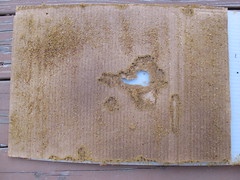
Still, the girls were going strong, and I wanted to see where they were. Also, the top of my two deep brood boxes was filled with old frames that had wood that was starting to come apart. So I wanted to swap out some of the old frames for new ones and move the frames with brood still in them more to the edge so that I could, eventually, take them out, too. A long, slow process, but I figured I'd start by pulling one of the honey-filled frames in that box and substitute in a new frame.
I also wanted to see how they were doing with the new super, how far they'd gotten. The last time I'd looked, they'd only started building comb in the box. I had had a queen excluder between the brood box and the supers, but I pulled it out in impatience during the last inspection, as last year the queen hadn't left the established brood chamber at all, so I hoped that she wouldn't this year either.
I was well rewarded with my hope.
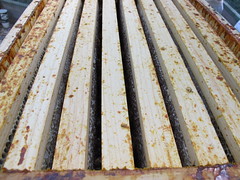
I was pretty amazed. Last year, when the bees first came and were establishing themselves, they had managed to fill three-quarters of one brood box by this time, and there wasn't even the thought of supers or honey that I could harvest at the this point, but it was pretty clear that they were doing really well right now. One of the keepers on the local email lists had said that the local yellow clover was going crazy with the unusually damp spring, so that we should all expect a lot of nectar flow. I still hadn't quite expected *this*.
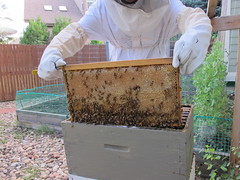
I'll probably do the shift the next time I go into the brood box, but it's good to just get the frame in. A local keeper had just done a study where he found that the keepers that just left all the old brood comb and frames in the box were less likely to have a die off than those that regularly circulated out old frames. It was a correlation, not causation, so he doesn't know why the die offs were less with old comb. Just that those with those tendencies had those results. So I'm unlikely to switch out a lot. And thinking it through some more I probably should have just worked to swap out the broken frame. Next time...
Still... this time I stole a bit more honey, and hopefully made a bit more room for the bees to fill in the brood box. They don't seem in any more of a situation where they will swarm, so this should just help that.
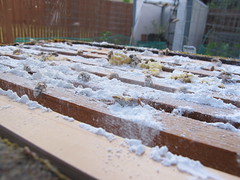
It's also kind of fun to see all the powdered "ghost" bees zooming around, though it does kind of perturb the poor girls. I do see a much higher mite count on the bottom board when I do this than when I don't, which probably just means that they're pulling more mites off each other and themselves when I do this. I'm supposed to do it on a weekly basis to really do a good job of it, but I just don't manage to get into the hive that often. Things are so busy during the summer. But I am happy that I remembered to do it while I did have the brood box open. There have been times when I've had the sugar all ready for it and I just totally forget in the midst of the adrenaline rush of having the hive open.
I will admit that with practice the adrenaline rush is getting easier to handle. I'm now able to observe while I have the hive open, when at the beginning, it was just so overwhelming. Now I know better what to do, what to expect, how to do it, and how to keep the girls from getting crushed or not worrying too much when two or three of them do get damaged. So I'm not quite as exhausted by the time I'm done doing the work that I outlined for myself. I'm still impressed by the super experienced keeps who can go through eight hives at a shot when they're in a beeyard. Practice really does make perfect.
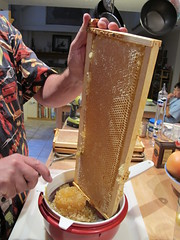
When he was done scraping the two frames, I put my equipment on and popped the two frames, still coated in honey, back into the top super. It should make it more attractive to the bees, and they may get going on building those up quickly with the incentive. The old empty frame I put next to the hive, and that night some creature dragged it away from the hive to try and eat it. But the plastic foundation foiled it and I let the girls clean it off the next day. Also the next day John put the pan of mashed wax out by the hive, so that the bees could eat some of the honey, but it was so hot out there that the whole pan just melted. One bee got caught, but that was it, and it cooled with the evening, so when I found it, the wax had solidified into a cake on top of a pool of pure honey. We poured that honey into another jar, and it's great. There are two jars from John's mashing that are pretty cloudy and I'm afraid he got more wax into them than I usually like having. We'll see how it settles, as the wax should come to the top. Eventually. *laughs*
For a beginning of the summer harvest, we got three quarts and another two-thirds of a pint, so about ten pounds of honey. Given than I'd gotten 40 pounds from this colony last year, I wouldn't be surprised if I got a lot more honey this year than last. But they also started a lot faster and were at great numbers even in March, so I'm just watching them very closely to make sure they have no reason to swarm.
Subscribe to:
Posts (Atom)