During the inspection I'd done on the 19th, I had half a dozen BIG larvae out of their comb in the middle of the area between the two deep brood boxes. I was worried that I'd just killed a bunch of queen larvae, but they were all together. It turns out that if the hive is making queens, they usually spread them around the box, half a dozen of them. And the only way I could tell if they were really doing that was by doing in and looking through the whole top box, which is where most of the new eggs and larvae now are.
I had one objective on the 19th, which was to get the screened bottom board in and give the hive the ventilation it needed. On the 20th, I wanted to do a complete inspection of the top box, and get some powdered sugar into the hive for the mites. Plus, on the 19th, one of the frames in the top box had the bottom bar break free of the frame, so I needed to wire it together so that it wouldn't fall apart.
When I finally got around to getting the frame out, balance on the edge of the box, and a wire around it, I found that I couldn't manipulate the wire except by taking a glove off. It was just too thin a wire, and there were too many manipulations I had to do very carefully for me to be able to do it any way but barehanded.
I was shaking pretty badly with that, but none of the girls bothered my hand at all. There were four of them bumping constantly at my veil and buzzing me continuously, but none of them bothered my hand at all. I was pretty impressed. I did get the wire around the frame and twisted together to hold. I was amazed at how hard that actually turned out to be, but I think it'll be all right. The bees can't get rid of the wire the way they can bite and chew and remove rubber bands (it still amazes me how quick they are to do that).
But the old deep frame are definitely coming apart.
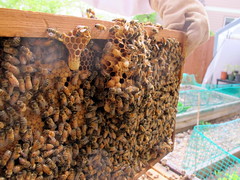
The entire hive was just dripping with bees. So many bees that I couldn't even see everything that the comb was holding, but this particular blanket of bees was pretty smooth. Queen cells are bumps that are on the edges, usually, and by themselves, whereas the regular worker brood is more like this, just covered with nurse bees and the foragers who are bringing in pollen and nectar to feed all the babies.
I was amazed. The upper box had been much lighter than the lower box, but then again the lower box was more full of honey. If the upper was nearly entirely full of brood, it would be lighter than the liquid content of the honey boxes and frames.
There were some lumps and bumps, and sections that the girls had built when and where the neighboring frame was bare.
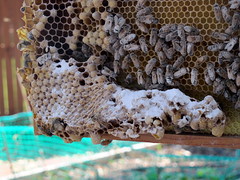
It allowed them to build the drone comb, where the cells are MUCH bigger than the worker comb, and they fill them with the male drones. The drones are very large, and they grow in packs like the big lump there in the middle. One of the strange things was realizing that there were no queen cells but a whole lot of drone clumps in all the edges and nooks and crannies that I hadn't really been able to see that much of. One of the really big chunks was right where those other poor larvae had fallen out when I'd pulled apart the boxes.
So there were drones, but all good, healthy hives are going to throw off a lot of drones this time of year. It's a way of sharing the hive's genetics, and it's a natural part of the bounty of the nectar flow. The good news was that I didn't see any queen cells at all. And I was able to drop a lot more powdered sugar on everyone. *laughs*
One of the strangest "growths" was this one, which was at the bottom corner of one of the frames. The facing frame was completely bare. This was made even more strange with the powdered sugar which I put on before I took the picture, by accident. But the fall of sugar makes it even odder yet.
Still, it really look like drone comb to me, just big cells all together instead of single Queen cells. So it looks like the hive isn't going to be swarming soon, and I'm trying to stay ahead of it by adding supers and making the hive bigger all the time.
Tuesday, May 27, 2014
Monday, May 19, 2014
Just a bit of summer ventilation
I went in today to add the screened bottom board with sticky paper to see what the mite count is like. I wanted to get some powdered sugar in there as I could see that the girls were cleaning themselves off on the entrance board, and I also wanted to see how they were doing with the super. AND I didn't have my husband's usual help as he was busy all day.
So I got everything ready, suited up, got my weather cover off by hand, lit the smoker, and went in. It was relatively simple to just get the boxes off, moved onto surfaces that could catch a queen if she happened to drop, and I found drones everywhere. Tis the seasons for the boys to get out, I suppose, but they were so big and I haven't been good at spotting the queen and I was just wondering if any of them were her, especially once I got down to the bottom board, had all the workers who were trying to come in backed up and buzzing me, and one of the drones took off from the bottom board and dropped into one of my basement window wells. Agh.
Anyway... I also had problems remembering how everything went with the bottom board and the screened board. One of those utterly newbie mistakes where I just forgot how the damned thing went together, and spent five minutes trying to keep bees off all the pieces and puzzle-solve it while all the bees were gathering in a bigger and bigger cloud.
Of course I also found three huge larva, naked, between the bottom brood box and the top brood box. At first, I panicked, thinking that they were exposed queen larvae... and that the hive is thinking about swarming! Eeek... but they were all in a bunch and there wasn't protective walls around them. I suspect that they were actually just more drones.
They were also going through the queen excluder to the supers and building comb in the super I'd placed a month ago. The top brood chamber isn't completely full, either, and I started to do a frame by frame inspection of the top box, but one of the old frames fell apart on me, the bottom bar just pulled free, with the nail right through it. I'm probably going to have to wire that one back together again eventually.
I think I was a little unnerved by just how MANY bees there are this spring compared even to last summer. There are just so many more of them!
I finally just decided to put everything back together, with the extra ventilation shims at the top of the hive, and the extra height bars for the front entrance, so that they have a bigger landing pad. It's hard to balance those things with gloved hands, but it was pretty clear that they were trying pretty hard to sting me when I found one of the girls hanging by her stinger in my deerskin glove. She didn't get through, though, so I'm going to have to go get my bee venom shot in a week or two. *laughs*
My goals were to just give the whole hive more ventilation and put the screened board in, and do a powdered sugar sprinkle. I got the powdered sugar into the brood boxes and we'll see how that goes in a few days. They clean the sugar off themselves and in the process clean off the Varroa mites. I haven't seen evidence of any other problems, yet, and I'm hoping that that'll be enough for this summer at least.
I did what I intended, but the possibility of the colony actually swarming really threw me. I wasn't expecting that, and I know that a second year queen is always stronger than the first year she starts to lay. I had added the super to make sure they had room, and they haven't actually filled all of the top brood box yet, either, so... there may actually be plenty of space. It's all such a puzzle, and I need to keep ahead of them to accommodate their needs. I'd rather not split them unless I have to... which probably means I need to really go in and do another frame-by-frame check to see if there are queen cells anywhere.
Probably in the next day or two. Sadly, since John wasn't here, I wasn't able to get any pictures of anything, and it would have been really useful to have pictures of the broken open larvae for ID purposes from experienced keepers.
So I got everything ready, suited up, got my weather cover off by hand, lit the smoker, and went in. It was relatively simple to just get the boxes off, moved onto surfaces that could catch a queen if she happened to drop, and I found drones everywhere. Tis the seasons for the boys to get out, I suppose, but they were so big and I haven't been good at spotting the queen and I was just wondering if any of them were her, especially once I got down to the bottom board, had all the workers who were trying to come in backed up and buzzing me, and one of the drones took off from the bottom board and dropped into one of my basement window wells. Agh.
Anyway... I also had problems remembering how everything went with the bottom board and the screened board. One of those utterly newbie mistakes where I just forgot how the damned thing went together, and spent five minutes trying to keep bees off all the pieces and puzzle-solve it while all the bees were gathering in a bigger and bigger cloud.
Of course I also found three huge larva, naked, between the bottom brood box and the top brood box. At first, I panicked, thinking that they were exposed queen larvae... and that the hive is thinking about swarming! Eeek... but they were all in a bunch and there wasn't protective walls around them. I suspect that they were actually just more drones.
They were also going through the queen excluder to the supers and building comb in the super I'd placed a month ago. The top brood chamber isn't completely full, either, and I started to do a frame by frame inspection of the top box, but one of the old frames fell apart on me, the bottom bar just pulled free, with the nail right through it. I'm probably going to have to wire that one back together again eventually.
I think I was a little unnerved by just how MANY bees there are this spring compared even to last summer. There are just so many more of them!
I finally just decided to put everything back together, with the extra ventilation shims at the top of the hive, and the extra height bars for the front entrance, so that they have a bigger landing pad. It's hard to balance those things with gloved hands, but it was pretty clear that they were trying pretty hard to sting me when I found one of the girls hanging by her stinger in my deerskin glove. She didn't get through, though, so I'm going to have to go get my bee venom shot in a week or two. *laughs*
My goals were to just give the whole hive more ventilation and put the screened board in, and do a powdered sugar sprinkle. I got the powdered sugar into the brood boxes and we'll see how that goes in a few days. They clean the sugar off themselves and in the process clean off the Varroa mites. I haven't seen evidence of any other problems, yet, and I'm hoping that that'll be enough for this summer at least.
I did what I intended, but the possibility of the colony actually swarming really threw me. I wasn't expecting that, and I know that a second year queen is always stronger than the first year she starts to lay. I had added the super to make sure they had room, and they haven't actually filled all of the top brood box yet, either, so... there may actually be plenty of space. It's all such a puzzle, and I need to keep ahead of them to accommodate their needs. I'd rather not split them unless I have to... which probably means I need to really go in and do another frame-by-frame check to see if there are queen cells anywhere.
Probably in the next day or two. Sadly, since John wasn't here, I wasn't able to get any pictures of anything, and it would have been really useful to have pictures of the broken open larvae for ID purposes from experienced keepers.
Sunday, April 20, 2014
First Full Inspection of the Spring
Had a really truly full day today, and I absolutely decided that I had to fit an inspection in today.
It started with breakfast with my son, then grocery shopping for an Easter party tomorrow that will have about six families who all decided to accept the invitation today. Then I had to get a bee block for a research project for individual wasps and bees by the University of Colorado, luckily the professor lives here in Longmont, so I didn't have to go into Boulder to get it. Then my husband, son, and I helped move furniture for the owner of one of the flooded houses. The house is mostly together, and a neighbor had been storing her furniture and needed to get rid of it. So we were there to put it all into place. Luckily, one other member of the church came to help us as there was some significantly heavy lifting. Then I had an hour and a half saber lesson with the Denver Fencing Club, and my son and I both go to that, and I was exhausted by the end of it.
So, knowing I was tired, I sat down with my bee journal and a pen and wrote down exactly what it was I wanted to do with the inspection and what my decision points were. I needed to do the following:
It started with breakfast with my son, then grocery shopping for an Easter party tomorrow that will have about six families who all decided to accept the invitation today. Then I had to get a bee block for a research project for individual wasps and bees by the University of Colorado, luckily the professor lives here in Longmont, so I didn't have to go into Boulder to get it. Then my husband, son, and I helped move furniture for the owner of one of the flooded houses. The house is mostly together, and a neighbor had been storing her furniture and needed to get rid of it. So we were there to put it all into place. Luckily, one other member of the church came to help us as there was some significantly heavy lifting. Then I had an hour and a half saber lesson with the Denver Fencing Club, and my son and I both go to that, and I was exhausted by the end of it.
So, knowing I was tired, I sat down with my bee journal and a pen and wrote down exactly what it was I wanted to do with the inspection and what my decision points were. I needed to do the following:
- Figure out if there were queen cells and/or drone cells to see if my very busy hive was preparing to swarm.
- See what the honey situation in the hive was to figure out if I needed to supplement with sugar syrup.
- To see what the population in the hive really was after wintering-over. And see if it was big enough to warrant a super already.
- To remove the entrance restriction. Our neighborhood's fruit trees are blossoming now, all the dandelions are out, and so our flow is On and there was going to rain tonight and tomorrow. Plus, there was going to be a week of 60+ degree day weather and no freezes at night. So it seemed time to at least do that. But I know that here we can still have a snow or two before Mother's Day, so I didn't want to put the screened bottom board in, yet.
- To remove a few frames of really badly formed comb so that I could do inspections without rolling so many bees. I knew, from last summer that two frames on the bottom box were badly deformed, and I'd deliberately moved that box to the bottom so that they'd eat it out first.
- To see how the brood was doing and what the queen's laying pattern looked like just to assess how she was doing this spring. There have been at least half a dozen orienting flights since early March that I've seen, so I knew she was laying pretty well, but I still wanted to see how it was going.
I don't do a lot of inspections. I do them only when I have a reason to, unlike some beeks who say that they go in every week, no matter what, just to keep the bees used to them. But I also don't let them just do their own thing, I'm their beekeeper, and they do rely on me to manage things, especially things like space, mite control, and the size of their entrance. And I really, truly needed to know if they were going to need to be split. I wasn't prepared to do the split today, but I needed to know if I had to prepare for it.
And knowing I was tired meant that I had to plan all my moves and contingencies. Especially since I was kind of nervous about it as I haven't done a frame-by-frame inspection of the brood box since last fall. And if I had most of my decisions points plotted out beforehand, I could just do things and follow the decision points.
First good surprise was finding that the lower box was nearly completely full of bees. Last spring, I installed the package, and they mostly stayed in a tight ball in the center of the box together, and built out from there. Most of the wax, of course, is still from last year, but I hadn't expected nearly all of it to be full of either brood or honey!
I did the usual thing, for me at least, of taking the top box and putting it on the lid and then going into all of the bottom box, as that was the one that I was most concerned about with regards to the misshapen comb and the amount of honey that was left.
It was really full, though, so I had to be really careful about making sure that I could get one frame out and then start sliding the other frames over so that I could remove them without crushing anyone. Luckily, nearly every frame in this particular box was new, factory assembled, and solid enough that even when they were full of honey, they lifted out quite easily and the top staple held just fine.

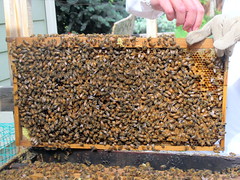
You can see the sheer density of bees. They were up and down most of the frames. I was using smoke so I tried to keep them away from the edges so that I could get good hand holds on the frames and not drop them.
I was surprised to see not quite as many bridging comb as I thought there was going to be. I remembered the last time I went into this box that they had comb going from frame to frame in all kinds of crazy places. I think it was one way to get drone comb in when I hadn't put any drone foundation into it. But the three pieces of bridging comb I did see was all honey comb!!
I took a few of those pieces by smoking the bees off the protrusions, and then scraping them off with my hive tool. I learned from last year, when I scraped a piece off with the bees still on it. All the bees that were on it drowned in the honey. So I decided not to do that ever again.
Another cool surprise was seeing the sheer amount of brood comb now in this box. The last time I'd done a complete inspection of this particular box, the center frames had been half filled with brood and half filled with honey. They hadn't built all the way to the top.
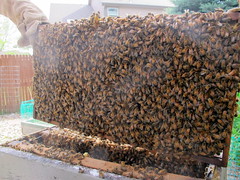
As you can see in this picture, the brood is pretty solid where the bees haven't hatched out, yet, and when I looked into the cells with larva in them, they were all tightly packed together. So the queen is still doing her thing and doing it really well. There were at least two solid frames of brood already, and I was pretty amazed.
The top box had the last, dried remains of the bee patties. I cleaned them all off and tossed them into our compost. The bees were pretty solid through this box as well, though it was a much lighter box than the bottom one. I think they'd eaten out all the honey and brood's pretty light.
Still, there were a lot of girls up here, too, and the brood pattern was now just the lower half of the frames up here, but they were filling the rest with honey and bee bread. I was pretty impressed by all of that, and it seems that the girls feel like they have plenty of room, as I didn't see any queen cells.
That was one of my prime worries. I didn't want to lose a very strong colony to swarming when I'd done so much work to help them make it through an extremely cold winter.
One lady who sells honey at the Longmont Farmer's Market said that they lost 70% of their hives. So it's been a pretty rough year for the commercial keepers. She said that I was good and lucky to have been able to keep my hive alive. So I'll take that as having done something right with the way I do things.
Given the sheer numbers, I thought I'd put a medium super on with a queen excluder between the brood boxes and the super. It wouldn't hurt to give them more space to grow into, and just discourage the idea of swarming all the more.
I got tired of the gloves, too, as the ladies were very gentle with me, and so when I had to respace the top bars of the super to make sure they were set at the right space, I just took my gloves off and went at it.
It's interesting that in the spring, the girls seem to be more gentle, when I know that last fall, when I was taking honey, they were really upset with me and were actively attacking me and following me around the yard after I'd stolen so much. But today, even when I was scraping off the misshapen bits, they didn't seem to care at all. They were just too busy getting things going again to bother with me.
So it was a nice, successful inspection. I didn't see any signs of diseases. The brood looked all healthy, solid, and in good shape. There were a LOT of bees, and there seemed to be plenty of honey in the hive for them to eat, since they seemed to be able to make even more as there was new, uncapped honey in a good bit of the comb.
I am very grateful that they wintered well, and that they're doing so well.
I did the usual thing, for me at least, of taking the top box and putting it on the lid and then going into all of the bottom box, as that was the one that I was most concerned about with regards to the misshapen comb and the amount of honey that was left.
It was really full, though, so I had to be really careful about making sure that I could get one frame out and then start sliding the other frames over so that I could remove them without crushing anyone. Luckily, nearly every frame in this particular box was new, factory assembled, and solid enough that even when they were full of honey, they lifted out quite easily and the top staple held just fine.
You can see the sheer density of bees. They were up and down most of the frames. I was using smoke so I tried to keep them away from the edges so that I could get good hand holds on the frames and not drop them.
I was surprised to see not quite as many bridging comb as I thought there was going to be. I remembered the last time I went into this box that they had comb going from frame to frame in all kinds of crazy places. I think it was one way to get drone comb in when I hadn't put any drone foundation into it. But the three pieces of bridging comb I did see was all honey comb!!
I took a few of those pieces by smoking the bees off the protrusions, and then scraping them off with my hive tool. I learned from last year, when I scraped a piece off with the bees still on it. All the bees that were on it drowned in the honey. So I decided not to do that ever again.
Another cool surprise was seeing the sheer amount of brood comb now in this box. The last time I'd done a complete inspection of this particular box, the center frames had been half filled with brood and half filled with honey. They hadn't built all the way to the top.
As you can see in this picture, the brood is pretty solid where the bees haven't hatched out, yet, and when I looked into the cells with larva in them, they were all tightly packed together. So the queen is still doing her thing and doing it really well. There were at least two solid frames of brood already, and I was pretty amazed.
The top box had the last, dried remains of the bee patties. I cleaned them all off and tossed them into our compost. The bees were pretty solid through this box as well, though it was a much lighter box than the bottom one. I think they'd eaten out all the honey and brood's pretty light.
Still, there were a lot of girls up here, too, and the brood pattern was now just the lower half of the frames up here, but they were filling the rest with honey and bee bread. I was pretty impressed by all of that, and it seems that the girls feel like they have plenty of room, as I didn't see any queen cells.
That was one of my prime worries. I didn't want to lose a very strong colony to swarming when I'd done so much work to help them make it through an extremely cold winter.
One lady who sells honey at the Longmont Farmer's Market said that they lost 70% of their hives. So it's been a pretty rough year for the commercial keepers. She said that I was good and lucky to have been able to keep my hive alive. So I'll take that as having done something right with the way I do things.
Given the sheer numbers, I thought I'd put a medium super on with a queen excluder between the brood boxes and the super. It wouldn't hurt to give them more space to grow into, and just discourage the idea of swarming all the more.
I got tired of the gloves, too, as the ladies were very gentle with me, and so when I had to respace the top bars of the super to make sure they were set at the right space, I just took my gloves off and went at it.
It's interesting that in the spring, the girls seem to be more gentle, when I know that last fall, when I was taking honey, they were really upset with me and were actively attacking me and following me around the yard after I'd stolen so much. But today, even when I was scraping off the misshapen bits, they didn't seem to care at all. They were just too busy getting things going again to bother with me.
So it was a nice, successful inspection. I didn't see any signs of diseases. The brood looked all healthy, solid, and in good shape. There were a LOT of bees, and there seemed to be plenty of honey in the hive for them to eat, since they seemed to be able to make even more as there was new, uncapped honey in a good bit of the comb.
I am very grateful that they wintered well, and that they're doing so well.
Thursday, March 27, 2014
Spring has Sprung
And the bees are going in and out with a bunch of pollen. They seem to be doing quite well, and eventhough they promised snow today, there wasn't any, and the girls were happily working away.
There were a lot of orienting flights every single warm day after two or three cold ones, so they're really building up quickly.
I really need to go in sometime and look at the frames that are there and replace the really misformed ones with clean bases again. There were a few frames where they'd hung two sheets of wax, and I was advised that they'd eat all the honey out of them over the winter, so that I could clean them out in the spring. I'm tempted to do it soon so that they'll also have more space in the hive and feel like they have to stay and keep building instead of swarming.
It was pretty funny today, though, as I just sat outside the entrance watching them come in with their pollen pellets. I saw some black flies at the front entrance. They were just there, and the bees were ignoring them, and finally they annoyed me enough that I started swatting them. The bee-girls didn't seem to take any more notice of me swatting the flies right on the entrance board than they had been taking notice of me without the violence I was doing to the flies. It's nice to know that my girls are quite tame.
There were a lot of orienting flights every single warm day after two or three cold ones, so they're really building up quickly.
I really need to go in sometime and look at the frames that are there and replace the really misformed ones with clean bases again. There were a few frames where they'd hung two sheets of wax, and I was advised that they'd eat all the honey out of them over the winter, so that I could clean them out in the spring. I'm tempted to do it soon so that they'll also have more space in the hive and feel like they have to stay and keep building instead of swarming.
It was pretty funny today, though, as I just sat outside the entrance watching them come in with their pollen pellets. I saw some black flies at the front entrance. They were just there, and the bees were ignoring them, and finally they annoyed me enough that I started swatting them. The bee-girls didn't seem to take any more notice of me swatting the flies right on the entrance board than they had been taking notice of me without the violence I was doing to the flies. It's nice to know that my girls are quite tame.
Monday, March 10, 2014
Last Winter Feed
It was 70° today and yesterday. The girls have been tumbling over each other getting in and out of the most restrictive entry. They even shoved the bar over so that they could get in and out one side of it, and they're all carrying pollen. There's silver maple here than blooms early, and I saw the aspens blooming as well, but they're not bee-friendly.
So I went in, today, opened up the hive, put more of the feeding patties on, as I have plenty of them and the girls were gobbling them up, using them as brood food. There's enough sugar and corn syrup in them for me to know that they're not going to starve. There are a lot of bees in the box, and I'm going to have to watch to make sure that they don't swarm. I didn't take apart all the frames today, simply because it was cloudy and there was a wind blowing, and my snow cover is a pain to take off from over the hive and it's supposed to snow tomorrow.
I know. Colorado weather.
Anyway... I also decided to take out the entrance restriction and let the girls clean out the bottom of the hive, as they have a huge pile of shaved wax built up behind it. And in the process of trying to get that out, I hefted the two brood boxes, and they're heavy. That means that they still have a ton of honey left for themselves! So I'm unlikely to feed them sugar syrup this spring. Just let them take care of themselves.
They were very happy, and there are a lot of bees not just in there, but working hard to build up the colony to be ready for spring. I'm going to have to go in, some 60/70 degree day and really assess if there are drone cells and/or queen cells to really know if they're going to swarm, but I wasn't quite up to it today.
One really good thing, though, was that I had a bee venom shot last Monday, and it's two sting's worth of venom, and the area that got shot was only a little warm. No swelling, no massive itching, no long-term pain at all, especially compared to the ankle sting I'd had last summer. So the shots really are working well. I don't exactly want to test it with a live sting, but now I'm far more confident when I work the girls and there's so much less to be afraid of that it's amazing.
So I went in, today, opened up the hive, put more of the feeding patties on, as I have plenty of them and the girls were gobbling them up, using them as brood food. There's enough sugar and corn syrup in them for me to know that they're not going to starve. There are a lot of bees in the box, and I'm going to have to watch to make sure that they don't swarm. I didn't take apart all the frames today, simply because it was cloudy and there was a wind blowing, and my snow cover is a pain to take off from over the hive and it's supposed to snow tomorrow.
I know. Colorado weather.
Anyway... I also decided to take out the entrance restriction and let the girls clean out the bottom of the hive, as they have a huge pile of shaved wax built up behind it. And in the process of trying to get that out, I hefted the two brood boxes, and they're heavy. That means that they still have a ton of honey left for themselves! So I'm unlikely to feed them sugar syrup this spring. Just let them take care of themselves.
They were very happy, and there are a lot of bees not just in there, but working hard to build up the colony to be ready for spring. I'm going to have to go in, some 60/70 degree day and really assess if there are drone cells and/or queen cells to really know if they're going to swarm, but I wasn't quite up to it today.
One really good thing, though, was that I had a bee venom shot last Monday, and it's two sting's worth of venom, and the area that got shot was only a little warm. No swelling, no massive itching, no long-term pain at all, especially compared to the ankle sting I'd had last summer. So the shots really are working well. I don't exactly want to test it with a live sting, but now I'm far more confident when I work the girls and there's so much less to be afraid of that it's amazing.
Friday, January 17, 2014
A Warm Break
It was warm today, nearly 60, and the side yard was sunny and bright. When I went out at 2pm I heard the hum that Jet calls 'the vacuum sound'. It's the usual sound of new bees orienting themselves!
After the other article about the fact that the bees are still rearing young in the winter, it wasn't as unexpected as it would have been before. But I was still pleasantly surprised to see the cloud of bees hovering in front of the hive. It made me put on my suit and veil and have John light up my smoker, because I was going to approach a living, active hive instead of the one that was very quiet and didn't have that many bees in December.
This is the box of patties that I was mailed. It's probably more than a single hive can use in a winter, given how slowly they're actually eating it. It's about 10 pounds of pollen substitute, sugar, and corn syrup cooked into slabs that can fit under the lid of the hive. The mix of proteins smells like brewer's yeast when I open up the bag, and it's supposed to be refrigerated, so I keep it in our 30 degree garage on the most part. When the weather warms and I start putting supers onto the boxes I can't have this stuff on the bars because the bees will try to pack some of it away.
So it'll probably go into the freezer at that point, and there's plenty for at least another year, even if I split the hive into two hives and have two in the spring. We'll see how it works out.
It's interesting thinking about what a bee probiotic really is, *laughs* I do love the advertising, though.
Here's what we saw when I pulled the top off the boxes. There's a lot more bees than there were in December. I was pretty impressed at how many were on the patties themselves and getting chunks off of it to feed on. There's a huge chunk out of the front patty and they're both pretty nibbled.
So I figured that they were definitely using the things. The only problem was that I couldn't move the original remains, as they were too soft from the warmth of the day! So I had to cut a new patty into strips to try and fit it into the spaces between.
I am glad that they're using them, so it means that they really needed the extras. The bees do keep a little pollen in what they call beebread, and they stuff some cells with the stuff, but here there's no flowers through the winter, so pollen's hard to come by. Therefore, these patties are supplementing the food needed to raise larvae.
When I raised the lid in December none of the bees were on the lid, and nearly none of them were in the upper chamber of the two boxes. So seeing this many bees on the lid was very cool. They were active, buzzing, and two or three were coming at me to defend the hive. The rest were just busy going about their business in the box and on the lid.
There were just a few bees using the front entrance at this point. The others had already oriented, and were gone back inside. The sun had gone to the west enough to leave the hive in shadow, so it was getting gradually chillier.
I had some problems putting the new patty on until I realized that the inner lid actually had a lip of about an inch and a half, not just the width of the rim of the boxes. I had to pull the new stuff back far enough so that the lid could go back on. It was pretty clear, though, that the bees were doing well, and that their numbers have already increased.
There were about a dozen bodies out the front entrance, and one lady was dead on the front edge of the landing board. That was interesting to see, she looked as if she were about to take off, but was so utterly still.
Here's a clearer look of the two eaten away patties. There's holes in the one to the left and the one on the right is carved away quite neatly. There's poke marks everywhere, so they're definitely taking away from them both. The new patty that I put half of on here was all shiny and smooth.
The girls were all pretty active, so I have good hopes for the coming year. It's definitely not looking like they're going to die out this winter, even if it gets cold again. After they survived two cold spells, they're now increasing their numbers, so it's looking good. The more of them there are, the more area they'll be able to incubate, and the more they'll increase. I just hope that I manage to figure out if I should split the hive in March before they decide to swarm.
After the other article about the fact that the bees are still rearing young in the winter, it wasn't as unexpected as it would have been before. But I was still pleasantly surprised to see the cloud of bees hovering in front of the hive. It made me put on my suit and veil and have John light up my smoker, because I was going to approach a living, active hive instead of the one that was very quiet and didn't have that many bees in December.
This is the box of patties that I was mailed. It's probably more than a single hive can use in a winter, given how slowly they're actually eating it. It's about 10 pounds of pollen substitute, sugar, and corn syrup cooked into slabs that can fit under the lid of the hive. The mix of proteins smells like brewer's yeast when I open up the bag, and it's supposed to be refrigerated, so I keep it in our 30 degree garage on the most part. When the weather warms and I start putting supers onto the boxes I can't have this stuff on the bars because the bees will try to pack some of it away.
So it'll probably go into the freezer at that point, and there's plenty for at least another year, even if I split the hive into two hives and have two in the spring. We'll see how it works out.
It's interesting thinking about what a bee probiotic really is, *laughs* I do love the advertising, though.
Here's what we saw when I pulled the top off the boxes. There's a lot more bees than there were in December. I was pretty impressed at how many were on the patties themselves and getting chunks off of it to feed on. There's a huge chunk out of the front patty and they're both pretty nibbled.
So I figured that they were definitely using the things. The only problem was that I couldn't move the original remains, as they were too soft from the warmth of the day! So I had to cut a new patty into strips to try and fit it into the spaces between.
I am glad that they're using them, so it means that they really needed the extras. The bees do keep a little pollen in what they call beebread, and they stuff some cells with the stuff, but here there's no flowers through the winter, so pollen's hard to come by. Therefore, these patties are supplementing the food needed to raise larvae.
When I raised the lid in December none of the bees were on the lid, and nearly none of them were in the upper chamber of the two boxes. So seeing this many bees on the lid was very cool. They were active, buzzing, and two or three were coming at me to defend the hive. The rest were just busy going about their business in the box and on the lid.
There were just a few bees using the front entrance at this point. The others had already oriented, and were gone back inside. The sun had gone to the west enough to leave the hive in shadow, so it was getting gradually chillier.
I had some problems putting the new patty on until I realized that the inner lid actually had a lip of about an inch and a half, not just the width of the rim of the boxes. I had to pull the new stuff back far enough so that the lid could go back on. It was pretty clear, though, that the bees were doing well, and that their numbers have already increased.
There were about a dozen bodies out the front entrance, and one lady was dead on the front edge of the landing board. That was interesting to see, she looked as if she were about to take off, but was so utterly still.
Here's a clearer look of the two eaten away patties. There's holes in the one to the left and the one on the right is carved away quite neatly. There's poke marks everywhere, so they're definitely taking away from them both. The new patty that I put half of on here was all shiny and smooth.
The girls were all pretty active, so I have good hopes for the coming year. It's definitely not looking like they're going to die out this winter, even if it gets cold again. After they survived two cold spells, they're now increasing their numbers, so it's looking good. The more of them there are, the more area they'll be able to incubate, and the more they'll increase. I just hope that I manage to figure out if I should split the hive in March before they decide to swarm.
Tuesday, January 14, 2014
What I Didn't Know About Winter Bees
Donald Studinski is one of the more outspoken beekeepers in the Colorado beekeeping associations. He's knowledgable, experienced, and very very opinionated about how he sees the world of beekeeping. I often enjoy his missives, and recently he came up with a really nice article about what really happens with bees during the winter: Deep Freeze, Honeybees, and You. The title is kind of funny, but it has some really intriguing details about what bees really do all winter and how they actually are raising young through the cold months.
We had a good eight inches of snow during the cold blast that froze most of the rest of the country, and in the following days it started to all melt and slide off the roof.
When I had the beehive on the window-wells of the basement, it was out of the arc of the fall of snow from the 2nd story roof on that side of the house (also the solar panels are up there, which is another story all together); but now that I moved it off the window wells, the hive is right in the path of the falling snow. So I had John put the cover up. It's just a huge sheet of particle board that's screwed to a couple of supporting posts.
The problem was that the bottom edge of the particle board, once the board was covered in snow, was right where the run off from the warping board fell onto the entrance of the hive!! Half a dozen of the girls drowned trying to get out of the hive while the melt was happening. Agh. When I discovered this, John and I went out, pulled the hive back the few inches it needed to keep the entrance out from under that edge, and I propped the back of the hive up a couple of inches (the width of a 2x4). Water ran out the front. Gah.
But it all dried within six hours of that, and the next day I saw dozens of the girls flying again. They'd dragged the bodies out of the hive. I saw one of the girls bodily picking up a carcass and flying away with it. About half a dozen are dumped just below the entrance, but most have been tidily cleaned up and taken away. So they're doing quite well, it seems, and I am supposed to have a 60 degree day in the next few days. I should be able to go in and see if they're eating the patties and using the proteins for their winter brood. I'll definitely take pictures then.
We had a good eight inches of snow during the cold blast that froze most of the rest of the country, and in the following days it started to all melt and slide off the roof.
When I had the beehive on the window-wells of the basement, it was out of the arc of the fall of snow from the 2nd story roof on that side of the house (also the solar panels are up there, which is another story all together); but now that I moved it off the window wells, the hive is right in the path of the falling snow. So I had John put the cover up. It's just a huge sheet of particle board that's screwed to a couple of supporting posts.
The problem was that the bottom edge of the particle board, once the board was covered in snow, was right where the run off from the warping board fell onto the entrance of the hive!! Half a dozen of the girls drowned trying to get out of the hive while the melt was happening. Agh. When I discovered this, John and I went out, pulled the hive back the few inches it needed to keep the entrance out from under that edge, and I propped the back of the hive up a couple of inches (the width of a 2x4). Water ran out the front. Gah.
But it all dried within six hours of that, and the next day I saw dozens of the girls flying again. They'd dragged the bodies out of the hive. I saw one of the girls bodily picking up a carcass and flying away with it. About half a dozen are dumped just below the entrance, but most have been tidily cleaned up and taken away. So they're doing quite well, it seems, and I am supposed to have a 60 degree day in the next few days. I should be able to go in and see if they're eating the patties and using the proteins for their winter brood. I'll definitely take pictures then.
Subscribe to:
Posts (Atom)