I may also move the doubled-up frame closer to the edge of the bottom box and see if there's a way to get it out of circulation completely.
Sunday, June 23, 2013
The Internets is Smart...
... and it looks as if it's not a terrible thing, just a lack of ventilation and/or room, as I suspected when I saw the top bars were completely lined with bees. So adding the super and going in to look around and make sure it's full up will be enough to deal with the rest of it.

Saturday, June 22, 2013
Too Many Girls?
This evening before dinner, I noticed that there were an unusual number of bees just hanging out outside the entrance on the left side of the hive. I didn't think too much about it, but tomorrow there's supposed to be the possibility of severe thunderstorms and gusty winds, so I wanted to put the cover back on straight. I thought that would be a simple enough task, but then I went out there and saw all the girls hanging out outside still!
It's been a full brood cycle since I did my last inspection, and I've been seeing orienting flights. So I suddenly started to wonder if there were just so many workers now that they didn't fit?
So after a quick tactic session with my husband, I pulled out my last deep box that I have frames for, and we took off the outer cover, pried off the off-set inner cover to lots of buzzing. I got my suit on after that chorus, just so that I could work more calmly. I got the lid off completely, gently set it by the entrance, and then saw that nearly all the frames in the top box were full.
So I gently put a queen excluder on top, added the box, and shook all the workers from the bottom of the lid onto the the top box. They rapidly descended into the slots and made it very simple to put the lid on and get the outer cover back onto the box. I didn't see all that well, but there were bees coming up between ALL the frames of the second box, and they were doing it front to back, so I suspect that it is far more full than I expected. I'll do a full inspection after the weather calms down, but I hopefully made enough room for the girls for when the rain comes down.
It's been a full brood cycle since I did my last inspection, and I've been seeing orienting flights. So I suddenly started to wonder if there were just so many workers now that they didn't fit?
So after a quick tactic session with my husband, I pulled out my last deep box that I have frames for, and we took off the outer cover, pried off the off-set inner cover to lots of buzzing. I got my suit on after that chorus, just so that I could work more calmly. I got the lid off completely, gently set it by the entrance, and then saw that nearly all the frames in the top box were full.
So I gently put a queen excluder on top, added the box, and shook all the workers from the bottom of the lid onto the the top box. They rapidly descended into the slots and made it very simple to put the lid on and get the outer cover back onto the box. I didn't see all that well, but there were bees coming up between ALL the frames of the second box, and they were doing it front to back, so I suspect that it is far more full than I expected. I'll do a full inspection after the weather calms down, but I hopefully made enough room for the girls for when the rain comes down.
Tuesday, June 18, 2013
Summer Days
The days were pretty hot a few weeks back, and it's going to be in the mid-90's again next week. When I wandered out into the garden on the 100 degree day last week, I saw a whole bunch of the girls just sitting in, around, and in front of the entrance all fanning like mad. When I also saw a candle completely liquified on my picnic table out front, I figured I'd better do something.
First, John built a small structure out of scrapwood over the hive, just to shade it. Then I offset the telescoping cover, and offset the cover itself underneath that, so that there was more air flow. The telescoping cover keeps the rain off. The funny thing was that I did it bareheaded and barehanded, and I loved seeing all the workers come out through the 'roof' to take a look at the sunlight they weren't used to seeing through the top of the hive. It was just an inquisitive thing, and there was no rise in the buzzing at all and none of the ladies tried to check me out. In fact, ten minutes later, when I went to look at the entrance, a good number of the fanning crew had gone on to other duties.
I'm thinking of just leaving it like that for the summer, maybe checking on whether or not they're gluing things down when I do the usual checks. They seem to be very content on the most part and workers are tumbling out of the hive at a really good rate as soon as it's warm. I've seen them in the cherry trees that are blooming nearby, and their back legs are just stuffed with bright pollen. The girls that are entering the hive have the same color pollen, too! So I suspect it's them, as the trees are just a block away.
First, John built a small structure out of scrapwood over the hive, just to shade it. Then I offset the telescoping cover, and offset the cover itself underneath that, so that there was more air flow. The telescoping cover keeps the rain off. The funny thing was that I did it bareheaded and barehanded, and I loved seeing all the workers come out through the 'roof' to take a look at the sunlight they weren't used to seeing through the top of the hive. It was just an inquisitive thing, and there was no rise in the buzzing at all and none of the ladies tried to check me out. In fact, ten minutes later, when I went to look at the entrance, a good number of the fanning crew had gone on to other duties.
I'm thinking of just leaving it like that for the summer, maybe checking on whether or not they're gluing things down when I do the usual checks. They seem to be very content on the most part and workers are tumbling out of the hive at a really good rate as soon as it's warm. I've seen them in the cherry trees that are blooming nearby, and their back legs are just stuffed with bright pollen. The girls that are entering the hive have the same color pollen, too! So I suspect it's them, as the trees are just a block away.
Monday, June 10, 2013
Inspection After a Month...
... since I did the last inspection, and I figured it was time. So a total of 42 days since installment.
This time I practiced with the smoker beforehand, I went over a game plan with John before I even opened it up, and then we went strictly by the guidelines and boundaries I set down for the whole thing, and it was really good.
I'm realizing, the more I do this, the better it is to have an end in mind before I go in. There's no point in disturbing the girls unless I have a decision point to make, and I need to figure out what it is I'm going to do. There are some books that say that in order to manage a hive properly, you need to go in every week. On the other side, there's several that say that every time you go in, you set them back by a week, and others that say that during good nectar flow in the summer you should never go in or you'll interrupt them badly.
I don't think I did much interrupting today, and it was good to see how far the ladies have gotten in just the month I was away.
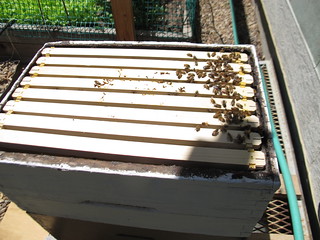 Before we left for China, I'd put a second deep box on top of the first, because the bees had already filled five of the eight frames, and I wanted to give them plenty of room while we were away. Unfortunately, I also knew that they have a tendency to want to go straight up from where they've already established brood or comb, so I needed to know if they'd spread out a little or had simply gone up.
I think another reason I needed the very clear plan before I went in was because I'm still jet-lagged and kind of woozy during the day. Mental processes haven't been as clear or as clean since the trip, between the cold and the drastic time shift. I keep wanting to sleep during the day and waking up at night, even more so than usual, so I've been fighting all that, too.
One of the things was just to get rid of the feeder, because while the sugar water was really good for getting the colony to build up its numbers, the bees were likely to take and store the sugar syrup instead of honey, and it just doesn't hold as well as actual nectar from flowers of all kinds. So I just took the whole top off, put the feeder out on the grass, and trusted that the two workers that were left in it would find their way home.
 It's kind of fun to see the brand-new clean top edges of the new frames that I'd bought from the bee equipment place. Already loaded with foundation, I didn't have to worry about the evenness of how the foundations were built or set.
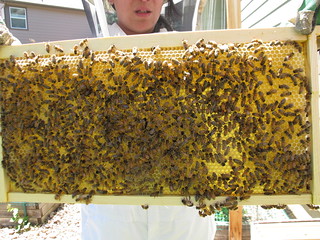
The first three frames were empty of everything but bees exploring their surfaces. The fourth was partially built on the right side, and the left was facing this particular frame, which is almost entirely built out! I was very happy to see this nearly filled with bees drawing out the wax. It's a clean side, with the wax nearly the same color as the foundation, and you can see through it, so no buildups from brood or anything, yet.
It was interesting to see this frame in contrast to the center one and the ones on either side of that, which were filled with nearly complete brood. Since it's been about a month since I put this box on, if the Queen had gone directly for the first frame when I put it on, there was time enough for a whole round of baby bees to grow up (takes them 21 days to hatch, develop, morph, and break free to fly.
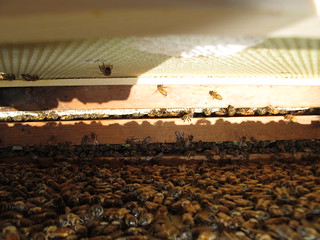 It was also fun to look down between the slats when I had the empty ones out to see how they were doing on the first box. They'd built out a little more, with two empty frames to the same side as on the top, so they were starting to fill it all up as well as they could, too. I love this picture as it's like a whole carpet of bees...
They seem to be doing quite well, as there are so many of them, but one thing I really did notice was that they were becoming more and more the same. That the all-yellow or all-black workers that I'd started with just weren't there anymore. All the ladies are looking more like sisters, now, with the same pattern of stripes and the same brown fuzzy thoraxes.
The dying workers are being tossed out the front door, too, and I'm seeing more and more of them piled up just off the edge of the entrance. They dry out into these abstract shapes of just the carapace and look almost like dried flower buds.
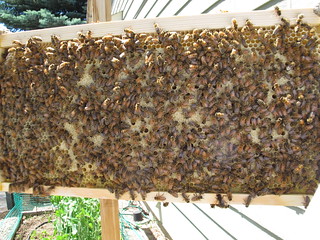 The next frame was solid brood. Capped and ready to fly in a week or two. On both sides. There were just a few holes, and I wasn't exactly sure if these were cells that the Queen had missed or if she'd laid in them and these were the first bees to fly. Either way, they were pretty scattered and few, which meant that the mass of the cells had eggs laid in them.
It was pretty intense to see a whole frame that was nothing but brood when it had felt so haphazard the last time I went in for an inspection, but the girls are doing their best to multiply and do it as quickly as their nectar flow and pollen finds allow. They're carrying in legloads of pollen all the time, and it's amazing seeing how much pollen they're finding and using to rear their young.
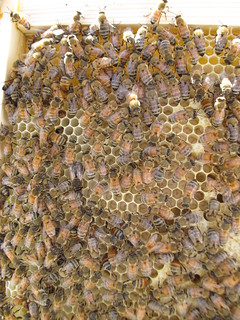 On the left, here, is one of the corners of the really crowded frames. It definitely reassured me that she was laying in nearly every cell she could reach, and just missed a few by mistake. It's just chock-full of pupae, who are about ready to be capped and let go to cocoon themselves and grow wings. So many of the workers were head-first into the cells they looked black. I had to study them pretty closely to see that they weren't a problem at all, and had a very good sense of what needed maintaining.
I really loved seeing the open cells again, and being able to distinguish, so easily, which cells were honey and which were brood. I was impressed to see how little they're storing, yet, and how much they're just pumping up the numbers within the colony. It fits the cycle, I think.... where they just up their numbers for a while and then try to store honey away so that they can survive the winter. Luckily, there's a number of fields of weeds nearby that are completely chock-a-block with dandelions. I saw them ALL blooming just a week ago, and the girls have plenty to eat.
The interesting thing was seeing that these frames were duller, more solid than the open, airy, uncapped frame where the light could just shine through. These were solid with developing bees.
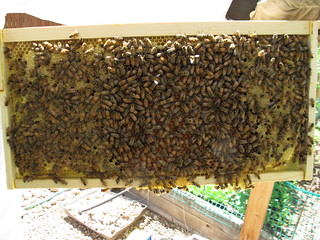 Then I saw this frame. Both sides were like this, where the center was empty, dark, and being cleaned out by the workers. The cell darkens after having held a pupae through larval stage and into adult. I hadn't seen any of this during the first inspection, of course, as they hadn't had the time to get that far.
It was really cool to see it up close, and then I realized that the queen is on this side of this frame! She's surrounded by attendants, and she's laying and she has a black thorax instead of the fuzzy brown one that the workers have. She's the only bee that isn't head-first into a cell... and if you click on the picture, it'll take you to flickr, where I've got her marked. *laughs*
The amazing thing was knowing now that she's re-laying the frames, and putting eggs into used, cleaned cells the way she's supposed to, and that it's going quite well. None of the bees seemed particular disturbed by my moving things around, and no one was attacking me and none of them were particularly agitated by my observations. I hadn't crushed anyone, for all that there were a lot more bees in there. Counting the full frames, the estimates are about half a pound of workers per completely covered frame, so I have approximately six pounds of bees now, about doubling what I started with, even with the loss of all the old workers.
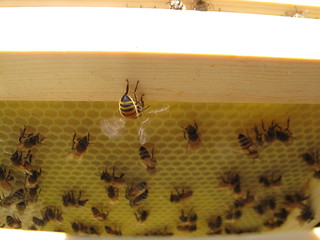 As a parting shot... *laughs* This bee was fanning furiously, as it was a pretty hot day, and they simply can stand at the top of a frame to fan out the heat. There's a few ventilation holes in the boxes, now, and I'm offsetting them a little to improve air flow. There's also a steady supply of water outside and the top box has a few holes drilled into it.
Given that the workers were starting to explore the frames to the side, and that they'd only really half-filled the boxes I'd given to them, I decided not to add a new super, yet, and let them just do what they were doing.
Over the weekend, one of our neighbors was having a garage sale, and her flowering tree in the front yard was just covered with bees. She's near enough that she was happily saying that she was feeding my girls... *laughs* I loved that. They weren't bothering her or anyone that was going to the sale, staying strictly on the blossoms. And I actually found a flowering cherry tree nearby that was also covered with the girls, so they're doing quite well in our neighborhood. Next up will be the Russian sage, the butterfly bushes, and plenty of summer roses. It's funny how aware I now am of the local flora...
This time I practiced with the smoker beforehand, I went over a game plan with John before I even opened it up, and then we went strictly by the guidelines and boundaries I set down for the whole thing, and it was really good.
I'm realizing, the more I do this, the better it is to have an end in mind before I go in. There's no point in disturbing the girls unless I have a decision point to make, and I need to figure out what it is I'm going to do. There are some books that say that in order to manage a hive properly, you need to go in every week. On the other side, there's several that say that every time you go in, you set them back by a week, and others that say that during good nectar flow in the summer you should never go in or you'll interrupt them badly.
I don't think I did much interrupting today, and it was good to see how far the ladies have gotten in just the month I was away.
I think another reason I needed the very clear plan before I went in was because I'm still jet-lagged and kind of woozy during the day. Mental processes haven't been as clear or as clean since the trip, between the cold and the drastic time shift. I keep wanting to sleep during the day and waking up at night, even more so than usual, so I've been fighting all that, too.
One of the things was just to get rid of the feeder, because while the sugar water was really good for getting the colony to build up its numbers, the bees were likely to take and store the sugar syrup instead of honey, and it just doesn't hold as well as actual nectar from flowers of all kinds. So I just took the whole top off, put the feeder out on the grass, and trusted that the two workers that were left in it would find their way home.
The first three frames were empty of everything but bees exploring their surfaces. The fourth was partially built on the right side, and the left was facing this particular frame, which is almost entirely built out! I was very happy to see this nearly filled with bees drawing out the wax. It's a clean side, with the wax nearly the same color as the foundation, and you can see through it, so no buildups from brood or anything, yet.
It was interesting to see this frame in contrast to the center one and the ones on either side of that, which were filled with nearly complete brood. Since it's been about a month since I put this box on, if the Queen had gone directly for the first frame when I put it on, there was time enough for a whole round of baby bees to grow up (takes them 21 days to hatch, develop, morph, and break free to fly.
They seem to be doing quite well, as there are so many of them, but one thing I really did notice was that they were becoming more and more the same. That the all-yellow or all-black workers that I'd started with just weren't there anymore. All the ladies are looking more like sisters, now, with the same pattern of stripes and the same brown fuzzy thoraxes.
The dying workers are being tossed out the front door, too, and I'm seeing more and more of them piled up just off the edge of the entrance. They dry out into these abstract shapes of just the carapace and look almost like dried flower buds.
It was pretty intense to see a whole frame that was nothing but brood when it had felt so haphazard the last time I went in for an inspection, but the girls are doing their best to multiply and do it as quickly as their nectar flow and pollen finds allow. They're carrying in legloads of pollen all the time, and it's amazing seeing how much pollen they're finding and using to rear their young.
I really loved seeing the open cells again, and being able to distinguish, so easily, which cells were honey and which were brood. I was impressed to see how little they're storing, yet, and how much they're just pumping up the numbers within the colony. It fits the cycle, I think.... where they just up their numbers for a while and then try to store honey away so that they can survive the winter. Luckily, there's a number of fields of weeds nearby that are completely chock-a-block with dandelions. I saw them ALL blooming just a week ago, and the girls have plenty to eat.
The interesting thing was seeing that these frames were duller, more solid than the open, airy, uncapped frame where the light could just shine through. These were solid with developing bees.
It was really cool to see it up close, and then I realized that the queen is on this side of this frame! She's surrounded by attendants, and she's laying and she has a black thorax instead of the fuzzy brown one that the workers have. She's the only bee that isn't head-first into a cell... and if you click on the picture, it'll take you to flickr, where I've got her marked. *laughs*
The amazing thing was knowing now that she's re-laying the frames, and putting eggs into used, cleaned cells the way she's supposed to, and that it's going quite well. None of the bees seemed particular disturbed by my moving things around, and no one was attacking me and none of them were particularly agitated by my observations. I hadn't crushed anyone, for all that there were a lot more bees in there. Counting the full frames, the estimates are about half a pound of workers per completely covered frame, so I have approximately six pounds of bees now, about doubling what I started with, even with the loss of all the old workers.
Given that the workers were starting to explore the frames to the side, and that they'd only really half-filled the boxes I'd given to them, I decided not to add a new super, yet, and let them just do what they were doing.
Over the weekend, one of our neighbors was having a garage sale, and her flowering tree in the front yard was just covered with bees. She's near enough that she was happily saying that she was feeding my girls... *laughs* I loved that. They weren't bothering her or anyone that was going to the sale, staying strictly on the blossoms. And I actually found a flowering cherry tree nearby that was also covered with the girls, so they're doing quite well in our neighborhood. Next up will be the Russian sage, the butterfly bushes, and plenty of summer roses. It's funny how aware I now am of the local flora...
Sunday, May 19, 2013
Seeing Orienting Flights
Yesterday, while I was stringing up the sugar snap peas (which had tripled their length in just three days of sunshine and plenty of water), I suddenly saw a cloud of bees in front of the entrance.
I asked my boss at the 911 dispatch center (I just volunteer as a transcript person there once a week), Ken Nichols, keeps bees and is very experienced his opinion on when to inspect bees, and he dragged out the lovely old adage of "if you want a dozen opinions, ask ten beekeepers." But he gave a very reasoned argument against going in every week, and for doing a bit more management at the end of the winter, and into the fall.
I told him about seeing larvae forming the last time I went in, and he smiled and said that I'd probably be seeing orienting flights soon, huge clouds of bees right in front of the entrance. They are newborns that are figuring out how to fly and how to find the hive and how and where it is, and every once in a while, after they start to get born, they'll just come out and hover. Knowing what it was made me run inside to tell the boys and grab the camera.
 They're all oriented toward the front of the hive, and they were all hovering just in a cloud all in front of the entrance. It was fascinating to watch.
The really fun part was that after the boys were gone and had taken their videos and done everything, I was just standing there, trying strings to a support and to my pea plants and watching all these shiny new baby bees learning how to fly. None of them bothered me, there was one old lady that buzzed me a couple of times, inquiringly, but she left me alone after not that long.
And it was amazingly peaceful to just watch them going out and in, out and in, and then, not that much longer later, they were all back in the hive and the usual traffic was going in and out.
Another thing Ken said was that you can tell a lot by just watching the traffic in and out of a hive. That if the workers are bringing in a lot of pollen, it means that they have plenty of brood to feed, because only the larva eat pollen. The bees only eat sugar water and honey. I'm realizing now that butterflies only eat nectar when their caterpillar stages eat everything around them. And watching the girls there were lots of gold and yellow leg burdens on their back legs.
It was amazing fun to watch them. Mimi came by today just to see the girls, and she stood happily right in front of the entrance, with the bees whizzing about her on their flight path, and watched them going in and out and being quite happily busy with the summer-like day. I'll admit to just sitting outside the hive and watching them work. It's peaceful stuff. I seem to be in need for a little orientation myself, so it's been nice to get it from these working girls.
I asked my boss at the 911 dispatch center (I just volunteer as a transcript person there once a week), Ken Nichols, keeps bees and is very experienced his opinion on when to inspect bees, and he dragged out the lovely old adage of "if you want a dozen opinions, ask ten beekeepers." But he gave a very reasoned argument against going in every week, and for doing a bit more management at the end of the winter, and into the fall.
I told him about seeing larvae forming the last time I went in, and he smiled and said that I'd probably be seeing orienting flights soon, huge clouds of bees right in front of the entrance. They are newborns that are figuring out how to fly and how to find the hive and how and where it is, and every once in a while, after they start to get born, they'll just come out and hover. Knowing what it was made me run inside to tell the boys and grab the camera.

The really fun part was that after the boys were gone and had taken their videos and done everything, I was just standing there, trying strings to a support and to my pea plants and watching all these shiny new baby bees learning how to fly. None of them bothered me, there was one old lady that buzzed me a couple of times, inquiringly, but she left me alone after not that long.
And it was amazingly peaceful to just watch them going out and in, out and in, and then, not that much longer later, they were all back in the hive and the usual traffic was going in and out.
Another thing Ken said was that you can tell a lot by just watching the traffic in and out of a hive. That if the workers are bringing in a lot of pollen, it means that they have plenty of brood to feed, because only the larva eat pollen. The bees only eat sugar water and honey. I'm realizing now that butterflies only eat nectar when their caterpillar stages eat everything around them. And watching the girls there were lots of gold and yellow leg burdens on their back legs.
It was amazing fun to watch them. Mimi came by today just to see the girls, and she stood happily right in front of the entrance, with the bees whizzing about her on their flight path, and watched them going in and out and being quite happily busy with the summer-like day. I'll admit to just sitting outside the hive and watching them work. It's peaceful stuff. I seem to be in need for a little orientation myself, so it's been nice to get it from these working girls.
Friday, May 10, 2013
The 12-Day Inspection
In which I learned a great deal about the fact that planning really does help the inspection of a hive, and I actually FIND evidence that the queen is amazing and doing really really well. My husband was wonderful and helped keep me on track and focused for the whole thing, and did an amazing job as cameraman.

But one of the main things I started with was deciding to use smoke for the first time. I had only used sugar water to spray the girls so that they would clean each other off before this. The feeding mechanism makes them full and the belly distension seems to make it impossible for them to sting.
The same mechanism is why smoke works, or so they say. *laughs* There is more lore about bees than I even really want to think about; but smoke makes the girls gorge on honey in case they have to fly away, and when they're full they can't sting. Usually the last thing bees have to worry about when the forest is on fire is a bear intent on eating them.
When I bought my bee suit, I got the smoker, too, and while the discussions on the Boulder beekeeper's list indicated that I might not have to use it, that sugar syrup was better, I decided to do it anyway. During the windy, cold day I was scared that I was going to draw too much heat out of the girls by spraying them with liquid, this way I didn't have to worry about them being wet. The nights are still going down into the 40's, so I thought I'd play it safe.

The smoke worked like a charm, too. When I got the feeder and empty box off the top, they were all well within the slats of the frames, and hovering over their stores. Also, since this time I did it in the middle of the day, on a sunny, calm day, a lot of the workers were out, and the hive itself wasn't quite so full. Still, as you'll see, there were plenty of the girls inside, still, to make it very interesting. You can also see here that the frames were pretty close together, and that there's a much bigger cap between the third and fourth frame from the left. Yes, that's where the doubled comb ended up.
The difference seems minuscule to my eye, too...

This is the next frame over, and you can see that they're building already. A small network of bees drawing comb, and they were drawing equal comb on the matching side of the frame next to it. So they were getting good and busy and building out a pretty good deal. It was interesting that it looked like they'd begun to build where the queen was first caged, and then started spreading from there, eventhough it was off of center by a frame. I guess she really is irresistible to them.

This is pretty typical, with the honey on the outside cells, and capped cells more to the middle with the brood and pollen and the like. You can see that they're all over the faces of this, and each tending to their own thing all at the same time.
It was surprising and really cool to hold these frames up and look at them in sunlight and not really bother the bees at all! I was surprised at how easy it was and how little notice they took when all I was doing was looking at them. They just kept working at all the things they were doing. Another cool thing was seeing how they all varied so much. Some were really dark and others really bright yellow, and I loved seeing the contrast across them all. It made it much harder to actually spot the queen, though! And I found out from Ken that when the Northern Colorado Beekeepers did their buy, they decided to not ask the breeders to mark the queens. It's something that stresses them, so I'm okay with having to be a better beekeeper to find her! *laughs*

I really loved being able to study each and every frame and with John's urgings actually take my time doing it. There were so many bees, and they were festooning all over the frames, building comb as fast as they could.
It turns out that they need a lot of sugar to be able to build wax, and these girls seemed really well supplied as they were building like mad. There were three completely full frames, and three partial ones like the first one that I looked more closely at. And the bees stuck to them all like they were glued in place. Nearly none of the girls took off or fell off, which was a relief for me as I always hated the idea of the queen just falling and getting crushed or something.

I added more smoke in the middle of the inspection because John said that the note of the hive was going up a little, but also because the next frame was the Big One that I'd felt like I'd failed at really looking at the time before.
So I added some more smoke, let the girls settle, and then got my courage together. I moved the frame over a few centimeters, grabbed both sides and removed it from the box, slowly and gently and didn't shake anyone off. One of two of the girls just took of into the air, now and again, but none of them were really bumping into me, or buzzing at that hum that really alerted ALL the "get ready to dodge or duck" instincts. They were pretty content, and doing all right. I also wasn't breaking any comb the way I had last time...

The bright orange cells are filled with pollen! Which is what they need to feed brood, which meant that they were raising brood, so that was my Really Good Sign.
I still couldn't see under the wax to see if the queen was there or laying, and I was mildly frustrated by that, until I got to take a very close look at the lower corner of the other side of this frame...

If you go to this picture and look into the uncapped cells around and under the bees, you'll see little white rings of larvae!!!
I was so happy to see them. I was just so relieved to actually see them, big, fat, glossy and happy. And the texture of the caps next to them meant that there were probably hundreds, if not thousands, of workers all laid, growing, and sealed off to cocoon and develop into bees! But it was amazing to see that the laying pattern was such that the queen was probably hitting every single cell, and putting eggs into all of them. The swarms of workers here were feeding, capping, cleaning, and otherwise caring for the babies. I also love that you can see one of the nearly transparent all-yellow workers in this shot too, a little above the center.

No pushed around bees. No angry bee, nothing that seemed to make any of them any unhappier than they were.
I was even able to give the broken off piece of comb to a kid that was fascinated by them, and he loved seeing how it fit together and how it broke. *grins*
The amazing thing to me was seeing it all go back together without any problems at all. And it gave me the courage to just go through the rest of the box!

So this is the last of the built frames, and it's about two-thirds full, which I was really happy to see. The workers on this one are "festooning"... where they're all kind of linked together, and connected up in order to build comb in a synchronized fashion. For some reason it seems to make it easier for them to build the stuff when they're all doing it at once.
And, of course, they were completely ignoring me and John, who had the camera and no protective clothing but a veil. We got the veils from a couple of friends of ours who had bought them for a Halloween costume party. They had no use for them, so when they heard that I was going to actually keep bees, they sent me the veils!

But I basically scootched (that's a technical term!) the frames over until they were as close as they could get with the workers still between them, and finally fit all the frames into the box. Since they'd built out six of the eight frames to some extent, I decided to add another box of frames on top. It would just give them more room. I also set up more sugar syrup and a watering station for them, with a tray filled with sand and rocks that could get water from our automated drip irrigation! So they'll have water and everything else, too!
So this second inspection was much, much, much more successful than the first, and I was so relieved about being able to see real evidence of the queen being just fine that I just collapsed for a while. Adrenalin and relief are a potent dose. *laughs* It's been twelve days since the queen was released, so I guess this is as good a time as any to see that she's been doing well.
Monday, May 6, 2013
Fail on Trying to Check on the Queen
I had a pretty thorough failure today, and with some thought and research, I am realizing why I failed to really find any evidence that the queen was in residence or laying, and there are multiple reasons.
Let's go through exactly what I did, first, and then what it was that really went wrong and where I lost heart and what I want to do about it the next time I go into the hive.
First off, I didn't get any pictures because I did it on my own while John was at some meeting that evening. So I didn't have my usual backup; however, I'd also gotten the mistaken impression that I should go in five days after the queen was released. I don't know where I got that number, and one Gabriel Petrut commented much later on one of my latter posts that one should wait until plenty of comb has been built, at least a week, if not more to give the queen time to go. I also read, later, that one shouldn't disturb the hive too much in the first ten days (after installation? After queen release? I'm not sure) or else the workers might ball the queen. Gah!
So I went in today. I put on all my equipment, went out to the box fairly late in the day, as my son was busy inside. The weather was windy, cloudy, and just a bit rainy, sprinkling even on an on again and off again basis. And the girls seemed crankier with the weather. I did use sugar syrup in a spray to calm them down now and again, but it was rougher going than the installation or the queen release.
I wasn't sure, at the time, if it was just because I was more nervous without my husband along, or if it was just me... and not the bees...
But I only had the one box. I had an empty box above, to keep a zip-loc bag of sugar syrup with holes in it. The feeder box had been leaking, so we'd taken it off, cleaned it out, dried it, and resealed it. but it was still drying, and I thought I needed to see what was going on.
I didn't really think things through, and just lifted one of the middle frames first. Something gave and then broke, and I was holding a frame with a lot of bees on it. I looked at both sides, and definitely saw honey and deep gold pockets all through the comb, a lot of the center was capped, but the edges were open, and when I looked closely, I couldn't see anything in the cups that I could recognize.
Then I was horrified to find that the next frame over was doubled up on comb! They'd actually attached a whole extra sheet of comb to one side of the frame, so I had absolutely no means of looking under it to see the bees that were hidden in the pocket between! I was so flummoxed by this that I had to stop and breathe for a bit. I broke off one of the pieces experimentally, and the bees got pretty angry with that, no duh, because I was breaking their home.
So I put it back, very slowly, as the bigger mass of comb meant that the frame was too big to fit into its usual slot, and a whole cascade of workers was pushed onto the top of the next frame! I was upset about that, too, and just decided to stop there and close things ups. I hadn't found specifics of her being there or not being there, and it really made me kind of obsessed for the next week, as I didn't want to bother them again. We did feed them, did fix the feeder and get plenty of straight syrup to them, but I didn't dare go in for another week plus...
Afterwards I did this research:
Let's go through exactly what I did, first, and then what it was that really went wrong and where I lost heart and what I want to do about it the next time I go into the hive.
First off, I didn't get any pictures because I did it on my own while John was at some meeting that evening. So I didn't have my usual backup; however, I'd also gotten the mistaken impression that I should go in five days after the queen was released. I don't know where I got that number, and one Gabriel Petrut commented much later on one of my latter posts that one should wait until plenty of comb has been built, at least a week, if not more to give the queen time to go. I also read, later, that one shouldn't disturb the hive too much in the first ten days (after installation? After queen release? I'm not sure) or else the workers might ball the queen. Gah!
So I went in today. I put on all my equipment, went out to the box fairly late in the day, as my son was busy inside. The weather was windy, cloudy, and just a bit rainy, sprinkling even on an on again and off again basis. And the girls seemed crankier with the weather. I did use sugar syrup in a spray to calm them down now and again, but it was rougher going than the installation or the queen release.
I wasn't sure, at the time, if it was just because I was more nervous without my husband along, or if it was just me... and not the bees...
But I only had the one box. I had an empty box above, to keep a zip-loc bag of sugar syrup with holes in it. The feeder box had been leaking, so we'd taken it off, cleaned it out, dried it, and resealed it. but it was still drying, and I thought I needed to see what was going on.
I didn't really think things through, and just lifted one of the middle frames first. Something gave and then broke, and I was holding a frame with a lot of bees on it. I looked at both sides, and definitely saw honey and deep gold pockets all through the comb, a lot of the center was capped, but the edges were open, and when I looked closely, I couldn't see anything in the cups that I could recognize.
Then I was horrified to find that the next frame over was doubled up on comb! They'd actually attached a whole extra sheet of comb to one side of the frame, so I had absolutely no means of looking under it to see the bees that were hidden in the pocket between! I was so flummoxed by this that I had to stop and breathe for a bit. I broke off one of the pieces experimentally, and the bees got pretty angry with that, no duh, because I was breaking their home.
So I put it back, very slowly, as the bigger mass of comb meant that the frame was too big to fit into its usual slot, and a whole cascade of workers was pushed onto the top of the next frame! I was upset about that, too, and just decided to stop there and close things ups. I hadn't found specifics of her being there or not being there, and it really made me kind of obsessed for the next week, as I didn't want to bother them again. We did feed them, did fix the feeder and get plenty of straight syrup to them, but I didn't dare go in for another week plus...
Afterwards I did this research:
- Studied a number of YouTube videos showing brood cells and their difference from honey cells.
- Realized that most inspections are done on sunny, calm days, in the middle of the day.
- Figured out that I should pull out one of the completely empty side frames, first.
- Realized that I really needed to try out the smoker instead of just the sugar syrup spray.
- Realized it would be easier with my husband as moral support, because emotional support really helped with the adrenaline rush and the tunnel vision effects while I'm still very new to this.
- Looked up the development stages of the larvae and realized that I REALLY had to give the queen more time before I looked for capped brood, as it would be at least eight days until they'd be developed enough to cap.
- Counted the days from the release to figure out what to look for when.
- Had another beginner beekeeper open a 'messed up hive' with comb being built so that it connected two frames! Eek. But learned from him that none of the experienced keeps had any specific advise to offer him, other than to make sure that the frames of any supers were spaced correctly, 3/8ths of an inch between frames.
- Sat back and realized that the doubled comb was not THAT big a deal. It was all right if I couldn't find the queen if I could find viable brood.
Subscribe to:
Posts (Atom)